SINGAPORE – At 19, Coeus Lee was hardly someone you would expect to suffer a cardiac arrest.
Yet, CCTV footage from his camp’s medical centre caught the undergraduate from the National University of Singapore, who turned 20 on Sept 12, collapsing moments after he walked through the door.
“I went to the medical centre to do my ORD FFI, the compulsory final medical check-up before I was deemed to have completed my national service,” Lee said.
When he came to, he did not realise that he had had a cardiac arrest.
“I was disoriented and missing my two front teeth. I thought I just had a bad fall, hit my head and blacked out,” he said.
Seow Swee Chong, a senior consultant with the Department of Cardiology at the National University Heart Centre, Singapore, told The Straits Times that Lee was fortunate that there were medics on hand to render emergency life-saving treatment.
“He survived without significant neurological impairment,” Seow said.
Lee was sent to Woodlands Hospital, the closest hospital to his camp, but was referred to the National University Hospital for specialist care.
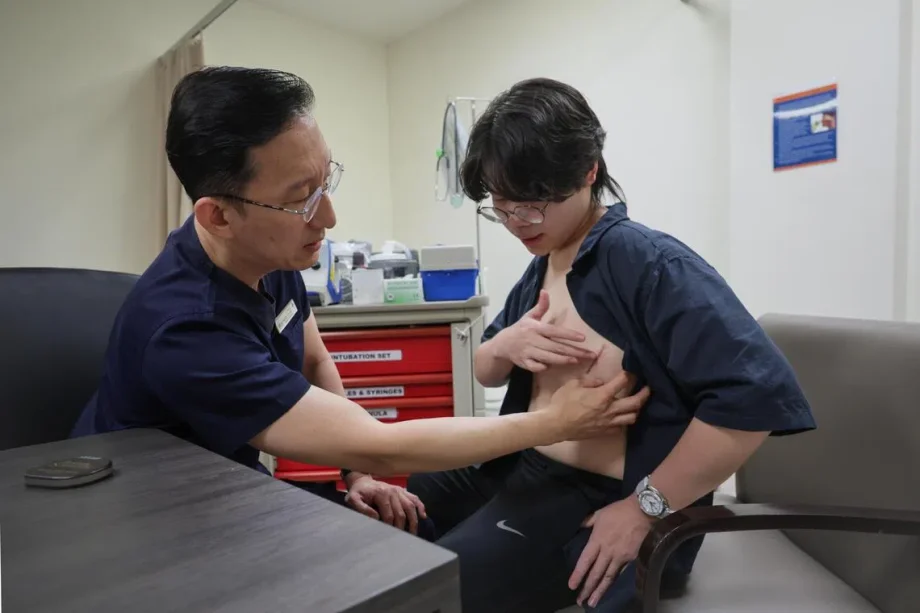
To reduce Lee’s risk of another sudden cardiac arrest, Seow and his team decided to implant an extravascular implantable cardioverter-defibrillator (EV-ICD) – a new generation of defibrillators – under his breastbone, directly outside the heart.
The surgery was carried out about 1½ weeks later.
Lee’s young age made him a suitable candidate, making him one of the first patients in Singapore to receive the device.
It uses a lead, a thin wire placed outside the heart and veins, to deliver life-saving shocks and send tiny electrical pulses to the heart muscle.
“The lead goes under his breastbone (or sternum), with the main battery box placed under the skin near the left armpit. By doing so, the heart now sits behind the wire and the box. This allows the device to send painless electrical pulses like a pacemaker or, whenever there is the possibility of an arrest, stronger electric shocks to fix abnormal rhythms,” Seow said.


Read Full Article At Source