SINGAPORE – At 72, Ivan Low boasts a grip strength of 47kg, a physical milestone that outperforms many men decades younger.
But when he first joined Alexandra Hospital’s (AH) one-year healthy longevity programme at age 71, the home gym enthusiast was surprised to learn that lifting weights wasn’t enough to safeguard his health.
Low then added spinning, or indoor cycling, to his exercise routine. A food lover, he also started to watch his diet more closely. He now eats more vegetables and fruits, and has cut down on desserts and snacking on potato chips in front of the TV.
Having entered the trial at 71 with a biological age of 67, Low managed to shaved off another two years to reach 65 by the time his chronological age hit 72.
Biological age looks at how much damage has happened to the body’s cells over the years. This damage occurs naturally with age, and is affected by a person’s genes, habits and physical environment.

Ivan Low preparing for a bioelectrical impedance analysis test, administered by senior staff nurse Eswari Sundrasagaran at Alexandra Hospital on April 28.
ST PHOTO: JASON QUAH
More than chronological age, biological age reflects a person’s overall health and potential longevity, with an older biological age linked to earlier development of chronic diseases from dementia to diabetes.
Low’s experience reflects a paradigm shift anchored by AH’s clinical trials: healthy longevity medicine grounded in geroscience – the interdisciplinary field that studies the biological mechanisms of ageing. This emerging discipline treats ageing as a manageable condition.
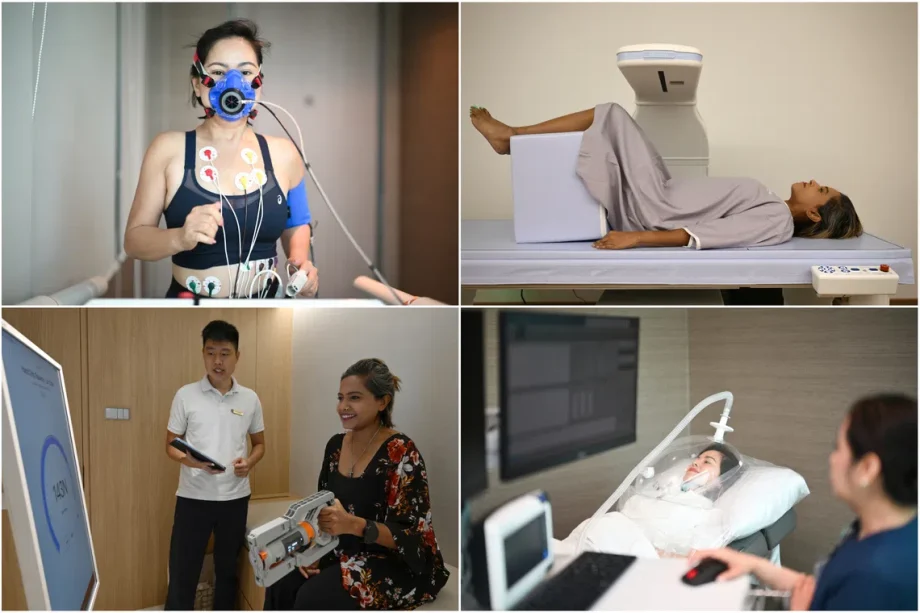
Clinicians aim to delay age-related decline by using advanced diagnostics such as biological age monitoring, microbiome analysis – which evaluates the gut’s microorganisms to assess metabolic health, immunity, and inflammation; functional measures such as cardiorespiratory fitness tests, and more. This is coupled with personalised lifestyle interventions such as targeted exercise regimes.
Private healthcare players enter longevity space
What began as a public research initiative at AH, which opened its clinic in 2023, has expanded into a broader healthcare boom across Singapore.
Driven by the nation’s shift from sick care to preventive care and backed by rising affluence, private healthcare groups and commercial players are racing to offer biological age testing, precision diagnostics, and personalised lifestyle interventions.
In early 2026, Raffles Medical Group, for one, launched a healthy longevity clinic, led by a resident family physician, and supported by a psychologist and a Traditional Chinese medicine (TCM) physician.
In July, IHH Healthcare introduced Healthspan, offering biological age testing across its Parkway Shenton clinics and advanced longevity evaluations at its executive screening centres.
Other non-medical players also entered the fray. Morrow Medical, part of wellness venture Morrow, founded by entrepreneur Allen Law opened officially in August, offering preventative screenings, while premium fitness outfit Tsquared Lab opened a longevity clinic Tsquared Health at the start of the year.
Some existing GP clinics have also started to offer biological age testing and longevity programmes on top of their traditional offerings.
For some Singaporeans, the appeal of such testing lies in knowing themselves better, inside and out. Lee Siu Yin, 73, a senior nurse mentor at AH who already exercised regularly and ate well, paid for the hospital’s longevity programme to see if her efforts were paying off.
“I would rather have quality of life than to live longer (in poor health),” Lee said. “I wanted to know: Am I ageing faster or slower?”

Lee Siu Yin and Ivan Low participated in Alexandra Hospital’s one-year healthy longevity programme.
ST PHOTO: JASON QUAH
How longevity testing works
Unlike standard screening tests like mammograms and stool tests which are done to exclude diseases, longevity diagnostics focus on biological ageing, organ system health, and functional resilience (the body’s ability to withstand, adapt to, and recover from physical stress or illness). Their primary purpose is not to rule out medical conditions but to guide preventive interventions.


Read Full Article At Source