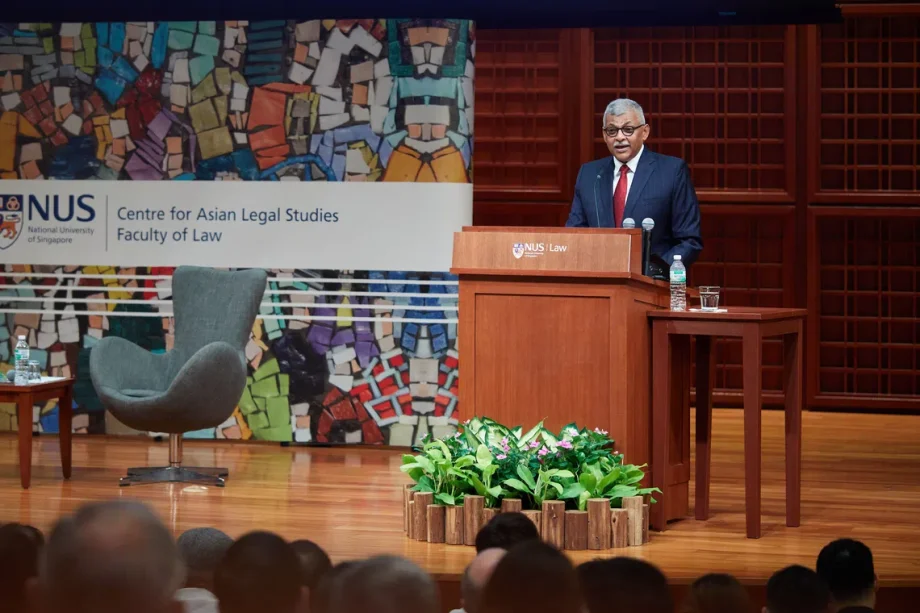
SINGAPORE – Singapore’s repeal of a law that had criminalised sex between men is an example of why the rule of law should never be regarded as a “finished achievement” and must adapt as societal values and circumstances evolve, said Chief Justice Sundaresh Menon on Sept 2.
Section 377A of the Penal Code reflected the prevailing social norms of an earlier era. Its repeal showed that the rule of law has to evolve to produce an outcome suited to society, even as the underlying principles endure, he said.
He was speaking at a dialogue after delivering the National University of Singapore Law Bicentennial Lecture on the Rule of Law at the Yale-NUS College Hall.
In the hour-long lecture, he spoke about how the rule of law has been instrumental in stability and development in Singapore since the days of Stamford Raffles, through ensuring legal certainty, justice and equality, and how its conception must respond to the political, social and historical conditions in which it operates.
The challenge against Section 377A of the Penal Code and its eventual repeal illustrated these points, he said at the dialogue that followed.
The law was officially repealed in January 2023 by the Government, after the Court of Appeal ruled in February 2022 that it was unenforceable in its entirety in a legal challenge.
In its judgment, the apex court had also said that the law could violate Article 12 of the Constitution – the equal protection provision – if a particular approach were taken to evaluate it.
Talking about the case during the dialogue, Menon said the rule of law had provided a framework for ordered liberty within which diverse groups can have their concerns about 377A addressed.
Different branches of the Government had also played their respective role leading to the eventual repeal.
Given that many of the issues cited in the legal challenge had been political, social and moral in nature – such as whether the law should be repealed and whether homosexuality is moral or immoral – they were not questions for the court to decide, he said.
Instead, the court focused on the legal question of whether prosecution under the law was permitted, given the promises by the Government before 2023 to leave the law on the books without proactively enforcing it, he said.
Read Full Article At Source