In May 2010, I was invited to Brunei to give two lectures on agriculture. At the time, the government there had just launched a plan to become more self-sufficient in rice production to promote greater ‘food security’ – a goal Brunei still holds today, along with greater ‘sustainability’. After one of my lectures, I was asked by a journalist what I thought of the plan. My sense at the time was that this plan was wrongheaded, and I said so. Brunei is a tiny, super-wealthy sultanate composed mainly of tropical rainforest on the ecologically fragile island of Borneo. The country’s wealth was (and still is) based overwhelmingly on oil and natural gas. I suggested that the sultanate carry on with carbon, and purchase the rice it needed from neighbouring countries in Southeast Asia, which is, after all, the buckle of the world’s rice belt. In other words, pursue your comparative advantage, rather than divert resources to produce a cheap, basic commodity relatively inefficiently on bad soil in an unsuitable setting.
Alas, the country is still plugging away on its rice plan, which hasn’t gone all that well. After years of assiduous efforts and considerable investment, in 2024 Brunei produced 8 per cent of the rice it consumed, up from 4.8 per cent in 2017, which means it is still a long way from self-sufficiency.
Fortunately for Bruneians, the sultanate easily gets all the rice it needs from neighbouring countries, as Southeast Asia has long been a rice-surplus region. I would argue that, if Brunei remains insistent on achieving greater self-sufficiency in rice, it would do better to buy or lease farmland and hire agriculturalists elsewhere to grow rice for the sultanate than try to raise rice for itself.
The Brunei case is instructive, or it should be. As a result of the short-term supply-chain disruptions of the COVID-19 period, countries around the world have been pushing for greater food security and greater sustainability, come hell or high water, and, in so doing, paying insufficient regard, in my view, to the opportunity costs involved. Safety-first strategies rather than strategies promoting efficiency are all the rage these days, and it behooves us to raise a caution flag or two before we go too far down the ‘security’ path. A deep dive into one of the most unusual – and sophisticated – of such efforts, that undertaken in Singapore, is instructive in this regard, for it illustrates the real possibilities and the potential pitfalls of the security/sustainability approach.
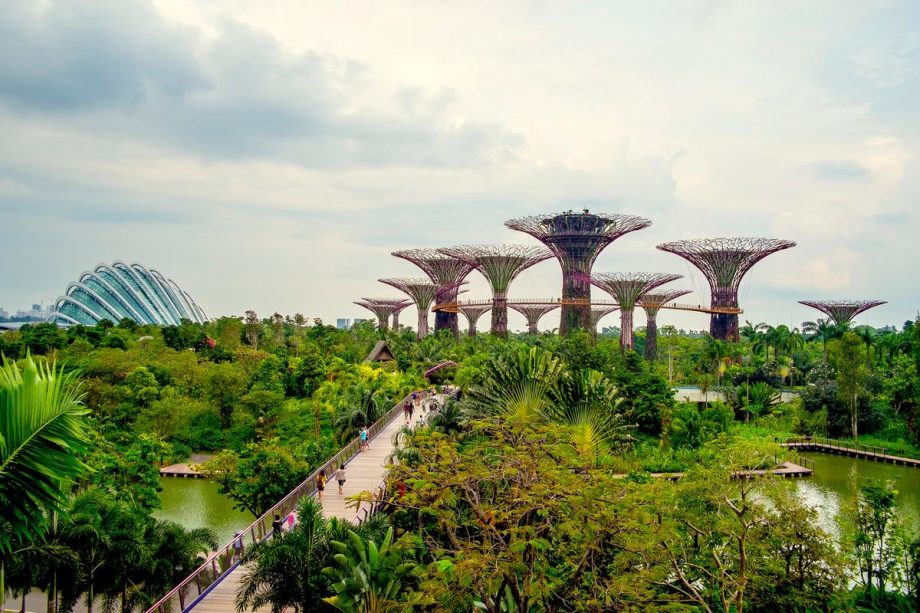
Singapore’s interest in both water and food security, and sustainability more generally, has long, tangled roots. In part, it grew out of governmental policy initiatives to ‘green’ the city-state since independence in 1965. Urban ‘greening’ was seen by the People’s Action Party (PAP) – which has ruled Singapore from the pre-independence period to the present day – as both conducive to public health and a means to boost tourism. An important generator of foreign exchange, tourism was particularly important early on, as Singapore strove to climb the developmental ladder ‘from third world to first’, as the legendary PAP leader Lee Kuan Yew put it. Singapore succeeded spectacularly in this effort – it is now among the wealthiest countries in the world – and, as its population became richer, it increasingly supported green policies, reflecting a preference to ‘buy environment’.
The PAP was cognisant of such consumer preferences, which dovetailed with its own strategic plans, and hopped onto the climate-change bandwagon beginning in the early 2000s. Fearful of what might happen to the low-lying island just north of the equator should temperatures – and, more ominously, sea levels – rise, should severe weather ‘events’ become more frequent, and should the climate in general become more unstable, the PAP became a strong advocate of climate-change mitigation, and greater sustainability and food and water security. By buying into the mainstream climate narrative, going green, decarbonising and promoting more sustainable practices across the board, the PAP at once demonstrated its ‘wealthy nation’ OECD-like chops and signalled to Singapore’s more sophisticated and independent voting population that the venerable ruling party wasn’t fossilised but could in fact change with the times. The Singapore Green Plan, launched in 2021, reflects such priorities, including among its five key pillars the goal of rendering Singapore a true ‘City in Nature’ by 2030.
The fact that sustainability dovetailed nicely with another complementary PAP goal, national resiliency, facilitated things further. One could argue that under PAP leadership, independent Singapore was always concerned with resiliency – toughness, the ability to bounce back quickly, and to withstand, even absorb, shocks to the system. That said, the Asian financial crisis of 1997-98 and the aftershocks of the Great Recession, as well as the upheavals and disruptions associated with two public health crises – first SARS in 2003, and then COVID-19 in 2020-23 – encouraged the PAP to double down on resiliency qua strategy. While the strategy had many dimensions, ranging from fiscal prudence and financial independence to social inclusion and solidarity, greater water and food security were right up there. Singaporean leaders had long been anxious about the degree of dependence the island-nation had on Malaysia for its freshwater supply, and the food supply-chain disruptions (real and potential) associated with the COVID-19 pandemic motivated the PAP leadership to push for greater sustainability and self-sufficiency in both the supply of freshwater and in domestic food production on the island, preferences made manifest in policy and practice.
The issue of importing water has proven controversial – and, from a Singaporean perspective, dangerous
Let’s start with freshwater supply, where Singapore’s quest for sustainability and self-sufficiency goes back a long way. Small islands the world over typically suffer from limited supplies of freshwater, which has often led their governing authorities to intervene, sometimes massively, to ensure adequate supplies for drinking, sanitation, etc. Singapore is unexceptional in this regard and, pre-independence, the British colonial government created several reservoirs in the country, beginning with the MacRitchie Reservoir, completed in 1867, followed by the Lower Peirce Reservoir, in 1910, and the Upper Seletar Reservoir, in 1940.
In addition to drawing water from the reservoirs, Singapore began importing significant quantities in pipelines from the state of Johor in Malaysia in 1927 and has continued to do so ever since, principally via water agreements signed in 1961 and 1962. The issue of importing water has proven controversial – and, from a Singaporean perspective, dangerous – no time more so than in 1965 when the Malaysian prime minister Tunku Abdul Rahman related to the British high commissioner to Malaysia Anthony Head that ‘If Singapore’s foreign policy is prejudicial to Malaysia’s interests, we could always bring pressure to bear on them by threatening to turn off the water in Johor.’ To be sure, Tunku’s statement must be contextualised – it was made during the heated Konfrontasi between 1963 and 1966 involving Malaysia, Indonesia and Singapore – but Singapore’s leaders never forgot this implied threat. With so much of its freshwater being imported – at least half, at the time of independence – they have therefore worked diligently over the past half-century both to price water efficiently and to strengthen and diversify their hydrological portfolio in order better to ensure water security.
Singapore’s government has tried to structure and shape demand for water by pricing it as a scarce but invaluable resource, rather than a ‘free’ good. At the same time, it has also dramatically improved technologies for water capture, collection, ‘harvesting’, treatment and storage on the island. It has done so through a variety of deft public-sector interventions, ranging from innovative rainwater collection to additional reservoirs – the construction of the Marina Barrage, which allowed for the transformation of salty Marina Bay into a freshwater reservoir, is a case in point – to the construction of the country’s surface and underground drainage systems to damming river estuaries around the island.
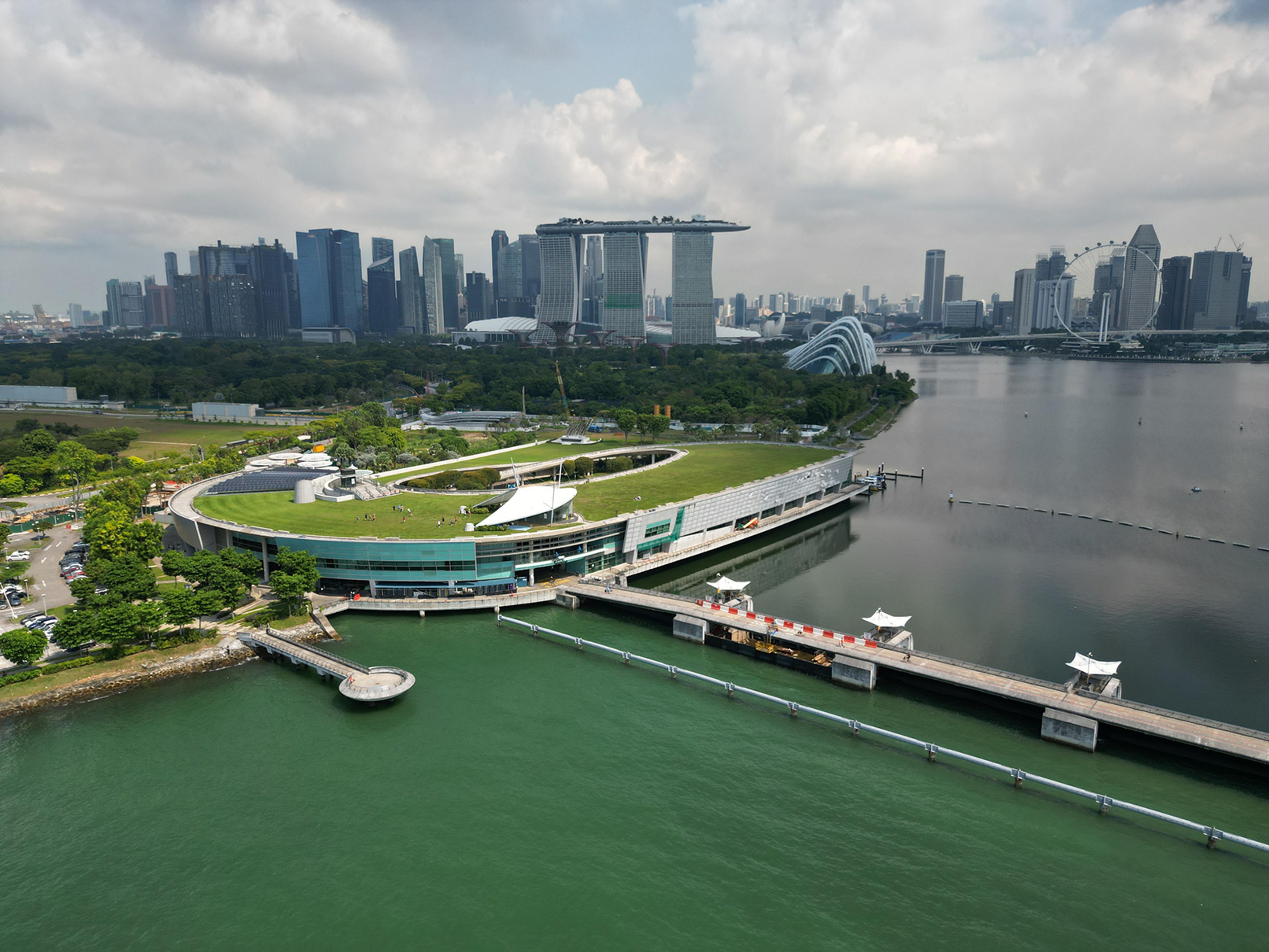
The Marina Barrage in Singapore. Courtesy Wikipedia
Moreover, despite intermittent tension and disagreements with Malaysia over the terms of existing and possible future agreements, Singapore has been able to maintain long-term rights to import a significant quantity of water – both raw and treated – at a fixed price from Johor until 2061. However, because of uncertainties regarding the future of water imports thereafter, Singapore’s leaders began pursuing other water-supply strategies too.
In the early 2000s, Singapore pushed to develop two major new sources of supply: reclaimed water (branded NEWater) and desalinated water. Scientific knowledge relating to both water reclamation and desalination had been around earlier but, by the first decade of the 21st century, the technology had improved sufficiently and the price points reduced enough to initiate reclamation and desalination projects at scale in Singapore. NEWater – reclaimed from ‘used’ water through reverse osmosis, microfiltration and UV technologies, and safe for drinking – was introduced in 2002, and the first desalination plant commenced operations in 2005. Adding these water sources to the two older ones led Singaporeans to speak of the country’s ‘Four National Taps’ – a term first used in 2004 by Lim Swee Say, minister of the environment – with the proportion of water imported from Malaysia falling to about 40 per cent by 2009.
Read Full Article At Source