Resonance: A Plague Tale Legacy faces a difficult balancing act. Can it move away from its predecessors’ terrifying waves of rats and still deliver a supernatural terror that ties into rewarding environmental puzzles? Can it ditch the series’ sibling protagonists and still tell a moving story focused on two people learning to lean on one another? And can it add fierce, frenetic combat to the franchise’s formula as a new gameplay pillar without abandoning its core identity as a puzzle game? At times, Resonance succeeds–especially during its stronger first half–but it too often loses its footing. And as the game increasingly misses the mark, it further distances itself from what worked so well in the first two A Plague Tale games without adding anything to make up for the loss.
Set in 1334, about 15 years prior to the first two A Plague Tale games, Resonance follows Sophia instead of series protagonist Amicia de Rune. As a young girl, Sophia was forcibly injected with blood that causes her to have visions of a long-lost civilization. Wanting to cure her of these visions, her father eventually finds and travels to the island that she has seen in her visions, but in his attempts to uncover the island’s history, he is killed by a mysterious and terrifying beast. Wanting to discover what her visions mean and learn about what truly happened to her dad, Sophia travels to the island with her best friend, Leni, in tow.

The story, especially in the first half, is very good. This series has consistently done a fantastic job of quickly building up characters or situations in its introductions to be narrative buy-ins that are solely there to be destroyed or yanked away early on and create emotional stakes: Amicia’s happy family life in the first game, the hope that Amicia’s life had returned to some degree of normalcy in the second game. Resonance does the same. You actually spend quite a bit of time getting to know Sophia in Europe and the fairly happy life she has with the adopted family of smugglers she grew up with before a tragic event forces Sophia to go to the island. There’s a real sense of desperation in her tale, and the stakes of what may happen to her or Leni if she were to return to her allies empty-handed and without answers are abundantly apparent.
Leni and Sophia have an odd dynamic. Narratively, it’s pretty good. There’s some angst beneath the playful banter of the two friends that implies there could be romantic feelings pushing the two together, and the two play off one another in cutscenes incredibly well with their very different skill sets–Sophia is a fighter who can muscle through problems that require strength, and Leni is a pickpocket who is adept at getting in and out of places she doesn’t belong.

But that’s never reflected in the gameplay. Leni can hold her own in a fight just as well as Sophia can (she even one-shots whichever enemy she’s dealing with as soon as you handle the second-to-last foe) and regularly helps out with pushing open heavy doors and moving partially stuck levers. And at the same time, Sophia can squeeze into any spot Leni can and is usually the lead on how to solve puzzles (because she’s you, the player!). The story does a great job of framing that these two are only succeeding because they have one another, but then this framing is repeatedly struck down whenever the cutscene ends and control returns to you. Again, it all feels very odd, like Resonance is holding onto its partnership framing for no other reason than that the first two games used it.
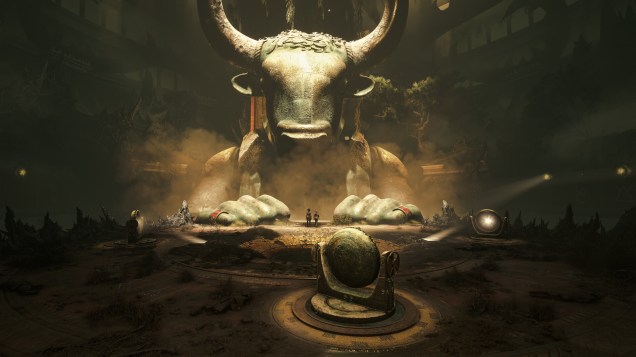
The mysterious, newly discovered island that Sophia and Leni find themselves on is quickly revealed to be Crete, what was once home to Minoan society and, if the myths are to be believed, a minotaur-inhabited labyrinth. The characters don’t know that–it’s 1334, so all of those stories have yet to be uncovered again.

This is a terrific framing for a puzzle game. As Sophia, you carry a book loaded with drawings from your childhood visions, your dad’s early attempts to explore the island, and all the follow-up expeditions that the smuggling gang undertook after his passing. There’s no writing–it’s all a series of drawings. And using those drawings, you have to figure out how to retrace the steps of those who came before, while also finding your own way forward when unexpected roadblocks pop up.
To aid in her and Leni’s exploration, Sophia possesses an artifact that dates back to the Minoan society that once lived on the island. The sphere can redirect light to reveal hidden symbols left behind with invisible paint, and also open doorways that require lining up beams of light to hit certain points on a wall. These puzzles centered around the use of light are rarely complicated, but contribute to the feeling of Sophia and Leni being intelligent dungeon delvers who are uncovering long-lost history.


