Singapore – For at least three decades, Joanne Teoh, 68, has woken to views of a “pure green canopy” from her flat overlooking Maju Forest in Singapore’s Sunset Way estate.
Teoh has watched her mother grow old and her sons grow up in its shade, alongside long-tailed macaques, ambling monitor lizards and critically endangered straw-headed bulbul.
Recommended Stories
list of 4 itemsend of list
Earlier this year, Teoh, who has been documenting the forest’s flora and fauna since 2021, glimpsed Himalayan vultures for the first time, causing a stir among Singapore’s birding community.
Teoh now fears that this habitat will soon be lost forever due to the government’s plans to turn much of the forest into a residential area.
“Even if you build homes on part of this forest, as my sons tell me, we don’t want to live beside the graveyard of a decimated ecosystem,” Teoh told Al Jazeera.

Last month, Singapore’s Housing and Development Board announced plans to clear roughly 15 of Maju Forest’s 23 hectares (37 of 56 acres) to build homes at Sunset Way, as well as at least 10 hectares (25 acres) of Gillman Forest, located about 6km to the south.
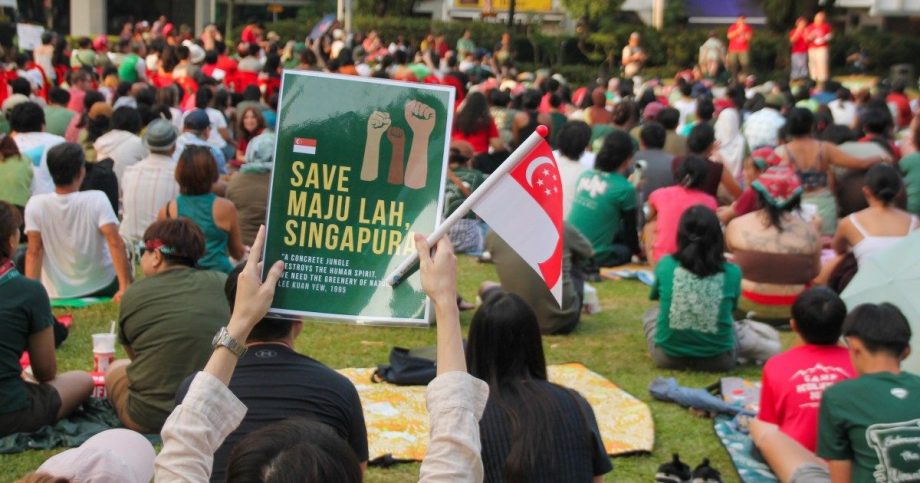
The proposals have stirred unusually vocal opposition among the public in a country where planning decisions are typically top-down and rarely contested openly.
Teoh and her neighbours are among many residents spurred into action, strategising online and over coffee about how best to advocate for stronger environmental safeguards and greater transparency.
Public petitions calling for the cancellation or revision of the projects have attracted more than 60,000 signatures.
The fate of the developments has become an unlikely focus of reflection in the period around Singapore’s National Day, which falls on August 9.
“Maju” means progress in Malay, the mother tongue of the city-state’s largest ethnic minority, and Singapore turned 61 this month.
The debate has led to a rare bout of soul-searching over what kind of progress Singapore, one of the world’s wealthiest countries, wants to see, and a wider conversation about land use and public involvement in planning.
Tensions between development and conservation have surfaced before, most notably when public pushback over the planned rezoning of Dover Forest, a 33-hectare patch in the west of the city, led the government to retain a large portion of the development as a nature park.


Read Full Article At Source