NUS AI Sense Maker gives researchers a head start

NUS AI Sense Maker gives researchers a head start


Academic writing can be immensely time consuming. From doing the research, organising that research, gleaming the relevant points from your sources and synthesising them into an academic paper of your own. And the pursuit is meant to be labour-intensive, given how much care needs to be taken in writing these papers.

But that doesn’t mean it’s impossible to make it just a bit easier, and NUS has endeavoured to do so with AI Sense Maker. It’s a research tool that utilises an OpenAI LLM and draws from the school’s ScholarBank repository, as well as the university’s Digital Gems, or digitised rare materials from its Special Collection. In total, it uses some 150,000 sources as an initial foundation.

Built by NUS Libraries and NUS IT, the college first announced and showcased AI Sense Maker in July, but the tool is only set to launch on 20 August. Amongst its capabilities is the ability to answer basic, conversational queries (not unlike the ones you’d usually Google), and give users an answer based on the sources in its database, with links to the sources used for each bit of information. 

This is opposed to traditional research methods, which often begins with trawling through multiple databases and manually compiling sources (names like JSTOR and ScienceDirect may bring back unpleasant memories for some).
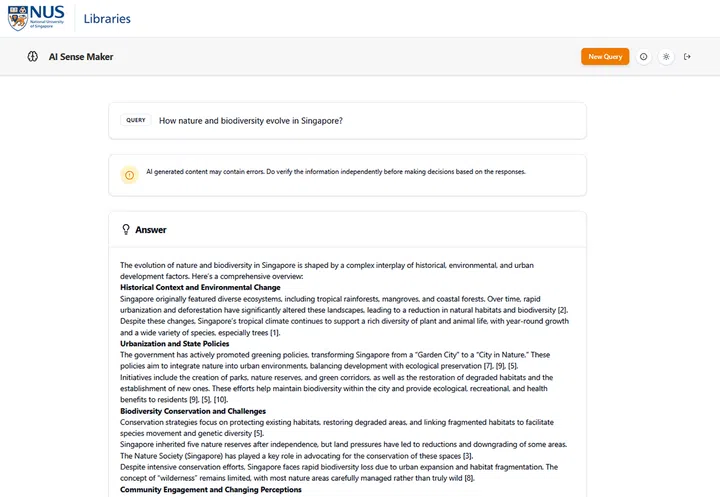
NUS AI Sense Maker

NUS is able to generate answers to conversational queries.
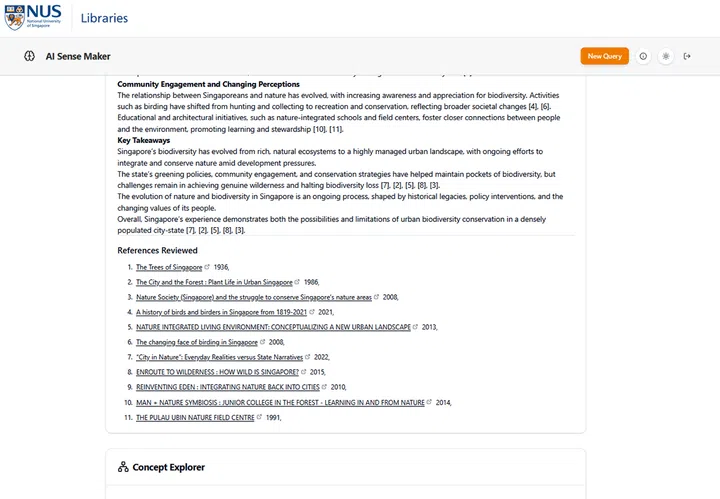
NUS AI Sense Maker

The answers provided have numbered citations, with a reference list at the bottom.

Image: NUS

AI Sense Maker answers the queries using semantic search, where it attempts to understand the intent and context behind the query rather than linking keywords together when searching for sources to form an answer. NUS stated that, thanks to this search method, it’s able to identify sources with relevant concepts even if they contain differing terminology or nomenclature.

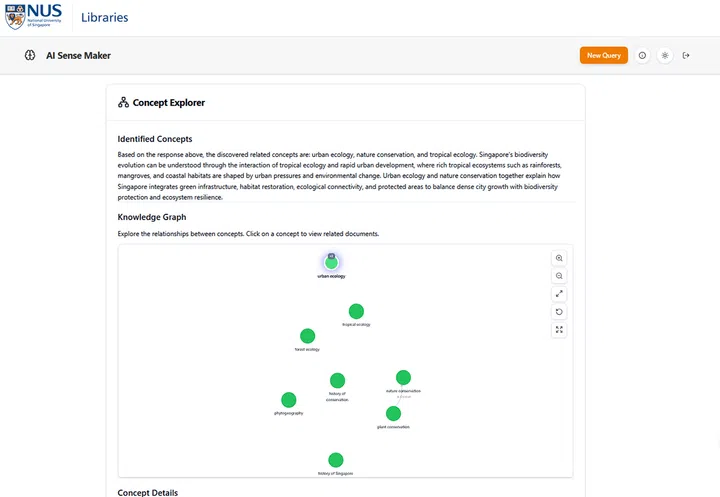
It’s also able to generate concept summaries and visualise the relationships between different concepts mentioned across its sources via an interactive knowledge graph. 

NUS AI Sense Maker

AI Sense Maker can also generate knowledge graphs to visualise how different concepts can be related.

Image: NUS

Of course, this doesn’t replace actual research and writing. Rather, it gives a researcher a headstart with a list of sources they can understand and look more closely into, jumping over some of the big hurdles they may face in the early stages of their research (especially when formulating their research question).

It also bears mentioning that NUS is the first university in Southeast Asia to use something like this, at least for student and academic research. It comes as part of NUS’s Library of Fantastic Things, a framework that incorporates technology to enhance students’ learning. If you happen to be an NUS student or part of its faculty, you can access it here from 20 August onwards.


Read Full Article At Source

Share. Save. Don't Miss The Buzz: XFacebookRedditLINETelegramWhatsAppGmail

Leave a Reply