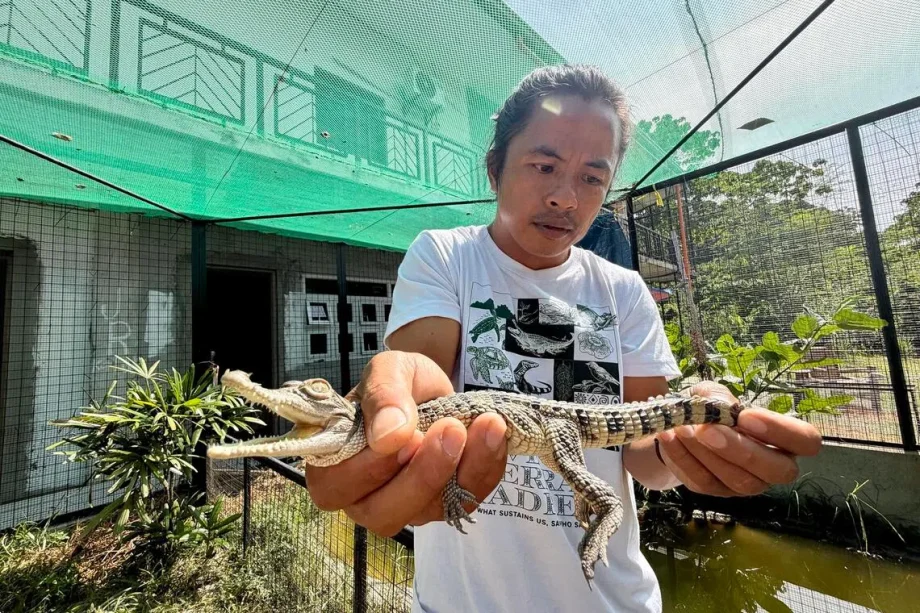
SAN MARIANO, ISABELA – The instruction, whispered on the bank of Dunoy Lake at seven in the evening, was that I should keep very still.
Conservationist Amante Yog-yog Jr swept his torch across the black water. Two points of pale yellow caught the beam and held it: the eye-shine of an adult Philippine crocodile, the rarest crocodilian on Earth. Then a second pair, and a third. Two more sat low in the vegetation ringing the lake, and in a shallower arm, two hatchlings moved among the fish.
On my own, I would not have seen them.
Dunoy Lake lies at the back end of San Mariano, a town in Isabela province about 460km north of the capital Manila and the gateway to the Northern Sierra Madre Natural Park. It is roughly twice the land area of Singapore, with 60,000 people scattered across it.
Reaching the lake took two hours on foot from where the paved road gave out, over rain-slick hills and mud that nearly took my boots, then wading across the Catallangan River, also crocodile territory. It is the walk families around Dunoy make weekly to reach the town centre.
I arrived on July 28 caked in mud, and quickly learnt how elusive the creature is.
That is the trick of the Crocodylus mindorensis after dark. You never see the animal whole, only two dots of reflected light that go out the instant you shift your weight on the mud.
“If you make a noise, if it even hears your footsteps, that’s it,” Yog-yog had told me earlier that day. “It jumps into the water and you won’t see it.”
Believed to be extinct in the wild in northern Luzon in the 1990s, the Philippine crocodile now numbers about 125 in Isabela, protected by residents who once hunted it.
In Manila, the crocodile is not shy. It is the fat, grinning creature on placards at every anti-corruption protest, the effigy hauled through the streets, symbolising the government official who eats and eats and is never full. Nobody at those rallies is picturing Crocodylus mindorensis. They are picturing, whether they know it or not, Lolong, the 6.17m saltwater crocodile taken from a creek in Agusan del Sur in 2011, which died in captivity within 18 months.
In fact, the Philippine crocodile is endemic, critically endangered and small, topping out at about 3m. You can tell it from its saltwater cousin by the large scales behind its head. In San Mariano’s recorded history, it has never killed a human.
“It makes me sad that they compare the crocodile to greed,” said Yog-yog, 39, who manages the Philippine Crocodile Conservation Centre for the Mabuwaya Foundation inside the Isabela State University.
“The truth is, they eat very little, and only once every four days.”
How a protective spirit became a symbol of greed
So where did the negative connotation come from? Before the Spanish arrived in 1565, the Agta, among the oldest forest-dwelling peoples in northern Luzon, did not regard crocodiles as monsters at all. They were “anito” or protective spirits of a parallel underwater world.
Colonisation and Christianisation, however, inverted that. Colonial officers who arrived in the 1560s did not distinguish the Philippine crocodile from the far larger saltwater crocodile, and wrote letters back to their motherland that the rivers were full of bloodthirsty animals. The friars who followed arrived with a mediaeval European idea of the crocodile as the devil’s creature, and found Filipinos making offerings to it. Crocodile veneration had to be stamped out along with the old religion.
The killing for money came later. Commercial hunting for skins began in the 1920s and intensified after the war, with hunters turning to the Philippine crocodile as the larger saltwater species grew scarce, according to a 2011 study in the journal Environment and History co-authored by Mabuwaya co-founder Merlijn van Weerd. By the late 1960s, the wild populations were too depleted for the trade to pay. Crocodile farming came long after the damage was done.
Logging opened the forests, wetlands were drained for irrigated rice, and fishing stripped the rivers of their food. By the 1990s, researchers assumed the Philippine crocodile was extinct in the wild in northern Luzon.

Conservationist Amante Yog-yog Jr watches over a body of water where a Philippine crocodile recently laid eggs.
ST PHOTO: MARA CEPEDA


Read Full Article At Source