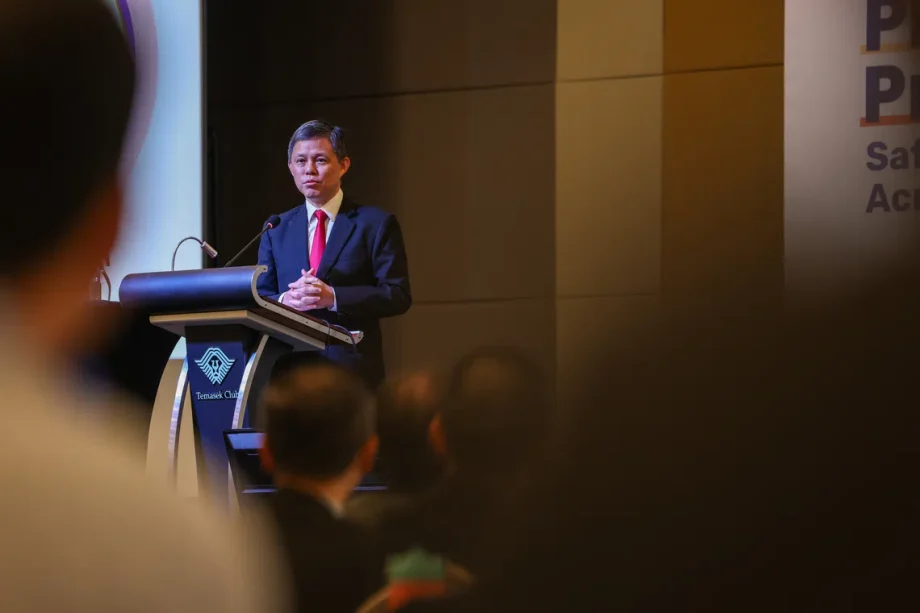
SINGAPORE – Identifying vulnerabilities that carry strategic consequences to the nation if they fail and adopting a “just in case” instead of “just in time” approach to deal with these is what Singapore requires, Defence Minister Chan Chun Sing said.
The essence of the “just in case” approach is investing ahead of time in capabilities that are not fully appreciated until the moment they are needed, Chan said, when he opened the 20th Public Health and Occupational Medicine Conference at Temasek Club on Aug 13.
Taking a leaf from what the late former US defence secretary Donald Rumsfeld said about “known knowns”, “known unknowns” and “unknown unknowns”, Chan said the conference theme, “From Prevention to Preparedness: Safeguarding Health Across Systems”, was apt.
“We all know that preventing something from happening, dealing with the ‘known knowns’, is necessary but not sufficient… It is much more challenging to deal with the ‘known unknowns’ and the ‘unknown unknowns’,” he added.
An example of a “known unknown” is disease outbreaks, which are bound to happen at some point. But something on the scale of the Covid-19 pandemic is considered an “unknown unknown”, as the world did not know the nature of the public health crisis, the timing of the outbreak or the preparations needed.
Touching on “unknown unknowns”, the minister said these could be in the realm of geopolitics, medicine and public health, for instance, and that this “should set us thinking about how we should prepare ourselves, our teams and our systems”.
Systems that are built “just in time” are lean and efficient and deploy resources only when the need arises.
But drawing parallels between public health and defence, Chan highlighted that there are vulnerabilities where the “just-in-time” approach is simply not good enough, as there will be no time to build capability from scratch when a crisis hits.
Hence, there is a need to go upstream with the “just in case” philosophy, which is also what the Singapore Armed Forces (SAF) medical system is built on, said Chan, who is also the Coordinating Minister for Public Services.
Through processes, including pre-enlistment medical examination and medical classification, SAF identifies risks and places national servicemen in roles suited to their health profiles, protects them from avoidable harm, and preserves operational readiness, Chan said.
Read Full Article At Source