SINGAPORE – Cabinet ministers had robust and candid discussions when coming up with novel laws such as the elected presidency and group representation constituency (GRC) schemes, said former deputy prime minister S. Jayakumar.
Various options and angles are explored by the ministers, and different perspectives are heard before a final decision is made for all major policies and laws, said Jayakumar, 87, who was also law minister during his 31-year-long political career.
Through his new book, he gave readers a glimpse of the debate behind these laws that had not been made public previously.
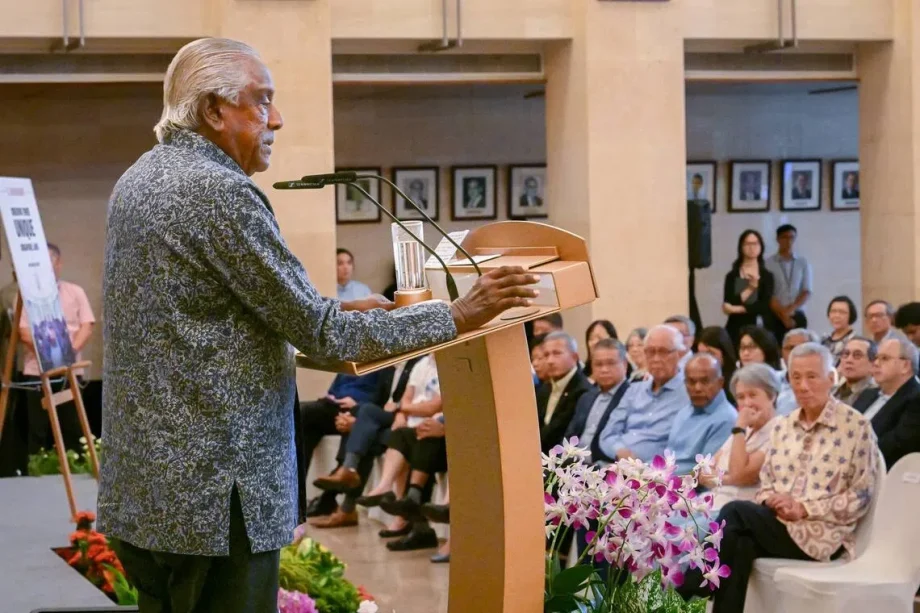
The processes behind these two laws, along with the Non-Constituency MP scheme, are the subject of the book Creating Three Unique Singapore Laws: An Inside Story by Jayakumar, launched on Aug 12.
“In government, before the die is cast, and you announce the law, announce the policy, all possible options ought to be looked at,” he said in an interview with The Straits Times and Lianhe Zaobao on Aug 5.
“For sound decision-making, you have got to explore all angles before the final decision is reached.”

Professor S. Jayakumar presenting SM Lee Hsien Loong with the book – Creating Three Unique Singapore Laws: An Inside Story – at the Ministry of Foreign Affairs on Aug 12.
ST PHOTO: SHINTARO TAY
He hopes that the book will help readers understand that there is a “fairly detailed discussion of important issues, (which) might give them some sense of comfort that things are not rushed through at a railroad speed”.
The former minister, who joined politics in 1980, was involved in the process of developing all three laws from conception to enactment.
Jayakumar acknowledged that the laws were deemed “controversial” and said: “I will be the first one to admit that all three, at various stages, different opposition quarters said it was to fix the opposition.”
But the specific mechanics of the laws are not sacrosanct and can be adapted by future generations, he said.
What matters, he added, is whether people agree on the underlying doctrines of the laws.
In the case of the elected presidency, it is the need to provide a custodial check on the Government’s power to spend the reserves and make key public appointments.
The GRC and NCMP schemes are to guarantee minority and opposition representation in Parliament, respectively, he added.
If there is agreement on these underlying doctrines, then the laws should be seen as the “modalities” arrived at to address these problems, he said.
If future generations feel the laws are not the appropriate mechanism, then they may come up with something else, said Jayakumar.
However, these laws are still relevant today, he said when asked.
The elected presidency was enacted in 1991, while the NCMP scheme was enacted in 1984 and the GRC scheme in 1988 – all years after they were first discussed in various forms around 1981 and 1982.
His new book, published by Straits Times Press, elaborates on how the ministers disagreed, discussed and came to a consensus when forming these laws, through his own recounts of what happened then, supported by newly declassified Cabinet papers.
Jayakumar said that when he first joined Cabinet, the robustness of the discussions fascinated him and left an imprint.
Read Full Article At Source