Spoilers follow for both House of the Dragon and the book Fire & Blood.
Season 3 of House of the Dragon has come to an end, and with it so too has any chance of Rhaenyra Targaryen (Emma D’Arcy) being the hero of this show. While her heel turn wasn’t as abrupt as and was far better developed than how Game of Thrones handled Daenerys’ descent into villainy, it seems the Iron Throne truly does corrupt, physically or morally, every Targaryen who occupies it.
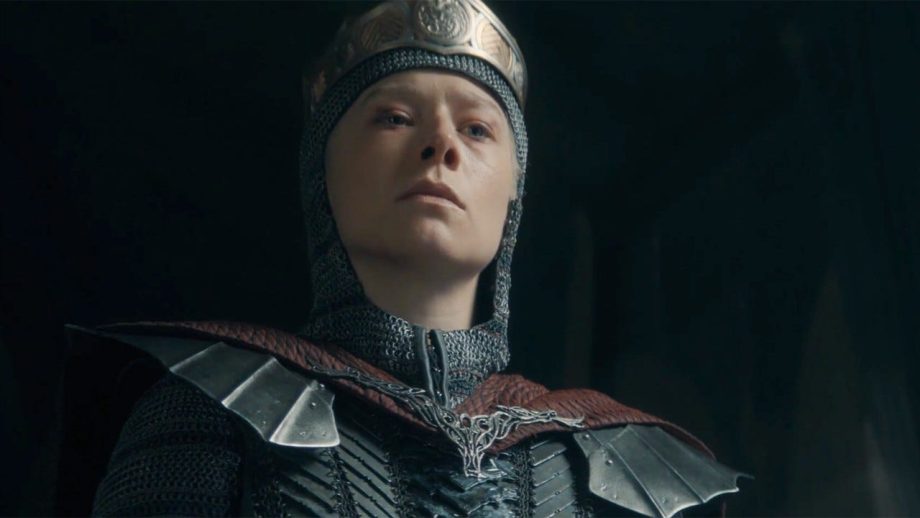
By the final moments of this episode, Rhaenyra has fully gone over to the Dark Side. She ultimately chooses to sacrifice her humanity in pursuit of power and to win the war against the Greens.
Series co-creator and showrunner Ryan Condal joined D’Arcy in a virtual press conference for the season finale, where they spoke about Rhaenyra’s descent into tyranny. “We had always looked at Rhaenyra being torn between Viserys’ philosophy, which is somewhat embodied by Mysaria. It’s somewhat embodied by Alicent in her conversations with them. And then Daemon, which is the fire and blood, rule by dragons, uncompromising. It’s very, very black and white to him and his empire building and his dreams and ambitions and all the reasons that Viserys passed him over to be king,” Condal explained.
“And Rhaenyra is torn between those two avenues, asking herself, ‘Can I rule as a woman during a time of war and still be true to the reasons that Viserys chose me to rule? Or do I simply just have to become Daemon in order to win and to hold this whole thing together?’ I think from Rhaenyra’s perspective, [it] wouldn’t be to be an authoritarian. It would just simply be to keep control, to hold the center. And she has to make all these compromises as she goes along.”
For their part, D’Arcy said, “I really, really wanted to make sure that that journey was a legible one. I think broadly, if we’re to be more practiced at protecting democracy, which seems increasingly fragile at times, we have to be smarter about understanding the behaviors of dictatorial leaders… This was an opportunity to attempt to try and make a certain type of behavior at least understood by an audience. And from an acting perspective, it felt much more playable to think about empathy and the sort of empathetic machine, and how that gets damaged and affected by events, than it did to solely think about her relationship with authoritarianism or something.”
Rhaenyra breaking bad comes just as her foe Aegon’s “resurrection” stuns the public and his brother Aemond seeks to atone for coveting his brother’s crown. Although neither brother can be considered a good guy now, this season has nevertheless revealed more layers of complexity to Aegon and Aemond as well as a growing self-awareness for both of them, as Condal explained:
“Even though he’s still angry with his brother and has agendas, I think what [Aegon] realized in his evolution is that he does deserve a lot of the things that happened to him probably in some way and had to learn how to be a better king, and perhaps that he needed to be away and walk amongst the people as a pauper. And the irony of the season is that Aegon now, not in the proximity of the throne, goes on this incredible character evolution where he becomes a much more dimensionalized man who is more sympathetic and possibly more suited to rule. And then Rhaenyra in the proximity of the throne is turned and altered and somewhat corrupted by being in its orbit.”
Featuring some major deaths and a whole lot of devastation, the House of the Dragon Season 3 finale leaves fans with a lot to think about over the next few years before the show returns for its fourth and final season.
So let’s break it all down, including how the season finale differs from the show’s source material, George R. R. Martin’s Targaryen history book Fire & Blood.

Rhaenyra: “I Am the Prince That Was Promised”
Rhaenyra is incredibly high on her own supply by the time she arrives with her Kingsguard at the Great Sept of Baelor, demanding that the High Septon finally anoint her in public. When he refuses her, as he previously did, she labels him a traitor and orders Alyn of Hull to slay him right there on sacred ground.
Rhaenyra convinces Alyn to do it by reminding him that he has Valyrian blood and their gods are more powerful than those of the Faith of the Seven. Afterward, Rhaenyra, with her heir Joffrey and her guards and councilors at her side, addresses a crowd of smallfolk gathered outside the Great Sept.
She reveals what has thus far been a Targaryen monarch’s biggest secret: Aegon the Conqueror’s prophecy about the great evil from the north that will one day attack the realm. She declares herself Rhaenyra the Chosen, and that only her line and not the Hightower faction can save Westeros from this vague, looming danger. She even mutters to herself in High Valyrian: “I am the prince that was promised.”
It’s unclear how the people will respond to her Chosen One proclamations, but that glance between Ser Torrhen Manderly and Grand Maester Orwyle suggests they think she’s gone loco, which certainly doesn’t bode well for the Queen maintaining their loyalty in the series’ homestretch.
But more importantly, you would think a monarch revealing to their subjects that there is a grave supernatural threat coming might have remained part of the historical record, yet by the time of Game of Thrones, which happens a little over 160 years later, no one seems to remember a thing. Was that something the Mad King went on about too? Was it another reason why Robert Baratheon and Ned Stark rebelled? It doesn’t seem so and would be one hell of a retcon if it were. It should also be noted that Fire & Blood doesn’t link Rhaenyra or her father to Aegon’s prophecy at all; that’s completely an invention of House of the Dragon.
As Condal explained: “It’s not in the book and it’s not in the history, but there is a bunch of talk about how Rhaenyra became very despotic and became a tyrant at the end and was very unpopular with the people. So we saw it as a, ‘This could just be something that happened and there was disagreement over exactly what it was,’ so it didn’t make the historical record. But my glib sort of toss-off from the historians is, ‘Oh, well, Targaryens say crazy shit all the time.’ But so much of their existence is this self-aggrandizement. And for the stone masons standing there in the crowd just looking up at this, it could just sound like somebody trying to make something of themselves because they have no idea of all the ‘real history’ that went into Rhaenyra making that speech. But we wanted something that felt like a real seismic change, a sea change in Rhaenyra’s relationship to her people. She’s seen the death of their religious leader. She’s standing outside of the church of the faith of most of the people standing there, as a member of a totally different faith, this old Valyrian faith of dragons and fire gods and blood magic, and pronouncing herself the chosen one, the leader that is going to take them through the fire and out of the darkness. And so tremendously, virtuosically performed by the great Emma D’Arcy.”
At some point, then, either Rhaenyra’s revelation of Aegon’s prophecy was scrubbed from the record, or no one bothered to mention it. Even if most people dismissed it as the ravings of a mad person, you’d still expect history to make note of it. It will be interesting to see how Season 4 handles this.
Read Full Article At Source