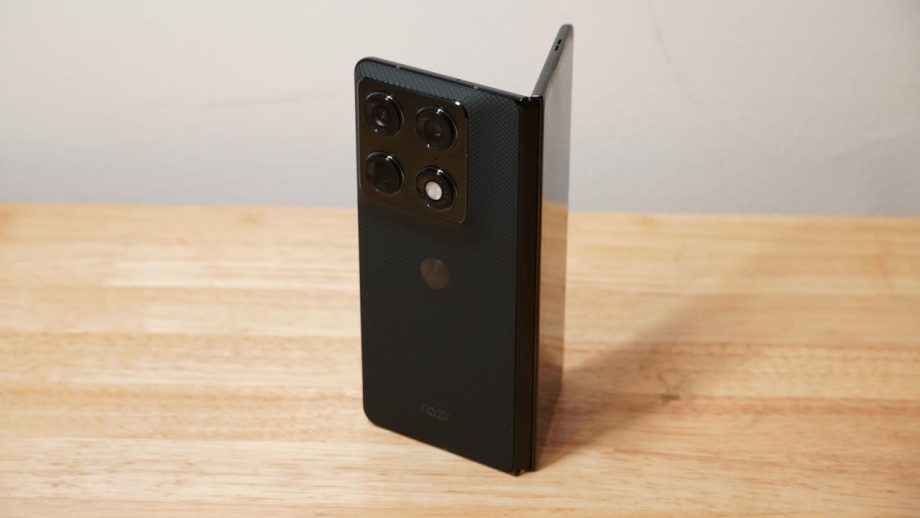
The Motorola Razr Fold takes the Razr family to a new dimension. While earlier foldables from Motorola followed in the footsteps of the original Razr, offering a flip-phone style footprint, the Razr Fold opts for a hotdog fold, akin to what Samsung has offered from its Galaxy Z Fold lineup. Motorola hasn’t taken generations of iterations on this design to get to a very solid point, though. The Razr Fold is impressively thin and looks like all the experience gained from the earlier Razr foldables is paying off big. At $1,899, it’s not a cheap option, but it may still have what it takes to earn your money or at least due consideration.
Motorola Razr Fold – Design and Features
As mentioned, the Razr Fold opens like a book rather than an old school flip phone. Where Samsung’s early folders were normal-size while open and double the thickness of a typical smartphone while closed, the Razr Fold has jumped straight to ultra-thin dimensions.
Closed up, it looks almost like any other smartphone, and it’s a pretty one with a textured, rubberized back. It’s a little thicker than most, and the camera bump adds quite a bit of depth (that’ll prove worthwhile), but it doesn’t feel unusually large. Unfolded, it becomes impressively thin at 0.19 inches to edge out even the Samsung Galaxy S25 Edge or iPhone Air – camera bumps aside. The hints that it’s a foldable are the asymmetry and the seem running around the perimeter of the phone. It is a bit on the heavy side at 8.6 ounces, but that’s not so crazy next to the 8 ounce iPhone 16 Pro Max.

Folded shut, the 21:9 exterior display is a large 6.6-inch, 1080×2520 panel, and it opens up to reveal an even larger, nearly square 8.1-inch, 2232×2484 internal display. Both screens are sharp and bright LTPO pOLED displays with the internal reaching 120Hz and the external hitting 165Hz. For ultra-wide cinema, the external display will probably be the one to go with, and then it won’t really stand out from the crowd of bigger flagship phone displays. But for the wealth of 16:9 content out there (or even squarer formats like 4:3 or The Snyder Cut), the internal display can provide a larger surface for viewing than the competition. That inner seam where the phone folds remains a minor nuisance. It shows glare readily, and it’s all the more apparent when displaying dark content or viewed at an off angle. You can also easily feel it when swiping across. That said, when the screen is lit up and you face it head-on, the seam mostly vanishes.
Either way, both screens can look gorgeous in the right conditions, and even though they love to show finger oils and glare on the interior folding seam is apparent, they push out enough brightness to easily get past that glare. You won’t want to treat the two displays the same, though. The exterior has Gorilla Glass Ceramic 3 that should withstand drops and scrapes a lot better than the internal display’s Ultra Thin Glass.
While you’ll want to be gentle with the phone, it’s still tougher than early foldables. It has an IP49 rating to keep a good deal of dust and debris out (just don’t fold it closed with a bunch of crud inside. It can also withstand submersion in freshwater and water jets.
It’s truly a shame we as a body of consumers let smartphone makers get away with killing the microSD card slot, because the Razr Fold likely could have had one. The SIM try in the phone is extra long, with easily enough space to accommodate two SIMs or a SIM and a microSD card, yet it only holds one SIM card. I might have accepted space constraints as an excuse if the SIM tray didn’t just have dead space built in.
Read Full Article At Source