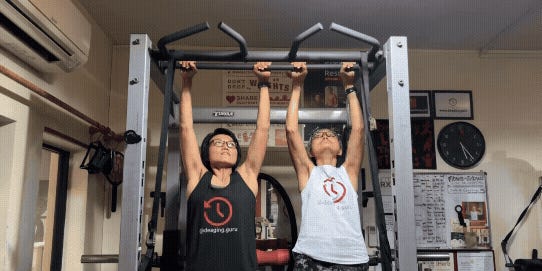
Watching Charlotte Lim at work in the gym, it’s easy to forget that she’s 80.
She does a pull-up, chin clearing the bar with ease. She drops to the ground and powers through a set of feet-elevated push-ups. Then, she grabs a dumbbell off the rack, holds it close to her chest, and drops into squat after squat.
Lim only started strength training at 72.
Before that, exercise meant little more than walking on a treadmill after she retired from a consulting and HR role. “For 15 years I coasted along, but I was looking to be stronger,” Lim told Business Insider.
Amanda Goh/Business Insider
It wasn’t until her daughter, Yan, 43, asked her to join the gym that she co-owns with her brother in Singapore that Lim finally started seeing results.
“Within a year, I could do an unassisted sit-up,” Lim said. “Within four years, I could do a chin-up.”
For Yan, it was important that her mother started working out with purpose. More than a decade ago, Yan’s father died unexpectedly at 69 from an aortic dissection. Since then, she’s made it a priority to help her mother stay healthy.
“It really was a wake-up call,” Yan, a fitness trainer, told Business Insider. “The gym is to keep my mom not just alive, but healthy with no chronic illnesses.”
Her brother, Tiat Lim, also a fitness trainer, told Business Insider he was fully on board with the idea of their mother joining from the start.
“Never in my wildest dreams did I expect her to be doing pullups, let alone weighted ones,” he said.
Starting from scratch
Research suggests people can continue building muscle and strength well into older age.
A 2023 study found that adults over 85 benefited from strength training as much as those aged 65 to 75.
“It is never too late to start strength training,” Dr. Chia Jia Qian, a geriatrician at Tan Tock Seng Hospital in Singapore, told Business Insider.
Chia said many older adults mistakenly think strength training is only for younger people or aspiring bodybuilders.
“Muscle mass and strength decline in tandem as we age, and those with poor muscle health are at higher risk of falls, fractures, decline in physical and cognitive function, subsequent disability, and poor quality of life,” she said.
However, she recommends beginners start with exercises that match their fitness level before gradually increasing the intensity.
“In fact, maintaining regular activity often helps reduce chronic joint pains and will improve function over time,” she said.
Amanda Goh/Business Insider
Read Full Article At Source