SINGAPORE – At 9.40am on a Friday, veterinary acupuncturist Kek Shing Jye is in a consultation room at Animal Wellness Referral Centre (AWRC) administering acupuncture to Zaizai, a 17-year-old Yorkshire terrier.
Zaizai suffered a stroke in March 2025, and lost muscle mass. The treatment is to help improve his mobility. His owner, Carol Ang, 47, takes a day of leave from work each month to bring him in.
“I’ve had him his whole life,” says the finance professional. “He is family, and I don’t see spending money on him as a waste.”
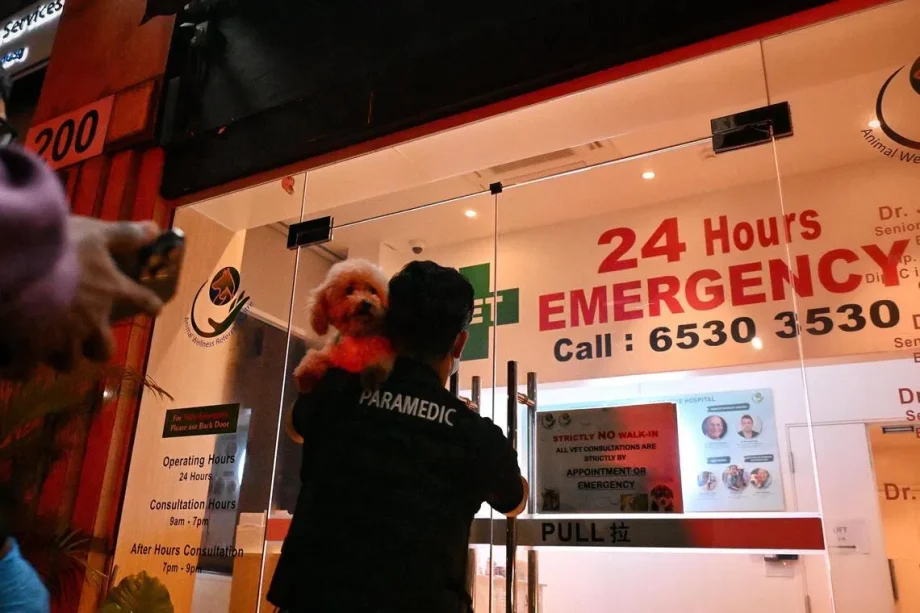
AWRC in Bukit Timah is one of a handful of veterinary facilities in Singapore that offers round-the-clock care. On one Friday in April, The Straits Times spent 24 hours here, from 8.30am to 8.30am the next day.
From the moment the day shift begins, the facility runs a non-stop cycle of consultations, scans, surgery and emergencies that does not slow when night falls. By night, the pace changes but does not ease. The waiting room stays open, the phones keep ringing and the staff keep working.
Pet ownership in Singapore has surged over the past decade. The number of licensed dogs climbed from 59,000 in 2011 to 91,000 by early 2025.
Cat ownership has also grown too. Since the National Parks Board (NParks) rolled out its Cat Management Framework in September 2024 – lifting the longstanding HDB cat ban while introducing mandatory microchipping and licensing – some 41,000 pet cats had been licensed by August 2025.

According to the Public Registry of AVS-Licensed Veterinary Centres, only four hospitals operate with a vet physically on-site at all times.
ST PHOTO: GIN TAY
Yet emergency veterinary care has not expanded at the same pace. According to the Public Registry of AVS-Licensed Veterinary Centres, only four hospitals operate with a vet physically on-site at all times. Others offer partial after-hours cover, with some clinics staying open until midnight or later and others relying on on-call services.
There are no official records showing how many round-the-clock veterinary facilities operated a decade ago. But the cluster of recent openings – including Beecroft Animal Specialist & Emergency Hospital in 2021 and AWRC in 2022 – points to an industry still catching up with demand.
The price of being prepared
Patrick Maguire, a specialist veterinary surgeon and co-founder of Beecroft, says admissions have been rising by about 15 per cent each year.
“We are seeing more emergency cases,” he says. “Our ICU is much fuller, especially at night.”
The most visible strain on the system is cost. Running a modern emergency hospital requires specialist staff, expensive equipment and enough supplies to handle cases that may arrive at any hour.
Back at AWRC, the morning’s cases are already stacking up. What was meant to be a routine post-operative visit for Coco quickly turns urgent when veterinarian Tammie Wong finds out that the 14-year-old poodle has a fever and a hard and bloated stomach.
“We need a stomach tube to release the pressure,” Wong tells a nurse. “If we don’t release it, the pressure could affect her organs and she may go into shock.”

During a post-operative check on April 17, 14-year-old poodle Coco developed a hard, bloated abdomen and fever. Veterinarian Tammie Wong uses a stomach tube to relieve the pressure during emergency treatment.
ST PHOTO: GIN TAY
Coco’s fight against cancer has come at a steep price. Diagnosed with a mast cell tumour in March 2025, she underwent surgery that cost more than $4,000. When the tumour returned a year later, a second operation cost another $8,000. Her owner, retiree Jan Tan, has since spent a further $7,200 on a cancer vaccine and more than $3,000 on natural killer (NK) cell immunotherapy.
Tan notes wryly that she cannot use her CPF funds to cover these bills.
As the owner of 10 dogs over her lifetime, she has witnessed pet care fees skyrocket first-hand. A simple diarrhoea case that once cost under $100 can now cost well above that. Consultation fees, she adds, have “pretty much doubled”.
Yet, she concedes that the higher prices come with much better treatment options.
“Previously, I had a dog with a mammary gland tumour, but only chemotherapy and radiation were available. Now, advanced options like NK cells and vaccines are available.”
Despite the financial strain and lack of certainties, Tan has never wavered.
“There is no guarantee when it comes to treatments,” she says. “But I feel I have to see it through. I would regret it if we didn’t do everything we could.”
Similar advanced treatments are becoming increasingly common across Singapore’s veterinary sector, offering owners more choices but also substantially higher costs.
Veterinary charges in Singapore are shaped by several structural pressures. Emergency consultation fees – which do not include diagnostics and treatment – at 24-hour hospitals often cost between $128 and $250, with after-hours surcharges added on top. X-rays ($100 to $250), ultrasound scans ($300 to $500), hospital stays (from $200 to $500 a night) and intensive care ($500 to $1,000 a night) all add to the final bill.
Depending on severity, a vomiting or diarrhoea case might cost from $60 to $500 while serious trauma case can quickly run into the thousands.
Maguire says a large part of the cost comes from the infrastructure needed to keep a facility open around the clock.
“The MRI and CT scanners at Beecroft are human-grade machines costing millions to buy and maintain,” he says. “We need those people there. We need those drugs there. We need our doors open, even if nothing comes in that night.”
Jean-Paul Ly, founder of AWRC and a vet for more than five decades, points to other cost pressures. Rents and wages have risen as clinics compete for a limited pool of veterinarians and nurses. Tighter hiring rules for overseas-trained veterinary technicians have further squeezed manpower, while imported medicines, disposable supplies and the arrival of premium-priced foreign specialist groups have all pushed up costs.


Read Full Article At Source