As an older Singaporean, my initial response to turning Orchard into a live-work-play area was: are you joking?
Personally, I find it a bit irritating because I recall a time when Orchard Road was a vibrant live-work-play area in Singapore. Back then unique subcultures found a place along the retail corridor, and Orchard Road resembled what Bugis / Midtown is like today.
An Orchard Road scene that attracted young and old? Check. A time when people saw it as a place to really hang out with friends, or express themselves? Check. A time when it was as much about social events as it was about shopping? Most definitely. And as I recall, we made extensive efforts to stomp it all out.
Consider the now demolished Ming Arcade. Today, most people who remember it at all will remember a run-down building with a KTV, or perhaps associate it with cheap beer buckets and chicken wings. But in the 1980s, Ming Arcade housed Rainbow Lounge, which was formative to Singapore’s early music scene. Local bands such as The Quests and Tokyo Square performed there, not because URA designated the area as an arts precinct, but because the conditions were right for such venues to take root.
Ming Arcade definitely wasn’t celebrated for this. It had a reputation for being rowdy, noisy, and attracting an unruly crowd (because a lot of the men kept long hair. I kid you not, ask your parents or grandparents). Ming Arcade was often targeted by the police and authorities.
Around the same time, Orchard Road also became home to another phenomenon: the Centrepoint Kids.
Hundreds of teenagers used to gather around Centrepoint, Far East Plaza and Daimaru. They came to meet friends, browse record stores, watch breakdancers, and just hang out together.
Much like Ming Arcade, they weren’t embraced. I recall multiple news reports (though you’ll likely have to search NLB archives to find them now) that portrayed them as a social nuisance. Shopkeepers complained they scared away customers. Security guards regularly chased them off.
Despite the name, they weren’t confined to Centrepoint. These youths were part of a developing subculture in the Orchard area, which was actively discouraged. So it’s ironic that, decades after they’re gone, we see efforts like *Scape trying to lure back youth into the shopping district.
This was also around the time when the Christmas Lights along Orchard started to become a big event. While it’s still featured today, it was almost an annual pilgrimage for some back then. Couples came for dates, friends met to soak in the atmosphere, and families would walk down the whole street.
My point here isn’t nostalgia. There was a time when people went to Orchard not to buy something but to hang out and socialise. Now, after sterilising it to make it an almost purely commercial zone, there are top-down efforts to bring it back.
Many of the proposals to do this seem to focus on refreshing old malls.
Redeveloping ageing properties, introducing more mixed-use developments and improving public spaces are all sensible ideas. I agree that most ageing malls today are due a makeover, becoming a place to experience rather than simply shop. Amidst all of this, I can’t help but feel we’re overlooking the obvious.
Orchard Road once possessed many of the qualities we’re now trying to engineer back into it. And perhaps it’s time to go back and identify what it had, prior to becoming a more sterile (yet slick looking) retail district.
Not because we should recreate the Orchard Road of the 1980s, but because knowing the cultural and economic conditions that once made Orchard Road feel alive, we might have a stronger start in its rejuvenation.
News pieces like this explain what’s happening in the market. Our consultations are designed to help you understand what it means for your own property decisions.
If you’re considering buying, selling or upgrading, we’d be happy to help you work through your options.
First, Orchard Road used to have better retail diversity.
An example is the now demolished Tanglin Shopping Centre, which housed a mix of antique dealers, specialist retailers, family-run restaurants – and at some parts of its history there wasn’t even a single anchor tenant – before it was demolished in December 2024.
That kind of commercial diversity attracts a wide range of people into the area, but unfortunately it’s hard to sustain this type of retail business model today. Most of the major malls along Orchard Road are now owned or managed by REITs and large developers. That’s not inherently a bad thing: they’ve professionalised mall management.
The challenge is that those same entities can also make Orchard Road feel stiflingly standardised. If every mall uses the same formula of international brands and familiar chains, then Orchard Road will remain a slick-looking gallery for tourists.
To some extent there is an awareness of this, with pop-up stores allowing for newer players with smaller budgets to make their presence felt along the shopping belt. Orchard also has existing strata malls (Lucky Plaza, Far East Plaza, Far East Shopping Centre, and Orchard Plaza) and spaces like *Scape. The question is whether we’re willing to embrace commercial inefficiencies to enable small or niche businesses to sprout there and thrive.
Perhaps we might go so far as to provide support or incentives for select strata-titled malls, to give them a facelift and support the niche businesses they carry (not shady massage parlours and the like obviously, but the family-owned eateries, antique stores, and niche hobby shops).
If these strata malls are demolished, it’s unlikely that expensive new modern malls can attract the same kind of small businesses.
Second, Orchard needs more businesses that give people reason to linger
How about we start with putting some benches back, especially in the malls here? If we want people to hang out, especially retirees and teenagers, we can’t expect them to keep buying $7.60 lattes just to sit down and talk.
That aside, the biggest challenge with Orchard Road is getting people to linger.
Ironically, *Scape already demonstrates many of the ideas we’re trying to encourage across Orchard Road. Its management deliberately provides free seating and gathering spaces. It encourages youth-led communities, and even instructs security officers to adopt a lighter touch. Yet from the linked article, we can see it’s still a major challenge, partly due to the retail and restaurant mix as mentioned above.
As an aside, the decline of cinema has really made things harder. Movies were once a reason for friends to gather for longer periods, both before and after showings. At this point, art studios, escape rooms, cooking classes, board game cafés, and live music spaces may have to be deliberately incentivised.
It’s going to be a long, slow process, and highly dependent on how much each industry player wants to co-operate and contribute. It’s also much tougher now that land values along Orchard Road are so high. It’s not like Joo Chiat or Tiong Bahru, where undervalued plots or properties allowed independent businesses, artists and cafés to transform the area.
But if we do make it, perhaps we’ll also remember the mistake of stomping it out to begin with, and not repeat that.
Meanwhile in other property news…
- Skypark Kepler is the first Banyan Group managed, luxury launch in JB. Should Singaporeans buy in? We took a quick tour.
- The October 2026 BTO launch is around the corner; check out our earlier preview on the various offerings, and the likely Plus and Prime spots
- Check out the flash estimated for the private residential market in Q2, and what it could mean for you going forward
- How did Legenda @ Joo Chiat end up having the best performing two-bedders, despite being a freehold boutique condo? Join us on Stacked Pro to find out.
Weekly Sales Roundup (13 – 19 July)
Top 5 Most Expensive New Sales (By Project)
| PROJECT NAME | PRICE S$ | AREA (SQFT) | $PSF | TENURE |
| SKYWATERS RESIDENCES | $17,343,000 | 2949 | $5,880 | 99 yrs |
| THE CONTINUUM | $5,351,000 | 1905 | $2,809 | FH |
| ONE MARINA GARDENS | $5,321,200 | 1647 | $3,231 | 99 yrs (2023) |
| PROMENADE PEAK | $5,068,200 | 1421 | $3,567 | 99 yrs (2024) |
| UNION SQUARE RESIDENCES | $4,473,000 | 1518 | $2,947 | 99 yrs (2024) |
Top 5 Cheapest New Sales (By Project)
| PROJECT NAME | PRICE S$ | AREA (SQFT) | $PSF | TENURE |
| NARRA RESIDENCES | $1,296,000 | 560 | $2,315 | 99 yrs (2025) |
| LENTOR GARDENS RESIDENCES | $1,412,300 | 689 | $2,050 | 99 yrs |
| COASTAL CABANA | $1,650,000 | 915 | $1,803 | 99 yrs (2024) |
| THE SEN | $1,654,000 | 678 | $2,439 | 99 yrs (2025) |
| VELA BAY | $1,675,000 | 592 | $2,829 | 99 yrs (2025) |
Top 5 Most Expensive Resale
| PROJECT NAME | PRICE S$ | AREA (SQFT) | $PSF | TENURE |
| THE NASSIM | $14,000,000 | 3122 | $4,485 | FH |
| HILLTOPS | $11,450,000 | 3208 | $3,570 | FH |
| THE CLAYMORE | $8,220,000 | 2680 | $3,067 | FH |
| THE ARCADIA | $5,256,000 | 3821 | $1,375 | 99 yrs (1979) |
| CONCOURSE SKYLINE | $4,780,000 | 2282 | $2,095 | 99 yrs (2008) |
Top 5 Cheapest Resale
| PROJECT NAME | PRICE S$ | AREA (SQFT) | $PSF | TENURE |
| TROPIKA EAST | $742,000 | 441 | $1,681 | FH |
| VETRO | $775,000 | 829 | $935 | 999 yrs (1882) |
| MANDALE HEIGHTS | $780,000 | 570 | $1,367 | FH |
| 8 BASSEIN | $835,000 | 452 | $1,847 | FH |
| THE FLORENCE RESIDENCES | $868,001 | 527 | $1,646 | 99 yrs (2018) |
Top 5 Biggest Winners
| PROJECT NAME | PRICE S$ | AREA (SQFT) | $PSF | RETURNS | HOLDING PERIOD |
| THE NASSIM | $14,000,000 | 3122 | $4,485 | $4,200,000 | 10 Years |
| THE CLAYMORE | $8,220,000 | 2680 | $3,067 | $4,020,000 | 20 Years |
| DORMER PARK | $3,550,000 | 1668 | $2,128 | $1,925,000 | 19 Years |
| THE BLOSSOMVALE | $3,150,000 | 1356 | $2,323 | $1,781,000 | 30 Years |
| OASIS GARDEN | $2,655,000 | 1475 | $1,800 | $1,536,000 | 17 Years |
Top 5 Biggest Losers
| PROJECT NAME | PRICE S$ | AREA (SQFT) | $PSF | RETURNS | HOLDING PERIOD |
| THE M | $1,028,000 | 441 | $2,329 | -$131,400 | 6 Years |
| 8 BASSEIN | $835,000 | 452 | $1,847 | -$51,000 | 14 Years |
| FOURTH AVENUE RESIDENCES | $1,530,000 | 624 | $2,451 | -$42,000 | 7 Years |
| THE MONTANA | $1,230,000 | 614 | $2,005 | -$36,110 | 12 Years |
| AFFINITY AT SERANGOON | $904,000 | 538 | $1,680 | -$19,888 | 2 Years |
Top 5 Biggest Winners (ROI%)
| PROJECT NAME | PRICE S$ | AREA (SQFT) | $PSF | ROI (%) | HOLDING PERIOD |
| THE CLEARWATER | $2,050,000 | 1389 | $1,476 | 224% | 27 Years |
| SEASONS VIEW | $1,725,000 | 1141 | $1,512 | 208% | 20 Years |
| COTE D’AZUR | $2,200,000 | 1421 | $1,548 | 202% | 24 Years |
| THE TROPICA | $1,573,888 | 1227 | $1,283 | 197% | 20 Years |
| HAZEL PARK CONDOMINIUM | $2,350,000 | 1324 | $1,775 | 153% | 17 Years |
Top 5 Biggest Losers (ROI%)
| PROJECT NAME | PRICE S$ | AREA (SQFT) | $PSF | ROI (%) | HOLDING PERIOD |
| THE M | $1,028,000 | 441 | $2,329 | -11% | 6 Years |
| 8 BASSEIN | $835,000 | 452 | $1,847 | -6% | 14 Years |
| THE MONTANA | $1,230,000 | 614 | $2,005 | -3% | 12 Years |
| FOURTH AVENUE RESIDENCES | $1,530,000 | 624 | $2,451 | -3% | 7 Years |
| AFFINITY AT SERANGOON | $904,000 | 538 | $1,680 | -2% | 2 Years |
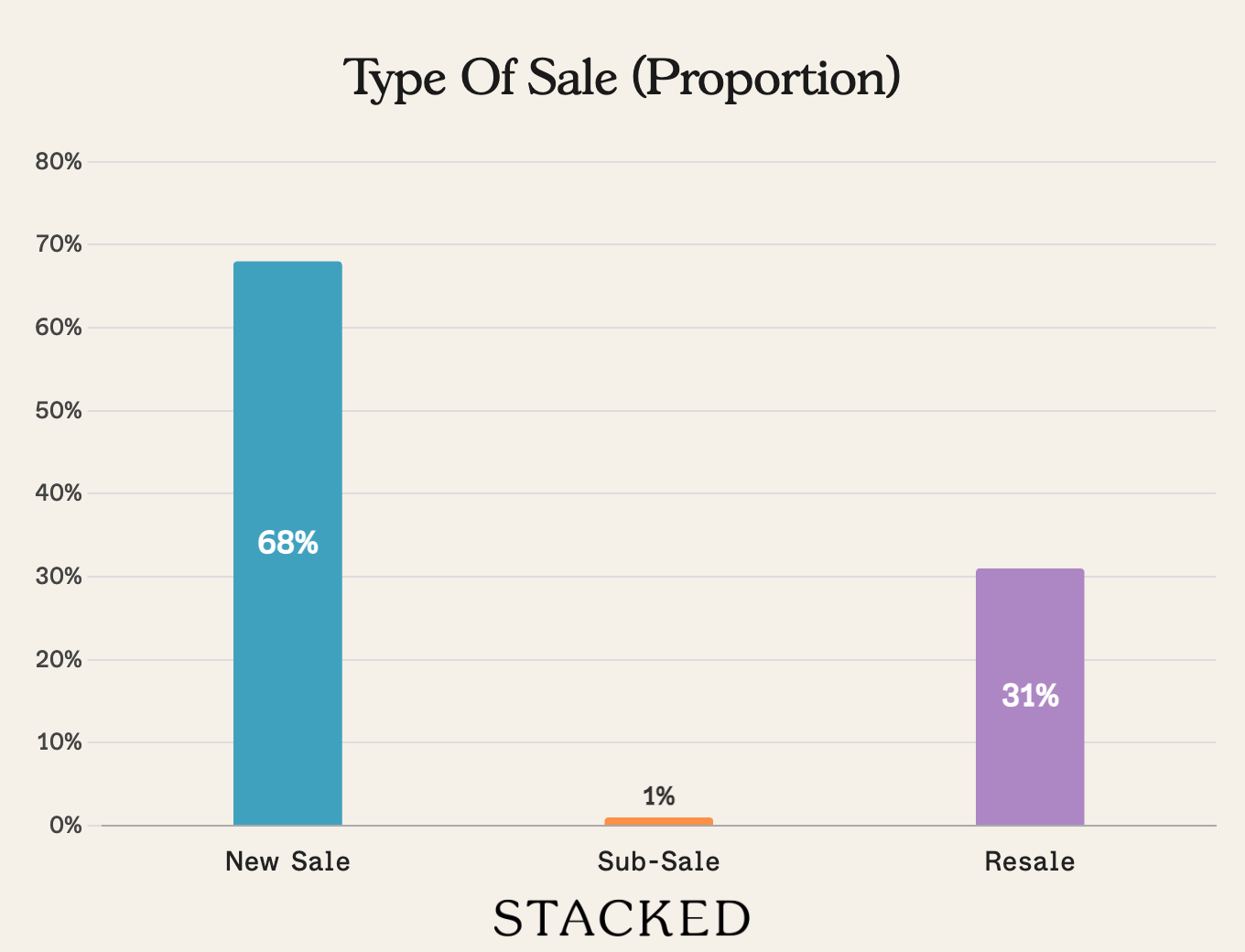
Transaction Breakdown
Follow us on Stacked for news and updates on the Singapore market.
A single headline is rarely enough to change your plans. The value comes from understanding how today’s news fits into the broader direction of the market.
If you’d like to talk through what a shift like this means for your own timing, purchase, or exit, you can reach out for a one-to-one consultation here.
And if you simply have a question or want to share a thought, feel free to write to us at stories@stackedhomes.com. We read every message.
Read Full Article At Source