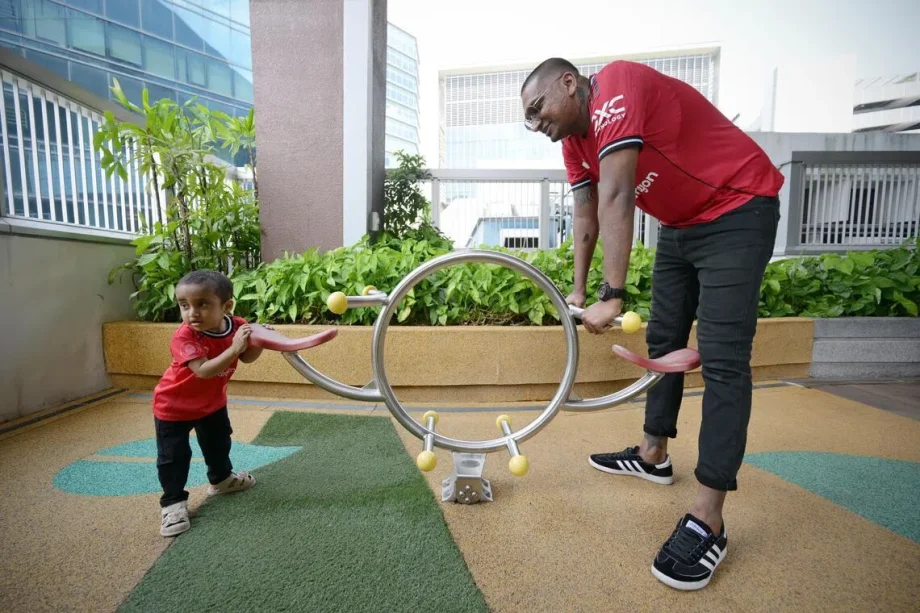
SINGAPORE – When service staff Noel Joshua Selvanathan, 36, first learnt that his son Isaiah was diagnosed with a rare genetic condition and needed a liver transplant to survive, he feared there was little he could do to help.
“I was incarcerated then, and having struggled with substance and alcohol abuse in the past, I was just not the right fit. I also suffered from hepatitis C and fatty liver disease, so all I could do was pray,” he told The Straits Times.
Isaiah, now three, was born with Alagille syndrome, a rare genetic disorder characterised by abnormal bile ducts that cause bile to accumulate inside the liver, making it hard for it to get rid of waste which accumulates in the blood. This also damages the liver.
Estimated to affect about one in 70,000 people, it is usually discovered either when patients are still infants or during early childhood. Liver transplantation is the only effective long-term treatment for the disease.
Isaiah was diagnosed at KK Women’s and Children’s Hospital but was later referred to the National University Hospital (NUH) as it is the only public hospital in Singapore authorised to perform paediatric liver transplants.
These complex procedures for children up to 18 years old are managed by the National University Centre for Organ Transplantation (NUCOT) and the Khoo Teck Puat – National University Children’s Medical Institute.
S. Venkatesh Karthik is a senior consultant with the Division of Paediatric Gastroenterology, Nutrition, Hepatology and Liver Transplantation in the Department of Paediatrics at the Khoo Teck Puat – National University Children’s Medical Institute (KTP-NUCMI). He said when he first saw Isaiah at two years old, the boy was very weak.
“What struck me when I first saw him was how jaundiced he was. Also, his appetite was very bad and his energy was very low. He was unable to play as a child of his age should be playing,” Karthik said.
Jaundice, the yellow cast to the skin and eyes, is a hallmark of liver problems.
“Even when his (older) sister, Alexandria, was trying to stimulate him to play, he just did not have the energy to do so. He used to lie down and smile,” he added.
That was when it hit home that the boy was in urgent need of a transplant.
“We got the nutritionist on board immediately to advise on his dietary plan as it was important for the child to be at optimal health from the nutritional point of view since liver transplant is a major undertaking,” he said.
The boy was admitted for a battery of tests and scans before he was listed for a transplant. In such situations, the child is put on the national waiting list or the team looks to the National Organ Transplant Unit for an altruistic anonymous living donor.
Finding the right donor
The average waiting time on the national list for a deceased donor liver in Singapore is about 12 to 22 months. But because donor organs are scarce, waiting periods can extend significantly depending on blood type, medical urgency and the severity of the patient’s condition.
Many patients opt for a living donor liver transplant, where a healthy family member or compatible living person donates a portion of his or her liver, reducing the wait time to about two months.
Noel said: “It was after my release and after I met with the doctors that I realised how serious the condition was. Isaiah’s doctors had determined that a liver transplant was his best chance at a healthy future.”


Read Full Article At Source