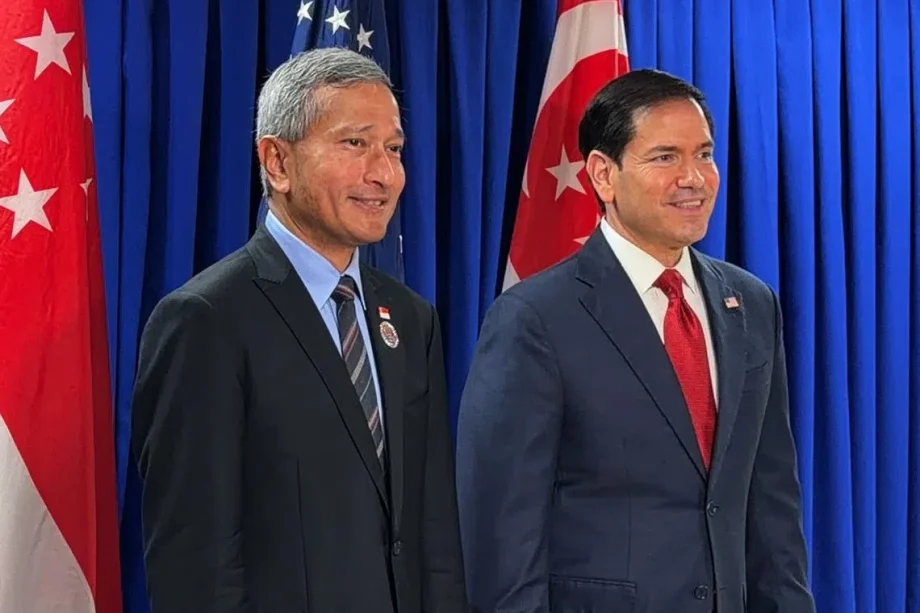
MANILA – Singapore is trying to make the point to the United States that it is “not a target” of Washington’s tariff policy, and to avoid becoming collateral damage as the Trump administration raises tariffs on trading partners around the world, Foreign Minister Vivian Balakrishnan said on July 23.
Speaking to Singapore media after wrapping up a week of meetings at the ASEAN Foreign Ministers’ Meeting in Manila, Balakrishnan said he had raised the matter during a bilateral meeting with US Secretary of State Marco Rubio.
“You know as well as I do that the American administration, for its own domestic political reasons, needs to raise tariff revenue. I’m not going to give you details of my discussion, but I am trying to find a way to make the point that Singapore is not a target of the US – not at all,” he said, adding that they had a “good, candid and honest-to-goodness discussion”.
“He understands us, he knows Singapore, and he’s obviously someone who’s got wide experience in both diplomacy and economics. I made the point quite categorically that the US has a trade surplus against us, and in fact it is growing, and on that basis, there really is no technical or economic basis to impose tariffs upon us.”

Foreign Minister Vivian Balakrishnan in a bilateral meeting with US Secretary of State Marco Rubio on the sidelines of the ASEAN Foreign Ministers’ Meeting in Manila on July 23.
PHOTO: MFA
The discussion came a day before the expiry of the Trump administration’s temporary 10 per cent across-the-board import surcharge, after which Washington is expected to roll out new global tariff measures.
The Trump administration has signalled that more targeted tariffs under Section 301 could follow, authorising duties against countries found to have engaged in unfair trade practices following an investigation.
Singapore has rejected suggestions that it engages in unfair trade practices, including the use of forced labour in supply chains, and has told the US that it does not condone such practices.
Beyond Singapore’s discussions with Washington, Balakrishnan said the uncertainty over US tariffs has reinforced the need for ASEAN to deepen economic integration and enhance its resilience.
Asked about Singapore’s priorities when it assumes the ASEAN chairmanship in 2027, he pointed to three broad themes: maintaining ASEAN centrality, building resilience and strengthening regional integration.
Despite growing rivalry between Washington and Beijing, Balakrishnan said both powers had approached this week’s meetings in a “careful, deliberate and constructive way”.
“To their credit, both of them are trying to approach this in a careful, deliberate and constructive way,” he said.
Read Full Article At Source