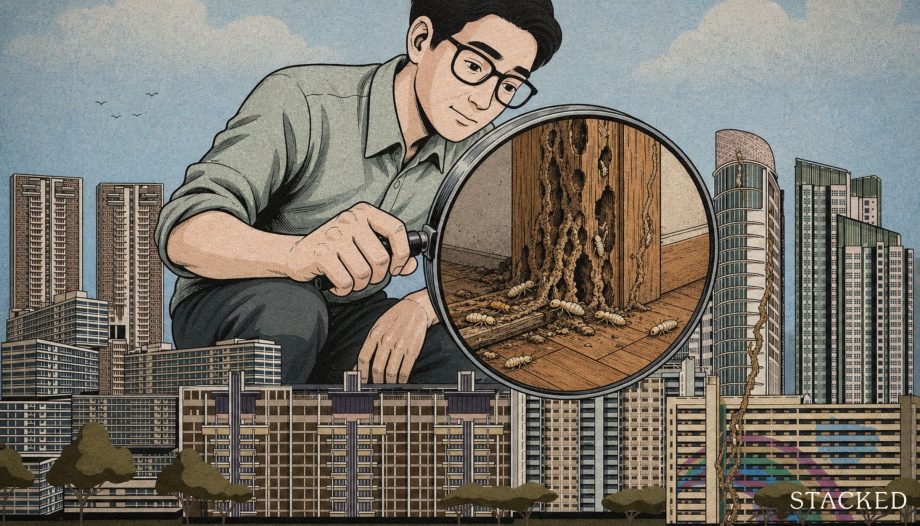
In what might be the first of its kind case brought to the courts in Singapore, the failure of a condominium’s Management Corporation Strata Title (MCST) to deal with termites resulted in a stiff penalty of over $42,000 in legal fees and disbursements to the wronged party.
While other types of condo management and maintenance issues have arisen in the past, this seems to be the first case that involves termites damaging parts of a homeowner’s property. Legal troubles involving a condo’s MCST and property owners underline the importance of this two-way partnership, and the highlights of this case should catch the eye of other condo owners.
The trouble started in December 2023 when Glenford Tan and his wife Vivian Loo, who own a unit on the fifth-floor at Freesia Woods, discovered a termite infestation in their home. Freesia Woods is a 129-unit condo at 61 Sunset Way in District 21, and the freehold project was completed in 2003.
The damage to the couple’s home included extensive damage to their wooden cabinets.
It was eventually discovered that these insects had burrowed their way up the building after they were nesting on the ground floor of the property. The responsibility of managing and maintaining this common area belongs to the condo’s MCST.
In 2025, the couple filed a lawsuit to claim damages from the damage to their property, as well as to take the MCST to task for its failure in reasonably maintaining the common property of the condo – specifically, by not preventing termites from nesting in the common property soil.
Now, the MCST didn’t dispute the fact that termites were found in the home. But they claimed that an unauthorised kitchen sink on the roof terrace of the couple’s unit created damp conditions which made the environment prone to termite infestation.
(In short, the MCST was arguing that it wasn’t underground termites – which would place the blame on them for not eradicating them on the ground floor – and it was damp wood termites)
According to court records, the dispute escalated to the point where the couple felt they needed to hire an expert witness, entomologist Teh Jo Leen, who testified that the termites came from the ground and were nesting in the common property soil after doing a site inspection. In the same visit, she also found extensive subterranean termite activity across the common property including the area near the gym.
News pieces like this explain what’s happening in the market. Our consultations are designed to help you understand what it means for your own property decisions.
If you’re considering buying, selling or upgrading, we’d be happy to help you work through your options.
Evidence by the lawyers of the MCST were unacceptable
When we read the court records, it seems like the lawyers for the MCST didn’t offer convincing evidence to prove their point. In fact, District Judge Chiah Kok Khun, who oversaw the case, noted that their lawyers didn’t inspect the property, but instead relied on a brief footage of termites at the property.
The judge also pointed out other failings by the usual pest control firm appointed by the MCST of Freesia Woods. Despite attending to the condo fortnightly for years, the pest control company, Lucky Pest, failed to detect the widespread subterranean termite activity that Teh found on a single inspection.
The judge also took issue with the fact that the owner of Lucky Pest, Chaudhry Muhammad, was even put forward by the lawyers for the MCST to give expert evidence. Judge Chiah called out the fact that Chaudhry – as the owner of the pest control firm hired by the MCST – has a personal interest in securing a favourable outcome for the MCST side.
And when cross-examined, Chaudhry admitted that he didn’t possess the relevant scientific, technical or other specialized knowledge or expertise to assist the court on the issues upon which he purported to give expert evidence. For us, the most concerning part of this debacle is that it appears this ‘expert opinion’ was in fact written by the lawyers of the MCST.
Takeaways from this case
A key observation that was brought up during this case was that parts of the legislation in the Building Strata Management Act 2004 and what constitutes as “maintain and keep in a state of good and serviceable repair common areas” can be up for debate.
In this case, it really boiled down to whether the MCST had taken adequate preventive measures to contain a manageable issue in a common area, before it developed into a full-blown infestation affecting residents in their own home.
In turn, the judge did find that the MCST failed in its duty, and awarded the couple’s claim of $10,978 for the damage of their property. It comprises the costs of dismantling and replacement of infested carpentry works and related necessary work of reinstalling items that could be reused.
In his ruling on the case, which was the first reported case regarding an MCST’s duty on preventing termite infestation in common areas, Judge Chiah ordered the MCST to compensate the couple their full claim amount, as well as over $42,000 in legal costs and disbursements incurred in the lawsuit.
What this case reflected was the extent of the accountability that condo MCSTs can be held to perform their duties even beyond perceived set boundaries. In this case, the damage was done to a condo unit’s interiors but the source of aggravation came from a common property area, which was under the MCST’s jurisdiction.
A single headline is rarely enough to change your plans. The value comes from understanding how today’s news fits into the broader direction of the market.
If you’d like to talk through what a shift like this means for your own timing, purchase, or exit, you can reach out for a one-to-one consultation here.
And if you simply have a question or want to share a thought, feel free to write to us at stories@stackedhomes.com. We read every message.
Frequently asked questions
What is the main topic of the article?
The article’s main topic is not specified in the provided content.
Does the article provide specific details about a process or product?
The article does not include specific details about a process or product.
Are there any instructions or steps outlined in the article?
No, the article does not outline any instructions or steps.
Does the article mention any benefits or advantages?
The article does not mention any benefits or advantages.
Is there any information about dates, costs, or locations?
The article does not provide information about dates, costs, or locations.
Does the article include any contact information or references?
No, the article does not include contact information or references.
Read Full Article At Source