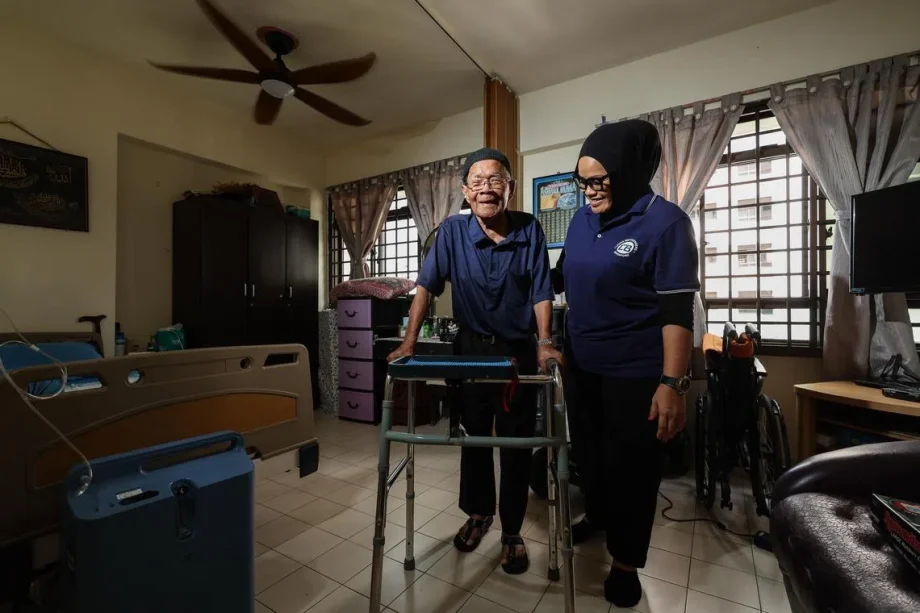
SINGAPORE – When healthcare assistant Radiana Ahmad visits elderly residents in their homes, her duties range from checking blood pressure and dressing wounds to helping the seniors shower, exercise and manage their medications.
The work can be physically demanding and emotionally complex, she said, adding that some seniors have dementia while others experience mood swings or loneliness.
The 49-year-old, who has worked with Lions Befrienders for over eight years, believes her job cannot be replaced by artificial intelligence (AI).
“Honestly I’m not too worried as AI can help do paper work but can’t bathe a senior, talk to them or notice when they are sad,” she said. “My job involves a lot of human touch and interaction.”
However, despite working in a sector that has been described as more “AI-resilient”, she feels some pressure to keep up with the technology amid a government-led push to adopt AI nationwide.
She started playing around with ChatGPT three months ago at the encouragement of her daughter, and now relies on it to translate for seniors who speak different languages.
Radiana said her company also ran a workshop recently on how to use Microsoft’s AI chatbot Copilot. “I think as long as we use AI to help us and not replace us, we’ll be okay.”

Radiana Ahmad (right), a healthcare assistant, guides her 89-year-old patient, Abu Alias Man, through a cup-stacking exercise during a home visit in Clementi on June 29.
ST PHOTO: BRIAN TEO
Other workers in AI-resilient sectors told The Straits Times that they have also started using AI to support or enhance their productivity, even though they are less worried than their peers about disruption to their jobs.
Deputy Prime Minister Gan Kim Yong had said in May that domestic-facing and essential sectors such as healthcare, early childhood education, social services and skilled trades will continue to provide important employment opportunities.
“Many of these roles rely on judgment, empathy, trust and human interaction. They can be augmented by AI but not easily replaced by it,” said Gan, who is also Minister for Trade and Industry, as he laid out the recommendations by the Economic Strategy Review (ESR) committees.
He added that Singapore must make these jobs better through productivity improvements, stronger skills recognition, and clearer career and wage progressions.
Licensed plumber Geraldine Goh believes skilled trades like hers remain highly resilient even as AI reshapes the economy.
“AI can help to acquire information but you need to process and apply it. It is mostly about experience, expertise and physical work,” said the 32-year-old who started her plumbing business Agraffe in 2017.

Plumbers Geraldine Goh and Yeo Kai Xun pictured with their plumbing equipment and tools in their van.
ST PHOTO: JASON QUAH
She has been using AI for administrative work like preparing quotations, allowing her to spend more time on technical and client-facing tasks since two years ago.


Read Full Article At Source