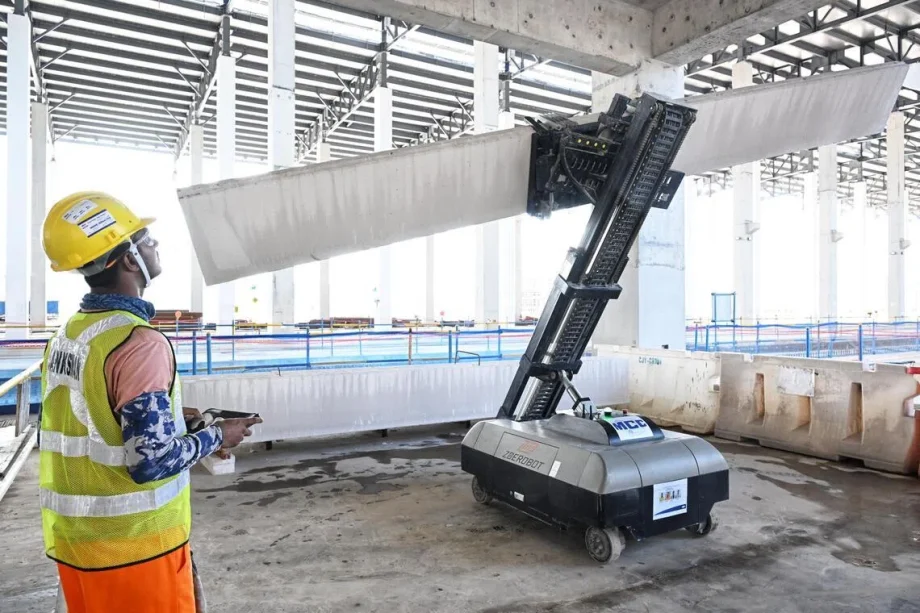
SINGAPORE – After more than two decades in the industry, Expand Construction founder Von Lee has a vision: The next generation of physical labourers will not be men, but robots that toil tirelessly in the sun.
Their human operators, said Lee, would control them from afar, in an office sheltered from the elements.
The proliferation of construction robotics has pushed the sector a step closer to Lee’s dream, and towards changes that could ease Singapore’s reliance on foreign labour, which has been becoming more difficult to recruit and retain.
Figures from the Building and Construction Authority (BCA) show that to date, more than 25 types of robots have been deployed across about 60 projects, from virtually no robots at construction sites in 2022.
However, these represent only about 5 per cent of larger construction projects here.
Those in the sector tell The Straits Times that robotics solutions can one day reduce manpower needs, but there are hurdles to overcome first.
The case for robotics
Asked about employing foreign workers, Edmund Ng, founder of Seng Soon Huat Construction, rattled off a long list of considerations.
These include worker levies, accommodation and transport fees, as well as salaries and allowances.
The challenge has been compounded by manpower shortages – contractors say firms here are competing for labourers with other countries – and a lack of interest from locals to join the industry.
In 2025, construction labourers were the top job vacancy among non-PMET roles across all sectors, according to the Manpower Ministry.
As at December of the same year, non-residents accounted for close to four in five of the 566,800 persons working in the sector.
“Frankly speaking, whose son wants to go into a construction site?” said Ng, whose company – a subcontractor specialising in painting – started using robots in 2025.
“The younger generation isn’t interested in this line because it is dirty, hard work. But if work is playing with robots, it might be something that attracts them,” he said.
For Ng, having one worker oversee three painting robots means one person can do work previously assigned to six.
He added: “If one day I am able to hire one local to manage five robots, instead of one foreigner to three robots, that is when there will be real change in the industry.”
It is such advantages that have prompted public agencies to take the lead on robotics use, with some mandating the use of robots in tenders.
The JTC Corporation, for example, has made the use of robots compulsory in its construction tenders since late 2025, while 16 of the 31 Build-To-Order projects tendered by the Housing Board since 2025 will adopt robotics solutions.
“HDB is progressively introducing construction robots to increase construction productivity and reduce reliance on manpower amid a tight labour market,” an agency spokesperson said.

A robot carrying out painting works at the Changi East Depot construction site on May 20.
ST PHOTO: CHONG JUN LIANG
Yang Xue, director at the Land Transport Authority’s (LTA) Lean Office, said the agency’s use of robotics also reduces workers’ exposure to potentially hazardous environments.
For instance, during the construction of Downtown Line Stage 3 – which opened in October 2017 – LTA used robotic shotcrete machines, which spray concrete onto tunnel walls to provide structural support.


Read Full Article At Source