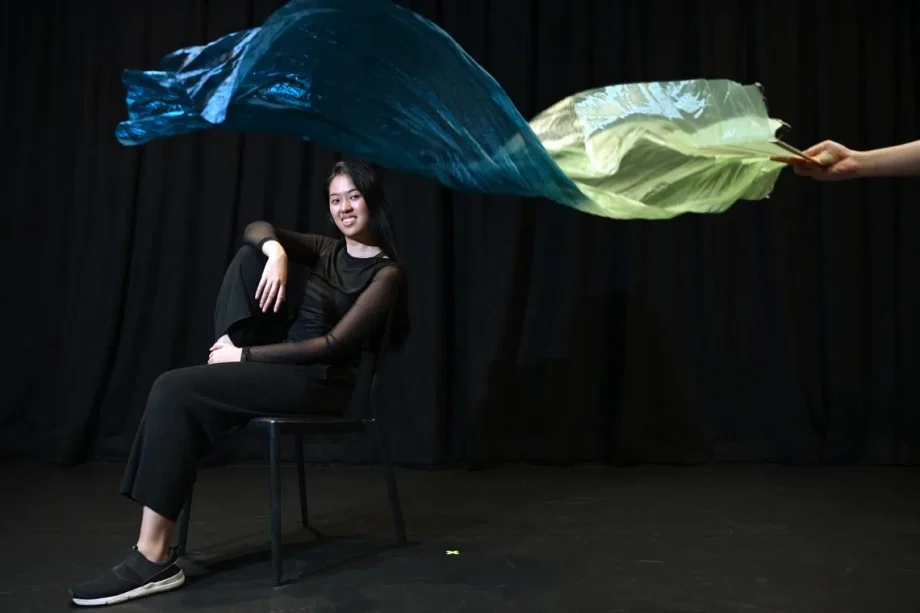
Born with hearing loss, Singapore Rhodes scholar spotlights disability through theatre

Born with hearing loss, Singapore Rhodes scholar spotlights disability through theatre


SINGAPORE – As a secondary school student, there were several times when Jade Ow arrived at an empty classroom after recess, thinking she was the first one back.

But when no one else entered after 10 minutes, she would rush around the school searching for her classmates and teacher, who would actually be in another venue, like the science laboratories.

“Probably there was an instruction telling everybody to go down to Lab 2, but I didn’t hear it… That happened a lot in secondary school,” said Jade, adding that incidents like these often led to misunderstandings.

Diagnosed with hearing loss at just five months old during a milestone check-up, Jade, now 24, said this was one of several challenges she faced in school as a student with a disability.

Once a “lone figure” in school, as described by her father, she slowly grew in confidence as she found her place and voice in a creative career.

The theatre studies graduate from the National University of Singapore (NUS) will be heading to Britain’s Oxford University in September to pursue her master’s under a prestigious scholarship.

In recognition of her leadership and dedication to inclusivity in the arts, Jade was chosen from among nine finalists in Singapore to become the nation’s 31st Rhodes scholar. The postgraduate scholarship is given to exceptional students from around the world to study at Oxford.

Without hearing aids, she picks up about 30 per cent to 40 per cent of regular speech at a normal speaking volume, and even then only with some effort.

However, despite wearing hearing aids from the age of six months, she always found them uncomfortable and eventually stopped using them after graduating from Eunoia Junior College in 2020.

Jade said the devices amplified background noise, making it harder to hear and focus on what people said.

“Throughout school, I also found that wearing hearing aids became a marker of difference,” she said, adding that she struggled with social interactions and making friends in primary and secondary schools.

After her diagnosis of moderate to severe hearing loss, her parents supported her with speech therapy and phonetics classes and by reading to her extensively at home.

She eventually became an adept lip-reader, but that meant she had to look directly at a person to understand what they were saying.

“If I am not looking directly at the person, or if I was trying to work on something else like typing a document at the same time, the entire conversation may fly over my head,” she said.

Her father, Ow Weng Keong, 57, told The Straits Times that he knew Jade was a “lone figure in school”.

“Almost every day when she came back (from school), she would have lots of stories to tell about the garden… So that was how I gathered that she would spend all the recess periods alone,” said Ow, a vice-principal.

Jade with her father, Ow Weng Keong, a vice-principal, and her mother, Ong Chui Hoon, a teacher.

Jade with her father, Ow Weng Keong, a vice-principal, and her mother, Ong Chui Hoon, a teacher.

ST PHOTO: NG SOR LUAN

While she struggled to fit in larger groups, Jade found solace in a few friends.

In primary school, her best friend was a girl named Snigdha Sri, who also struggled to fit in.

“We bonded over our challenges… and though we didn’t go to the same secondary school, we are still very close now,” Jade said, adding that Sri is currently in London practising law.

Jade with her primary school friend Snigdha Sri.

Jade with her primary school friend Snigdha Sri.

PHOTO: COURTESY OF JADE OW

In CHIJ St Nicholas Girls’ School (Secondary), Jade said, it was hard to blend in, and not being able to hear well often led to misunderstandings and people perceiving her as rude.

“I didn’t understand at that age that there was no way I could blend in… Now I tell people upfront that I’m a lip-reader and ask for their understanding, and generally they do,” said Jade.

Looking back on the struggles she faced in her early school years, Jade said she did not know how to self-advocate. For example, when she was placed at the back of the classroom, where it was hard to lip-read the teacher, she would not ask to be moved and struggled to understand what was taught during lessons.

During the Covid-19 pandemic, when everyone had to mask up, making it impossible to lip-read, she did not voice out that her hearing aids were not sufficient for her to understand what others were saying.

However, stumbling across the arts in secondary school and its possibilities for expression slowly built her confidence and helped her find her voice.

Jade was introduced to film-making as part of a Secondary 2 project. This led her to explore other art forms like Chinese calligraphy and photography in school.

Eager to put her newfound passion for storytelling into practice, Jade wrote, directed and filmed a 10-second horror short on her mobile phone in Sec 3, roping in her younger sister to play the lead, and her parents to set up their home kitchen for filming.

At that age, she neither understood the realities of pursuing a career in the arts nor had access to information about how to do so.

Jade Ow with her younger sister during their childhood.

Jade Ow with her younger sister during their childhood.

PHOTO: COURTESY OF JADE OW

Despite her hunger to immerse herself in the arts, she lacked the confidence to audition for dramas and plays.

“I felt self-conscious about how hearing people perceived my deaf accent,” said Jade, referring to the distinct pronunciation, pitch and rhythm that may be present in the spoken language of some deaf or hard-of-hearing individuals.

When she moved on to Eunoia JC in 2019, it was the first time she had a close-knit group of friends, who encouraged her to work towards her dreams. Jade became more hopeful and ambitious.

Jade (fourth from right) with her schoolmates from Eunoia Junior College.

Jade (fourth from right) with her schoolmates from Eunoia Junior College.

PHOTO: COURTESY OF JADE OW

She was thrilled to be given a chance to direct a production at her school’s Literature Festival in 2020, but that was cut short by the pandemic. Undeterred, she began researching theatre as a course of study, and decided to major in theatre studies at NUS.

While waiting for her A-level results, Jade signed up for acting and voice-training classes. In her second year at NUS in 2023, she joined a two-year theatre training programme run by social service agency ART:DIS Singapore, for deaf, neurodivergent and disabled performers.

She balanced the programme with her studies, often running on very little sleep when rehearsals, held about three times a week, could stretch past midnight.

“What kept me going was the prize at the end. I saw it as learning and pushed myself,” said Jade.

Her lecturers would sometimes tell her that her chances of making it in the industry were slim, but she knew they did not mean to offend.

“I understood that they were just explaining the reality of the theatre industry, so that we were aware of the unemployment and difficulties people face,” she said.

Jade wrestled with the tension between passion and pragmatism. She wanted to prove to herself and others that she could make it, and she set out to do the work.

To date, she has performed in numerous productions, including the play Please Let Me Have This by ART:DIS and Through The Looking Glass, an art installation and performance, at the Light to Night Festival 2025.

Jade performing in Through The Looking Glass for the Light To Night Festival 2025.

Jade performing in Through The Looking Glass for the Light To Night Festival 2025.

PHOTO: ART:DIS SINGAPORE

She has written a few plays in Singapore, including CUT-OFF POINT, a piece about academic pressure and looking beyond societal expectations through the eyes of a deaf protagonist played by her. The production will tour schools, ranging from secondary schools to universities, until September. 

Jade rehearsing for CUT-OFF POINT, a piece about academic pressure and looking beyond societal expectations.

Jade rehearsing for CUT-OFF POINT, a piece about academic pressure and looking beyond societal expectations.

ST PHOTO: NG SOR LUAN

In 2023, NUS awarded Jade the Hochstadt Scholarship and the Special Prize in Theatre Studies for her outstanding academic performance. She also received the 2024 Outstanding Deaf Talent Award from the Singapore Association for the Deaf.

She graduated in July 2025 with a first-class honours degree, and now works in programming at the National Gallery Singapore. But her accolades do not stop there.

Jade with her grandmother and sister during her NUS graduation ceremony.

Jade with her grandmother and sister during her NUS graduation ceremony.

PHOTO: COURTESY OF JADE OW

Jade is also a career mentor at social service agency Inclus, where she mentors students from schools such as NorthLight and Assumption Pathway.

She has also worked with organisations such as SG Enable and The Purple Parade on public education campaigns promoting accessibility and inclusion.

Yong Ying-I, chairman of the CPF Board who chaired the Rhodes Scholarship selection committee, said the panel was deeply impressed by Jade’s passion, leadership, and strong record of service to the broader community.

“We are delighted that she will serve as a role model for other Singaporeans, raising awareness and providing encouragement that disability need not be an obstacle to achievement, inclusion and contribution,” said Yong.

At Oxford University, Jade will pursue a master’s degree focusing on disability identity in cinematic and theatrical aesthetics.

Looking back on her journey as a student grappling with disability and lacking confidence, Jade said her biggest challenge was learning to break through the self-imposed limitations and assumptions she had about herself.

When she returns in two years after completing her master’s, she hopes to push the boundaries of her knowledge of what arts led by artistes with disabilities can be and advocate for people with disabilities in Singapore.

“I strongly feel that access to education and access to work in the arts is just as important an endeavour.

“Disabled people should not have to remain as audience members only; it is time they step forward as leaders.”


Read Full Article At Source

Share. Save. Don't Miss The Buzz: XFacebookRedditLINETelegramWhatsAppGmail