
As a young and single Singaporean who can’t afford to buy my own public housing at the moment, I find myself exploring beyond the borders of our little red dot for alternative housing options that would appeal to myself and fellow kindred spirits.
Last November, Singapore-based ferry operator Batamfast shared that they were exploring the possibility of a new ferry route from Tanah Merah in Singapore to Pasir Gudang in Johor, Malaysia.
When I read the news, it sparked curiosity on the viability of living in either Johor or Batam in Indonesia, where the housing markets are much more affordable compared to Singapore, and commuting regularly by ferry.
Travel by sea, unlikely traffic jams at immigration checkpoints, but still close to Singapore. Sounds like a dream.
And so, I started taking a look at the property markets around these overlooked transport nodes. And what I found was more nuanced and data-rich than what I had initially expected.
The challenge for many buyers today isn’t access to information.
It’s interpreting that information in a way that makes sense for their finances, goals, and stage of life.
Over time, that’s also why we decided to work with agents who shared the same data-driven and advisory-led approach behind our editorial, consultants who could help readers think through decisions more objectively, rather than simply push transactions.
Today, the team has worked with more than 2,000 clients across over $5B in property transactions.
Singapore’s increasing ferry connectivity with Malaysia and Indonesia
Over the years, several ferry routes have conveniently linked ports in Malaysia and Indonesia to Singapore. Some of the most frequently travelled routes serve areas in nearby Batam, such as Nongsa, Harbour Bay, Batam Centre terminals, and Bintan’s resorts; as well as ports in Johor like Tanjung Pengelih and Desaru Coast.
As the network of ferry routes between the three countries expanded over the years, the same narrative tends to surface: Shorter travel times and more reliable accessibility would lead to a spillover effect in the housing markets in Batam, especially from professionals working in Singapore.
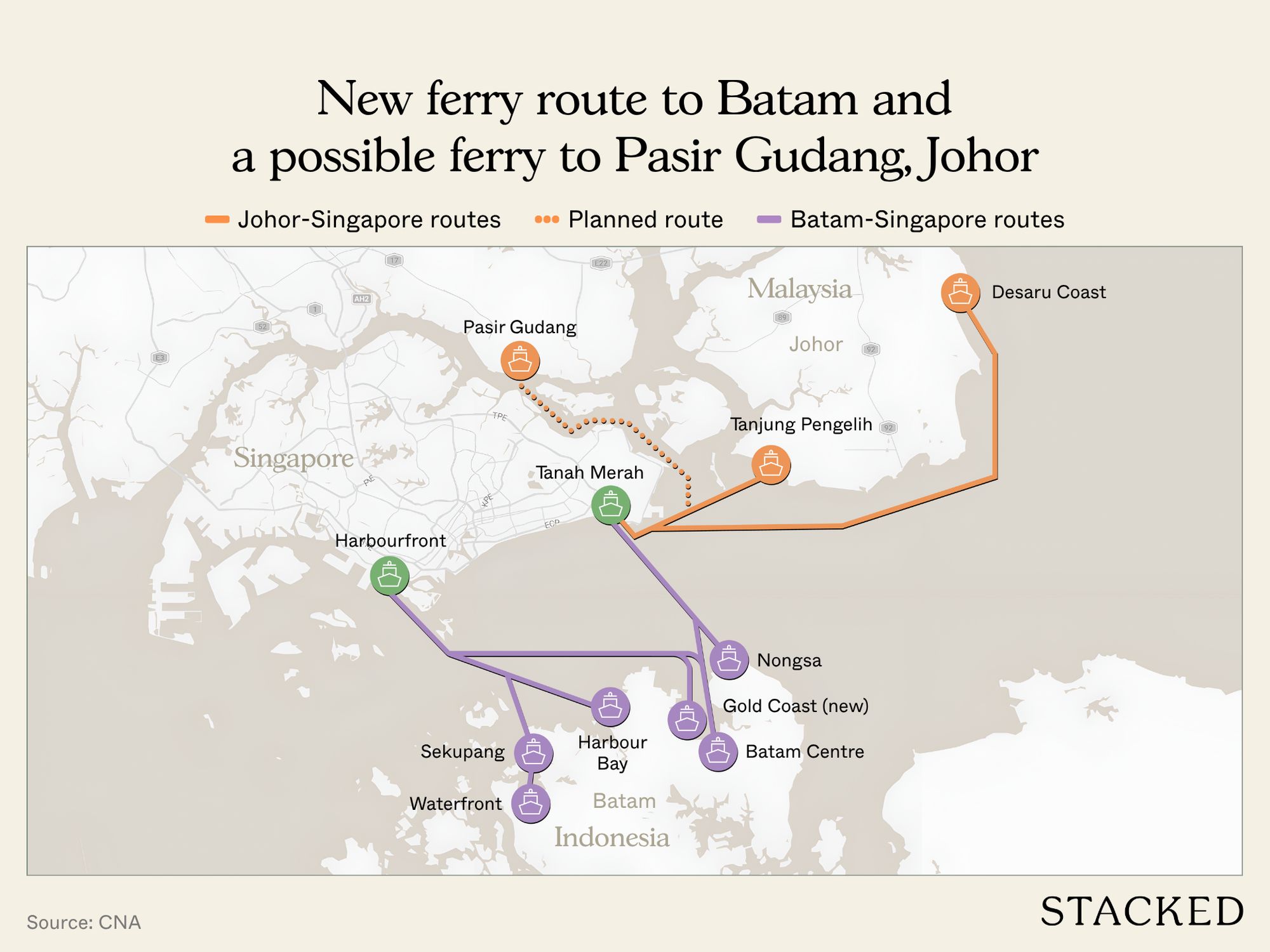
Current ferry routes from Singapore to Indonesia and Malaysia. Source: CNA Graphics
However, history has demonstrated that improved transport links alone are rarely enough of a pull-factor to significantly move the needle on housing demand in these housing markets. It is often state and federal level infrastructure projects, proximity to employment clusters, and other urban improvement schemes from Malaysian and Indonesian authorities which have bolstered the property markets in Johor and Batam.
In Batam, local and federal authorities are working on an ambitious 7km Batam-Bintan bridge project to integrate the Riau islands, as well as plans to modernise Batam’s international airport in order to promote the island as an aviation logistics hub.
If ferry services between Tanah Merah in Singapore to Pasir Gudang in Johor materialise, how might the expanded ferry connectivity change the housing plans of some Singaporeans? We should also consider who might be the likely buyers that would find this arrangement appealing.
Lessons from existing ferry-connected markets
The performance of the Johor property market may offer an instructive example. At the start of this year, the average residential property price in the Malaysian state was approximately RM471,485 (around S$138,000), according to data from the Valuation and Property Services Department (JPPH).
However, state-level averages mask a wide variation that differs across different towns and regions. In general, the clearest price denominator is a property’s proximity to Singapore, rather than ferry routes.
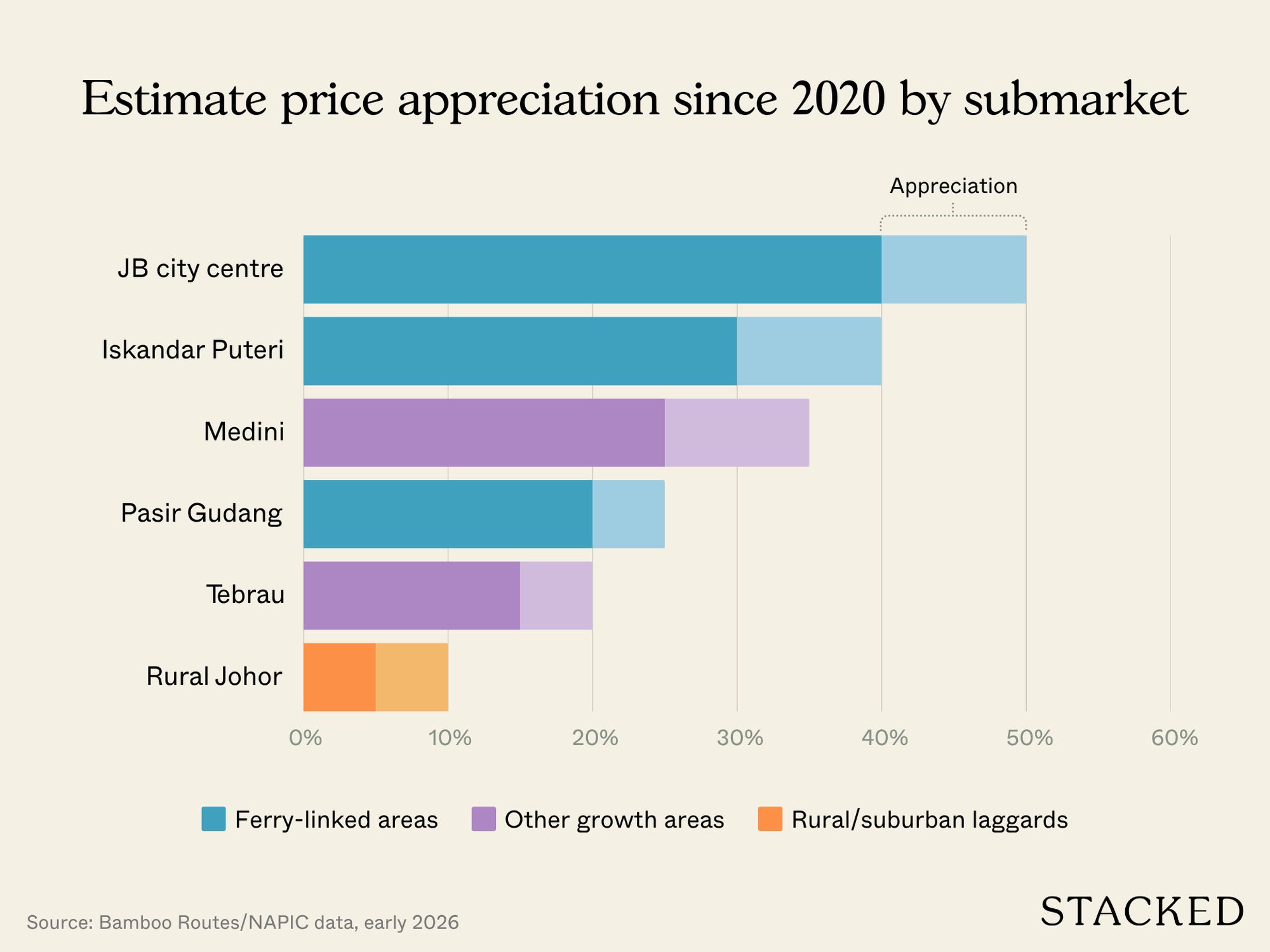
Properties in the city centre of Johor Bahru have recorded a price appreciation of 40–50% since 2020. This largely stems from development and buying activity around Bukit Chagar Rapid Transit System (RTS) Link to Woodlands North in Singapore, as well as the Johor-Singapore Special Economic Zone (JS-SEZ).
Other notable growth areas include Iskandar Puteri which has notched a 30–40% price increase over the same period, mostly supported due to its planned city status.
On the other hand, the housing market around Pasir Gudang – which is primarily an industrial district – has seen a more modest property price growth of 20–25% over the same period. Most of the residential demand stems from port proximity and logistics employment rather than lifestyle appeal or cross-border connectivity.
According to transaction data by Brickz, a Malaysian property research portal, median home prices in Pasir Gudang were RM390,000 (S$114,000) across 20,246 statewide residential transactions, based on transaction data compiled from May 2024 to March 2025.
In contrast, median home prices in Johor Bahru were RM590,000 (S$173,000) and RM653,000 (S$191,000) in Tebrau over the same period.

Read Full Article At Source