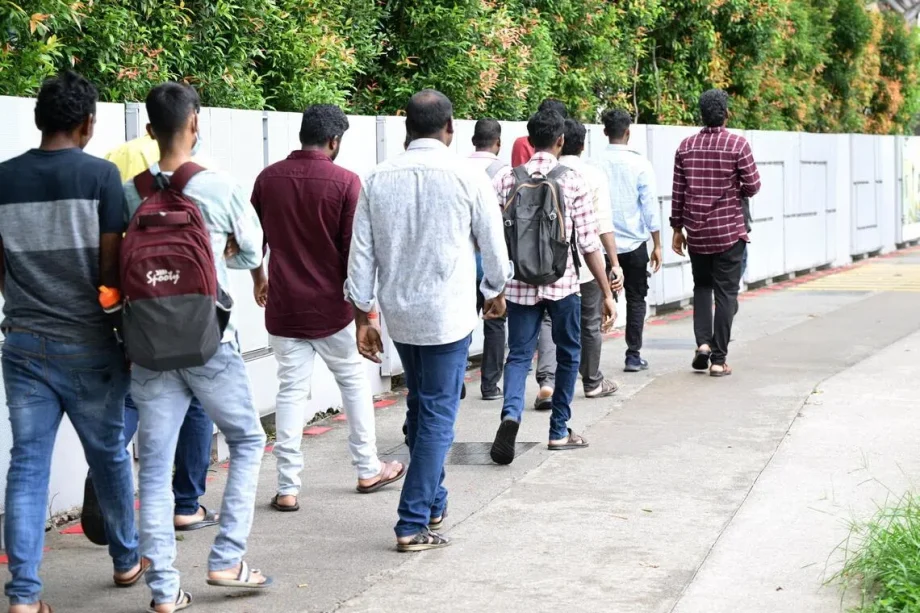
In March 2025, advocacy group Transient Workers Count 2 (TWC2) received a text from a migrant worker who had not been paid for a month by his employer, KPA Engineering.
Another worker came forward in May. Another in June. One said he had never once been paid on time since joining the company. More emerged over the following year, and each was advised to file salary claims with the Tripartite Alliance for Dispute Management (TADM).
Then, on June 22, 2026, about 100 workers turned up at the Ministry of Manpower (MOM) seeking help. Within two days, that number had grown to about 400.
By that time, the damage had already been done, and the focus was on how to clean up the aftermath.
Some of the workers have quickly found new jobs, and the authorities say they expect the majority of the rest to be successfully job-matched in the coming weeks.
But this episode should serve as a moment of reckoning. How did so many workers end up going unpaid before the problem came fully into view?
This is not about assigning blame before investigations conclude. Nor is it to suggest that Singapore lacks laws or institutions to protect workers. It has both. The question is whether our labour protection system is better at reacting to wage theft than preventing it.
The first workers who sought help over unpaid wages may have appeared to be isolated cases. In hindsight, they look more like early warning signs. That does not mean intervention would necessarily have been justified at the time. But it does raise a legitimate question: When several workers linked to the same employer begin reporting unpaid wages over an extended period, should that trigger closer scrutiny?
A Straits Times investigation found that KPA Engineering’s financial troubles pre-dated the wage crisis by at least two years. Public records show that HSBC registered a charge against the company over unpaid debts in 2023. That debt was settled, but DBS also registered two charges in 2024, both of which remain on public record.
KPA Engineering director Ramu Palani Velu, a Singapore permanent resident, is also listed as a director of seven companies. Three of them, including KPA Engineering, have workers who have reportedly gone unpaid for months. The existence of the companies having a common director is not, by itself, evidence of wrongdoing.
But financial regulators routinely look for patterns across related entities rather than viewing each case in isolation. Labour regulation may eventually need to adopt a similar mindset, if it has not already begun doing so. The objective is not to presume guilt, but to identify emerging risks before they affect hundreds of people.
Wage theft is not simply a dispute between an employer and an employee. It is a breach of the most basic promise underpinning any labour market: If you do the work, you will be paid. Every month they worked without receiving their salaries, the workers were effectively financing their employer’s business. Unlike banks, they had little practical ability to limit their exposure without risking their livelihoods.
Read Full Article At Source