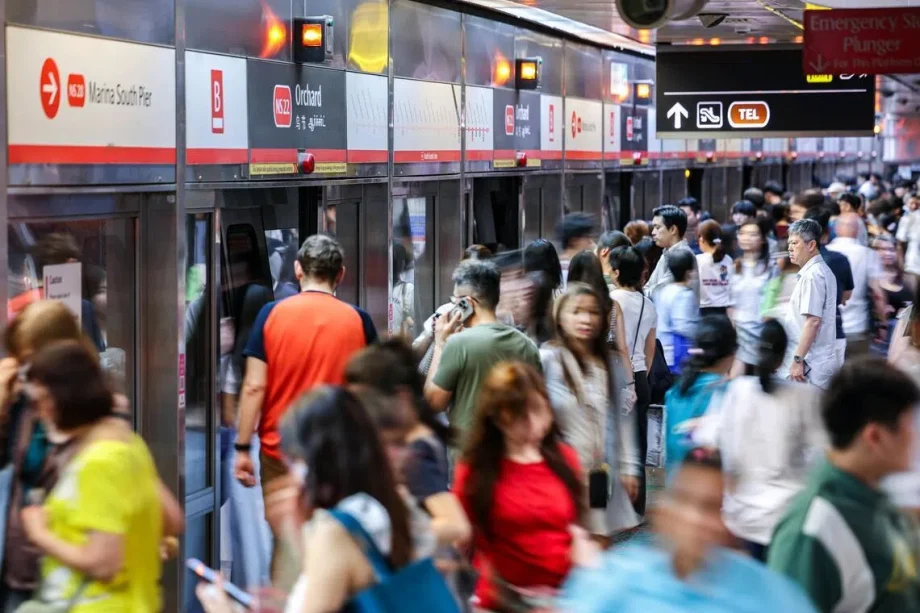
SINGAPORE – Residents in Sembawang took the longest time to get to work in 2025, with a median travelling time of 50 minutes – the highest among Singapore’s towns.
They were followed by those living in Bukit Batok, Bukit Panjang, Choa Chu Kang, Jurong West, Punggol, Sengkang, Tengah, Woodlands and Yishun, for whom the median travelling time was 45 minutes.
These findings were published in the General Household Survey 2025, which was released by the Department of Statistics (SingStat) on June 30.
For Sembawang resident Aaroon Krishna, the findings ring true: The 41-year-old operations executive spends about an hour travelling to work by public transport four days a week.
His journey includes a walk from his home to Sembawang station, waiting for the train, a ride on the North-South Line (NSL) to Jurong East station, another wait for his next train, a ride on the East-West Line (EWL) to Pioneer station, and a walk to his workplace.
Based on the General Household Survey 2015, people living in seven of those 10 towns also had the longest median commute of 45 minutes. The other three towns, Bukit Batok, Jurong West and Tengah, were not included in the previous list.
Singapore-based urban transport researcher Paul Barter said most workplaces are located in the Downtown Core, central region and other areas such as Tuas and Pasir Panjang.
SingStat said almost half of employed Singapore residents worked in the central region. Hence, people who live farther from these job centres would naturally take longer to travel to work, Barter said.
Poh Li San, the MP for Sembawang West, told The Straits Times that she had not received complaints from residents about long travelling times, as the NSL’s Admiralty station is within walking distance of many estates, while Woodlands station on the Thomson-East Coast Line (TEL) can be reached by bus.
She added that most of her residents working in the central area can use the NSL or TEL, and can often get a seat when boarding during the morning peak.
Others may work nearer home, such as at Woodlands Industrial Park or in Ang Mo Kio, said Poh.
Liang Eng Hwa, the MP for Bukit Panjang, noted that residents living farther from Bukit Panjang MRT station – such as Fajar and Segar – may find it inconvenient and time-consuming to travel within the town just to reach the MRT station, particularly during peak hours.
He added that the Downtown Line’s indirect loop through the city centre – from Bugis to Bencoolen stations – could further lengthen some journeys.
But Liang said there are city-bound bus services such as 972 and 972M, which use the expressways, offer faster connections, and complement rail services.
Read Full Article At Source