What happened?
Singapore’s construction sector is having its best year in over a decade.
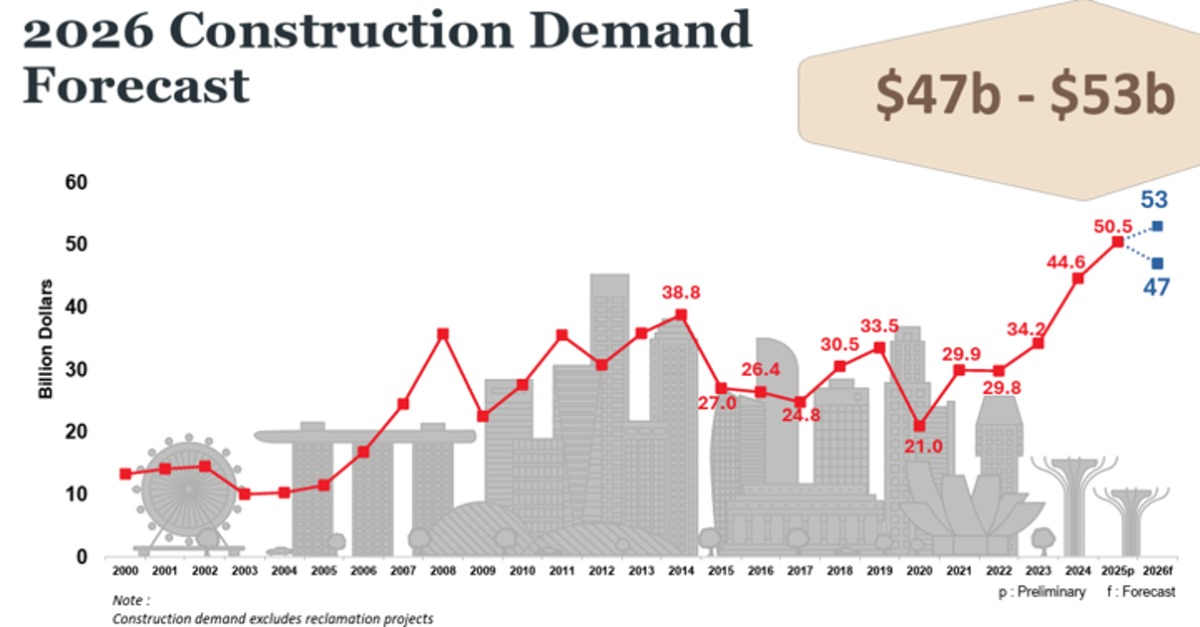
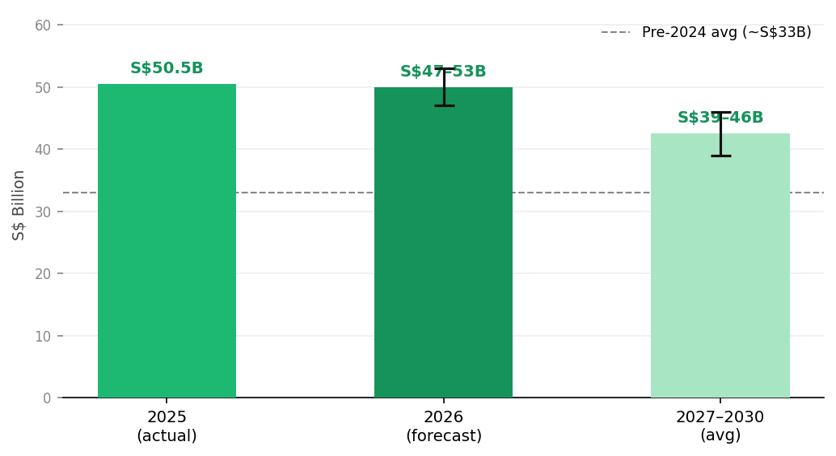
Total construction demand reached an estimated S$50.5 billion in 2025, marking the strongest year for the sector in a decade. Looking ahead, BCA expects demand to remain elevated at S$47 billion to S$53 billion in 2026.
In our recent article on 4 growth themes to watch in Singapore stocks beyond dividends, we identified Government Spending as one of the structural themes shaping the Singapore market over the next few years.
As we wrote then, infrastructure spending is typically stable and countercyclical, with multi-year investments that provide consistent demand for construction, engineering and related sectors.
That theme is now showing up more clearly in Singapore construction, where public sector projects account for about 55% of total demand, supported by major projects such as Changi Airport Terminal 5, the Cross Island Line, Tuas Port and new HDB flats.
In this article, I’ll look at what is driving Singapore’s construction upcycle, how long it is likely to last, and what kind of exposure makes sense for investors watching this multi-year infrastructure build-out.
| Construction Sector — Key Economic Metrics | ||||
| Metric | 2023 | 2024 | 2025 | 2026F |
| Total Demand (S$B) | ~S$33B | S$44.2B | S$50.5B | S$47–53B |
| GDP Share (%) | ~3.2% | ~3.5% | ~4.0% | ~4.2% |
| Sector Growth | 4.10% | 5.80% | 6.50% | +4–5% |
| Public Sector Share | ~50% | 55% | 55% | ~55% |
| DfMA Adoption | ~55% | ~62% | ~68% | >70% |
| Source: BCA, MTI | ||||
Why Singapore’s construction upcycle may have further to run
Construction demand is beating expectations and growing faster than the economy.
The construction sector is often seen as cyclical.
However, the current upcycle looks different because it is being supported by several large public and private projects at the same time.
It is not just a recovery from the pandemic. It is also a reflection of Singapore’s longer-term infrastructure needs across transport, housing, aviation, coastal protection and industrial development.
#1 – Singapore construction demand keeps beating forecasts
BCA’s construction demand forecasts have been exceeded in recent years.
In 2024, BCA had forecast total construction demand of S$32 billion to S$38 billion. Actual demand came in higher at S$44.2 billion.
In 2025, demand rose further to S$50.5 billion. That made 2025 the strongest year for Singapore construction demand in a decade.
The repeated upside surprise suggests that the construction upcycle has been stronger than many expected.
It also reflects a wider pipeline of projects being rolled out at the same time.
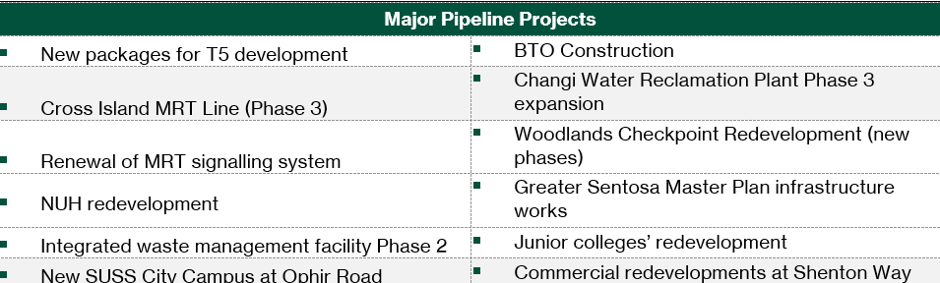
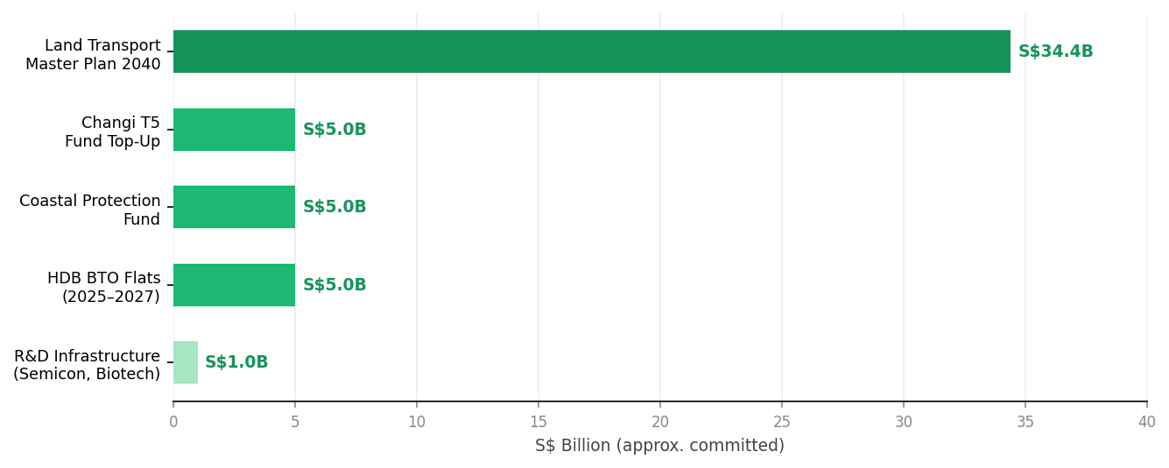
These include Changi Airport Terminal 5, the Cross Island Line, Tuas Mega Port, new HDB flats, healthcare facilities, educational institutions and coastal protection works.
Many of these projects are multi-year programmes. That means construction demand may not peak and fade immediately.
Instead, demand could remain supported as contracts are awarded and projects move through different phases of construction.
Total Construction Demand, Singapore (S$ Billion)
#2 – Singapore construction is growing faster than the pace of the economy
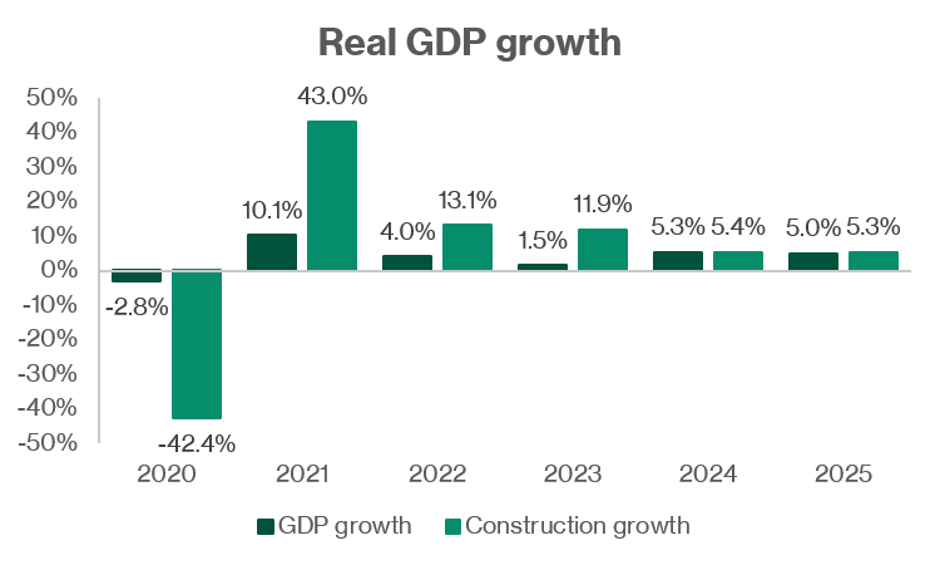
The strength in Singapore’s construction sector is showing up in the country’s economic growth numbers. Construction grew at around 5.3% in 2025, outpacing Singapore’s overall GDP growth of 5% — a sign that the sector is expanding at the pace of the broader economy, if not faster.
Construction still accounts for a relatively small share of output, at around 4% to 5% of GDP. But as major infrastructure projects move ahead, its contribution is becoming harder to ignore.
Construction Sector Growth vs. Singapore GDP Growth (%).
While activity may vary from year to year, the combination of airport expansion, rail infrastructure, housing supply and coastal protection suggests construction demand could remain above historical averages for many years.
#3 – Public sector projects now drive more than half of construction demand
The public sector remains the key driver of Singapore construction demand.
Public sector projects accounted for about 55% of total construction demand in 2024. (BCA, 2024)
This is important because government-backed projects tend to be more visible than private sector projects.
For construction-related companies, public sector demand may provide a clearer pipeline of work, even when private sector activity slows.
Major public sector projects such as Changi Airport Terminal 5, the Cross Island Line, Tuas Mega Port, new HDB flats and coastal protection works are not short-term projects.
They are large, multi-year programmes.
This gives contractors and related companies more visibility on potential future work.
Private sector demand also remains relevant.
It is being supported by high-specification industrial buildings, data centres, healthcare facilities and educational institutions.
Together, public and private sector demand have created a broader construction pipeline across Singapore’s economy.
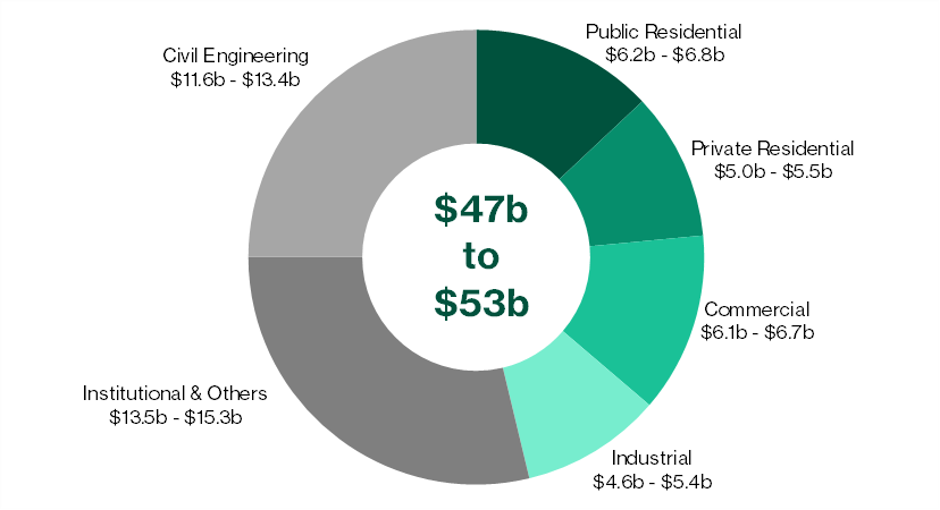
BCA 2026 Construction demand by segment
BCA’s outlook for 2027 – 2030
#4 – The margin story most investors may be missing in Singapore construction
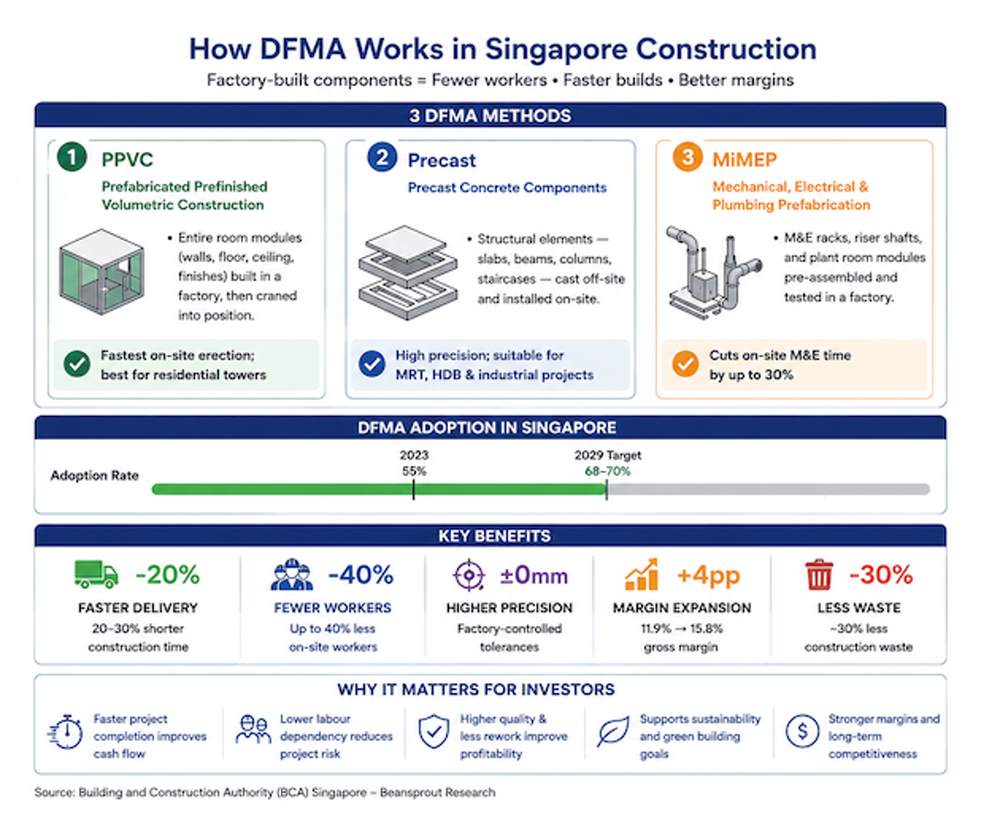
Another reason the construction upcycle may be different this time is the growing use of Design for Manufacturing and Assembly (DfMA).
DfMA refers to construction methods where parts of a building are manufactured off-site before being assembled on-site.
One example is Prefabricated Prefinished Volumetric Construction (PPVC).
Under PPVC, entire room modules can be built in a factory before being transported and installed at the project site.
This can help reduce manpower needs, shorten construction time and improve consistency.
According to the Ministry of National Development (MND), the adoption rate of DfMA across new developments increased from about 61% in 2023 to 68% in 2024, putting Singapore on track to achieve its target of 70% adoption by 2025.
DfMA has become an important driver of productivity and margin improvement, particularly for contractors with their own manufacturing capabilities.
Why government spending may support Singapore construction demand
Government spending and major infrastructure projects provide the long runway.
Budget spending alone does not automatically translate into profits for construction companies.
However, it can provide the foundation for a more visible pipeline of work.
That is especially important in a sector where order books, project execution and margins matter.
#1 – Government spending is driving large-scale investment into the construction sector
Budget 2026 committed S$154.7 billion in total government expenditure, which is the largest budget in Singapore’s history.
Read Full Article At Source