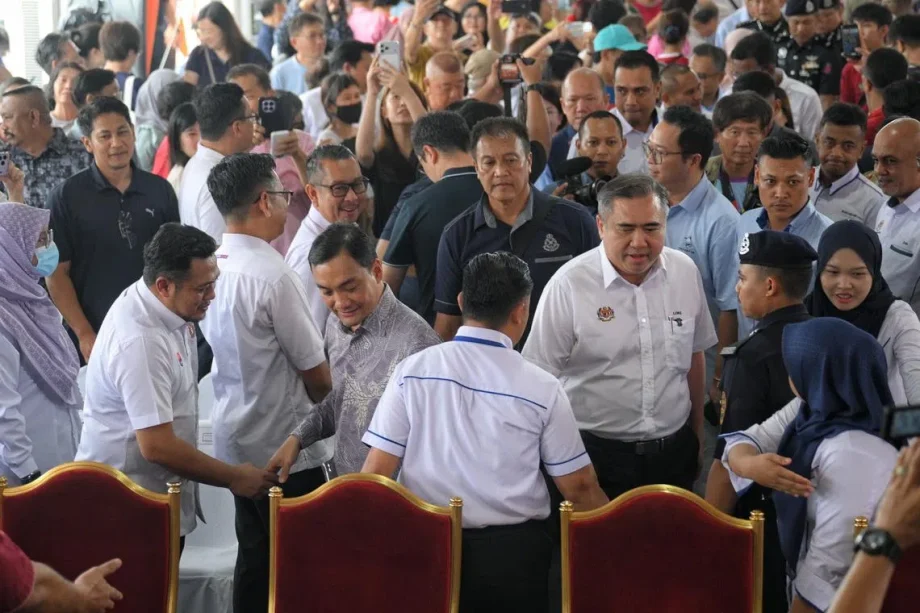
KULAI, Johor – When Johor caretaker Menteri Besar Onn Hafiz Ghazi stepped out of a black saloon car on June 16 for the launch of the state’s first commuter shuttle train service, Malaysian Transport Minister Anthony Loke was there to shake his hand. Loke then guided him through the media scrum at a packed train station in Kulai, Johor.
Once seated, he poured Onn Hafiz a glass of water. The assembled press chuckled at the affable gesture, as it appeared to signal a cooling of tensions after weeks of public sparring between the Johor Barisan Nasional (BN) chief and the Pakatan Harapan (PH) leader.
The cordiality lasted 12 minutes.
On stage later, Onn Hafiz pressed Loke over delays to Johor Bahru’s (JB) proposed elevated autonomous rapid transit (ART) system – a tram system that runs on rubber tyres on the road, a cheaper alternative to the light rail transit (LRT).
“If this project can be expedited, the federal government will deserve huge credit,” he told Loke, who is also secretary-general of the Democratic Action Party (DAP).
“But I worry should there be any hiccups; I hope you would also claim the discredit.”
With Johor’s July 11 state election looming, the Kulai event offered a preview of the fault lines that will define the campaign: a federal government led by PH and a state machinery under BN, both claiming ownership of the same infrastructure promises.
It was also a glimpse into a federal-state relationship fraying, with real consequences for the tens of thousands of commuters counting on the state to be ready when the Johor Bahru–Singapore Rapid Transit System (RTS) Link opens in 2027.
The cost should Johor fail to beef up its public transport is stark – for residents and, by extension, any visitors from across the Causeway.
The proposed RM10 billion (S$3.1 billion) ART system is expected to form a key part of Johor Bahru’s public transport network to help disperse passengers arriving from Singapore via the RTS Link, which can carry up to 10,000 passengers an hour.
State officials have warned that congestion in JB will worsen if the RTS Link opens before a supporting dispersal system is implemented.
While Loke announced federal approval for the ART project on May 17, Onn Hafiz has questioned its lack of progress, noting that it was tabled to the Cabinet in 2024.
Read Full Article At Source