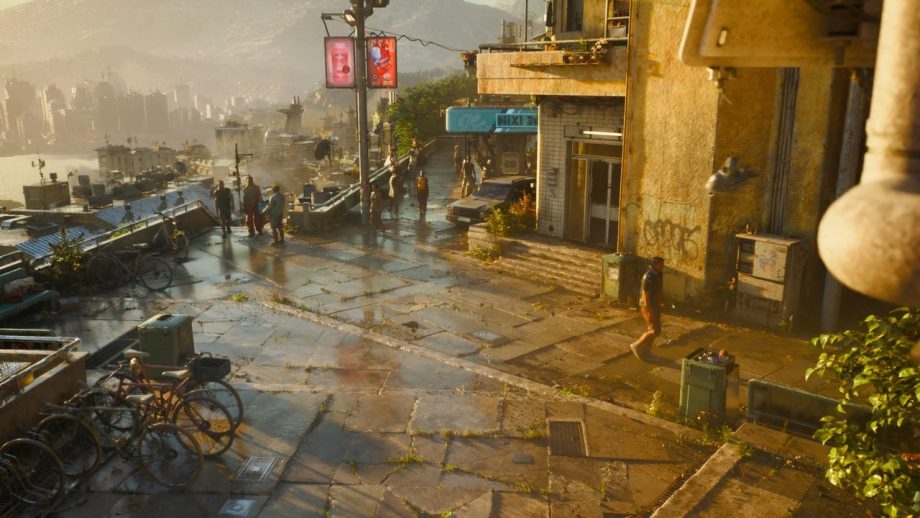
No Law is an ambitious project. It’s a Cyberpunk-style sci-fi action adventure set in a city packed with thousands of NPCs and buildings you can enter. But it’s not on the same scale as CD Projekt’s sprawling Night City. Rather, Port Desire goes for density and fidelity over sheer scale.
That’s a choice Neon Giant co-founders and co-creative directors Tor Frick and Arcade Berg made early on in development of this promising follow-up to cyberpunk twin-stick shooter The Ascent, which won plaudits for its attention to detail. Now, with the perspective shifted to first-person and an open world city to explore, No Law doubles down and expands on everything that made The Ascent so good.
No Law showed up at this year’s Unreal Fest (it’s being made using Unreal Engine 5), with an impressive tech demo, below. Ahead of the reveal, I spoke to Frick and Berg to get more insight into what they’re trying to achieve and what it all means for the player. There’s plenty of talk about Port Desire being the “most alive” open world city ever created, but how will this relatively modestly sized developer manage it? With physics that don’t reset, multiple interconnected systems that govern the behavior of its over 3,000 NPCs, and careful consideration for the buildings the player can and cannot enter, the developers tell me. And yes, you can kill everyone in the game and it will still work.
IGN: How are you using technology like Unreal Engine to make No Law?
Tor Frick: We don’t want to focus on, “Oh, it has the scale of a large city.” That’s not what interests us, and that’s not the kind of world we want to build. We want to build something where it’s more like, what is in your nearest surroundings? This building feels like a genuine building. This street feels like a genuine street. This apartment feels genuine.
Arcade Berg: I mean, it’s a cliche to say, but it’s quality over quantity. That’s a great example of us having to make a choice. What’s more important for us? Is it the scale or is it the fidelity? The fidelity we deliver on, it’s a really high fidelity, and we have pushed technology to achieve that fidelity, or what we want to do in the game with day and night and open world and all of this. Those are thanks to choices we made and investments we made into technology. We could not do that and at the same time deliver on a massive scale beyond what we’re already doing with Port Desire.
Make no mistake, Port Desire is still a large city and there are a ton of areas to explore. But of course it’s easy to imagine a city that is twice as big or 10 times as big or possibly a hundred times as big. We don’t want to do that, but also we couldn’t. We just couldn’t. We could have met that scale, but then we would have to bring down or not aim as high with the fidelity, and we just opted for fidelity in that case. And that’s usually what happens when we have to make a choice of where we go.
And that’s also where the game and the gameplay needs to follow, just make sure that everything is heading in the right direction. So us knowing that the city is more intimate and that the city has higher fidelity, we don’t do flying jet bikes that travel at the speed of light because you wouldn’t have a city large enough to travel around with it. So we make sure that the gameplay is utilizing the scale that we do deliver on the most. So we slowed it down so that you get to enjoy and explore the individual apartments, the office spaces, the buildings, climbing the facades of the buildings, because every building has a real scale because of the interiors. So it all needs to fit together.
IGN: Fidelity and density are your trademarks really after The Ascent, but what exactly is it about No Law that will make it feel like the most alive game ever?
Tor Frick: I think that’s one of the things that is so many little ingredients that play together. So for example, one of the things that I think is pretty unique to this game is, the buildings have an inside and an outside. They are not separate levels. If you go into an apartment, you climb up the fire escape, in through a window, you’re in the apartment, you look out through the window. The guy in the kiosk selling stuff is still out there. You can still see the people walking outside. You don’t go into an interior and we turn off the outside world. It’s always one thing. And we try to use that as much as possible, so you get this feeling like I am in a place where it doesn’t just stop because I loaded into a mission location. It’s always there. That’s just one part of it.
Other things are like, shops and bars will open and close as time passes, people will take shelter from the weather. The ebb and flow of people in the city will change throughout the day.
Arcade Berg: When we design interior spaces, we need to be mindful that people outside might actually hear this. It will lead to consequences. They could be good, they could be bad depending on what you’re doing and what you’re getting up to. We can’t level the sign and system design in isolation because everything is always connected.
They actually seek shelter. So if it’s raining, you will see AI actually heading under roofs to make sure that they don’t get wet. That also affects where they are, which also affects where they will hear you from. We’re really trying to have it be systems interacting, and hoping that players will play the game and do things and use the tools that we provide you with in ways we haven’t necessarily planned. That’s where we get the most enjoyment. So it’s always running that simulation and being consistent with what they offer basically.
IGN: Most of the time when I’m playing these open world games, there’s a lot of window dressing, but a lot of the time you can’t go into all the buildings you see. You go to a door, you can’t open it. There’s only certain buildings that you can go in. But it sounds like with No Law that you’re making a conscious effort to try and make that not be the case for this game. Is that a fair assessment?
Arcade Berg: It was a fair assessment because that’s exactly where we started. Our initial goal when we started this years and years ago was that every building interior should be explorable. And what we noticed even at the smaller scale, that is just too much. It’s too much to ask of any player. It is simply not fun, because it gets exhausting and overwhelming.
Our job as well as creators is to make sure that when you do go into interiors, that there’s something for you. There needs to be some interesting art. There needs to be a piece of fiction or some actual gameplay reward. There needs to be something, right? And we noticed that exploring too much dead space is actually a detriment to the gameplay experience. So we do not let you into every building for your own good!
Read Full Article At Source