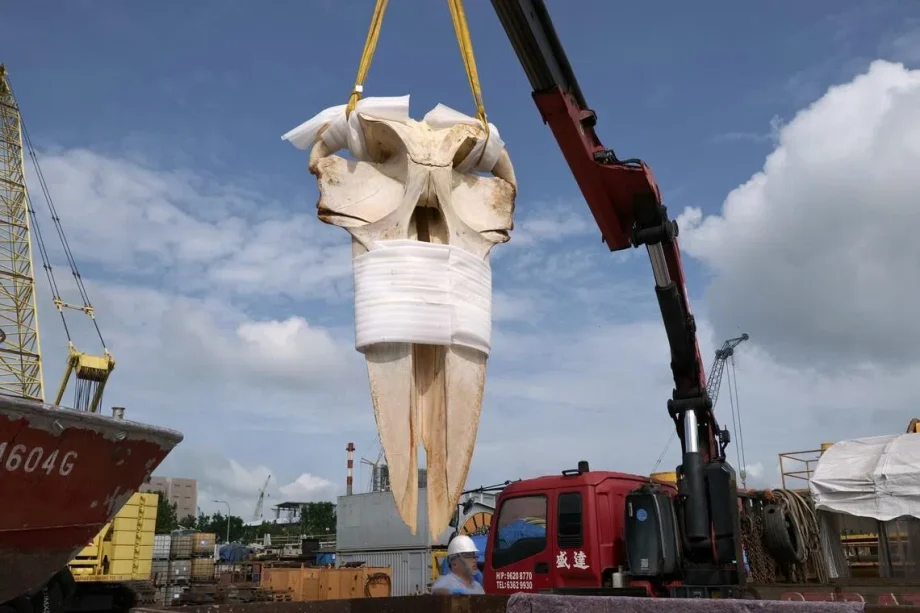
SINGAPORE – The carcass of a whale found in the waters off Tanjong Pagar on Sept 6, 2025, has been identified as an Omura’s whale, or Balaenoptera omurai, which is among the world’s most elusive baleen whale species.
Its biology, population, habitat and ecology “are largely unknown or poorly known”, Marcus Chua, assistant senior curator of mammalia of the Lee Kong Chian Natural History Museum (LKCNHM) at the science faculty of the National University of Singapore, told The Straits Times on June 6.
He noted that the Omura’s whale was described as a new species to science only in 2003, and scientists know so little about it that in the International Union for Conservation of Nature (IUCN) Red List classification of species extinction threat, it is listed as “data deficient”.
There is no information about how many of these whales exist in the wild, and little is known about their migration patterns. They are found primarily in warm and shallow coastal waters, across the Indo-west Pacific, including South-east Asian waters, the Indian Ocean, the north-west Pacific Ocean and Oceania, said the museum.
The recovered whale, identified as a sub-adult male, was likely in its late teens, said Chua, adding that an Omura’s whale reaches adulthood at about 20 years. There is no information about their lifespan.
When it was recovered in Singapore in 2025, the whale was missing half its body and measured about 6.3m. At full length, a 10.6m long baleen whale would weigh about 5,000kg to 7,000kg when alive, he said.
Found in an advanced stage of decomposition, the whale likely died between several days and two weeks prior to discovery, he said.
The Sept 6 incident is the first record of an Omura’s whale washing up in local waters.
And while Chua called it “unfortunate”, he also said that the recovery allows researchers to learn as much as possible about the cause of death and biology of the Omura’s whale.
“This will allow us to contribute to the knowledge and conservation assessment of the species,” he added.
He said identification of the whale was based on analyses of DNA and skull features. A portion of its DNA was a perfect match with the reference individual of the species, he told ST.


Read Full Article At Source