WHEN KTM Bhd finally unveiled its Kuala Lumpur to Johor Baru ETS (electric train service) on Dec 12 – after around seven years of construction – one thing was greeted with a collective sigh: the long journey time of nearly 4.5 hours.
On paper, it is possible for a train running non-stop from KL Sentral to reach JB Sentral, a rail distance of 330km, in three hours, given the design speed of the alignment, which is 160kph.
In practice, however, KTMB is running the ETS sets at 140kph to maintain a decent safety margin on the metre-gauge network, as well as to keep the lid on maintenance costs.
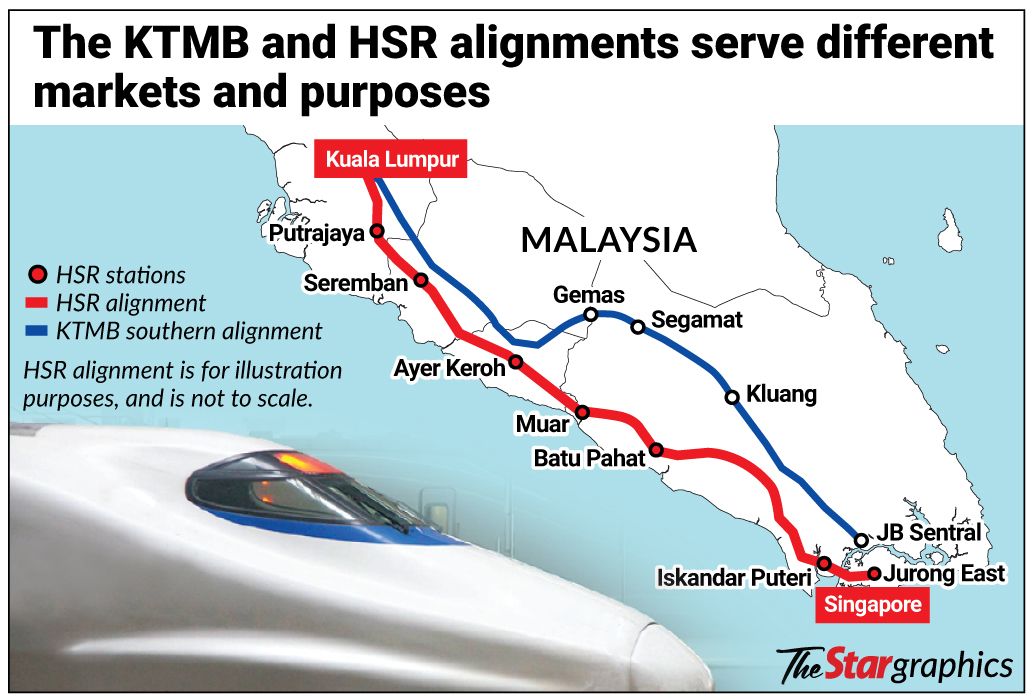
A significant limitation is the relatively dated metre-gauge alignment that was inherited from the colonial days, which sees KTMB’s southern alignment snaking through the interiors of Negri Sembilan, Melaka and Johor back in the days when moving freight was considered far more important than passengers.
The new southern ETS makes 15 stops between Kuala Lumpur and Johor Baru – including at Pulau Sebang (Tampin), Batang Melaka, Gemas, Segamat, Labis, Bekok, Paloh, Kluang, Rengam, Layang-Layang, Kulai, and Kempas Baru – before arriving at JB Sentral. This means a journey time of at least four hours and 20 minutes. This is a disappointment for those who are time-strapped, especially as the ETS is actually averaging only 76kph.
Some explain away this unsatisfactory travel duration by pointing to the Klang Valley Double Track (KVDT) rehabilitation work, which currently stretches from parts of Klang Valley to Serem-ban.
This situation is expected to last until 2029 (or later), thus locking in the “slow” journey time to JB Sentral for the next few years.
Worse, as there is practically only one single KTMB alignment, experts are already flagging other parts of the KTMB network that will need rehabilitation in the years to come, thus affecting future travel durations. For example, parts of the stretch between Seremban to Gemas were completed much earlier than the Gemas to Johor Baru stretch, with the Seremban-Sungai Gadut stretch completed in 2011, while the Sungai Gadut-Gemas stretch was completed in 2013.
Depending on the state of maintenance and the loading imposed on the tracks, these parts of the infrastructure need to be fully renewed at some point, beyond just simple maintenance. With this in mind, there is absolutely no guarantee that the ETS’s average speed will increase, while there are certainly many things that can slow it down.
Do we still need the cross-border HSR?
Some people have argued that the completion of the Gemas-Johor Baru double track, coupled with the impending completion of the Johor Baru-Singapore Rapid Transit System (RTS) Link by the end of 2026, will remove the need for the proposed Kuala Lumpur-Singapore High Speed Rail (HSR).
However, such arguments ignore the reality that any crossing into Singapore from Johor Baru will run into the massive crowd heading in and out of Johor and Singapore – making it among the world’s busiest land crossings – almost daily.