New York City is famously the birthplace of comics; it’s where the newspaper syndicates were based, where the first comic book was created and sold, and where DC, Marvel, and most of the other publishers were based for the first seven decades of the industry’s existence. It’s also where almost all superheroes live… even if they sometimes call it Metropolis or Gotham.
But the truth is that from the earliest days of comics, there was another significant location: Cleveland, Ohio. It’s where Superman is really from, and it’s also the origin point for Miles Morales, Jessica Jones, Black Lightning, American Splendor, Emmie & Friends, and many other characters, series, and creators. This is a history that’s world-famous in Cleveland, but fairly unknown everywhere else; now, however, a new 4,000-square-foot exhibition at Cleveland’s renowned Maltz Museum is dedicated to exploring and celebrating this colorful backstory.
It’s an expanded version of a traveling exhibit, JewCE: Jewish Comics Experience, which originally opened in October 2023 at the Center for Jewish History in New York and has been travelling ever since. The exhibit has been renamed Icons in Ink at the Maltz and exclusively doubled in size with a new section, “Cleveland: Home of Heroes!” It opened May 7, 2026 and runs through August 23, 2026, with a con day in July (more on that in a bit).
Full disclosure: I’m the original exhibit co-curator and new exhibit lead curator. You can read more about the original here and even watch a short documentary adaptation here.

The City of Steel
The comic book industry and its proprietary genre, superheroes, were created in the 1930s and ’40s almost entirely by first-generation American Jews, born to immigrant-refugees from Eastern Europe. Between the Great Depression and institutionalized antisemitism, they couldn’t find work, so they created an industry of their own.
New York was then home to the largest Jewish community in the world, so it only made sense for Stan Lee, Jack Kirby, Joe Simon, Bob Kane, Bill Finger, Will Eisner, Jules Feiffer, Martin Goodman, Harry Donenfeld, and so many other Golden Age pioneers to come from there. But many immigrants moved from New York to Cleveland in search of a lower cost of living and the employment opportunities of the booming industrial hub. Cleveland’s factories had earned it the nickname “City of Steel,” which would soon inspire its most famous creation: the Man of Steel.
One immigrant family that made this journey were the Siegels; another were the Shusters, who instead of New York, came to Cleveland through Toronto just across Lake Erie, where immigration laws were laxer. In 1930, 15-year-olds Jerry Siegel and Joe Shuster met in Glenville High School and became best friends. Jerry was an aspiring writer, and Joe an aspiring artist; together they created their own illustrated fanzine and comic strips. In November 1934, across one sleepless night and excited day, they came up with a new idea — Superman, the first superhero.
Cleveland celebrated this history last August when it dedicated a Superman Plaza downtown that features statues of Siegel and Shuster and a nine-and-a-half-foot Superman flying atop an eighteen-and-a-half-foot pillar. The first artifact in the Icons in Ink exhibit to welcome visitors is the original, smaller maquette for the Superman statue by famed sculptor David Deming.
The statue points to an ultra-rare copy of Famous Funnies #1 (July 1934), widely recognized as the first comic book. What can be considered the first comic art is an evolutionary question, spanning cave wall paintings to illuminated manuscripts and illustrated pulps. But the invention of comic books as a medium is credited to M.C. Gaines, an unemployed teacher and novelty salesman from the Bronx who thought to license old comic strips from the newspaper syndicates and republish them in magazine form.
Possibly together with friend Harry Wildenberg, a sales manager at Eastern Color Printing, Gaines also conceived of folding the tabloid sheets in quarters to create smaller, more economical book-size pamphlets. The result was Funnies on Parade, published May 1933, a reprint collection of strips produced by Eastern as a promotional giveaway for Procter & Gamble. Gaines then followed with the idea of selling comics on newsstands, testing the waters with Famous Funnies; it proved a smash hit, giving rise to an entire industry.
A Hero Comes Home
Siegel and Shuster famously spent four years unsuccessfully pitching their spaceman-in-spandex idea to every newspaper syndicate in the country, but it wasn’t until there was a comic book industry — and a publisher known today as DC was behind deadline and desperate for content — that Superman debuted, practically by accident, in June 1938’s Action Comics #1. Sales made Superman an instant success; while a few top-selling comics reached 200,000 copies back then, Superman sold 1.3 million. By 1941, his three titles had a combined readership of 12 million, plus a newspaper strip in 285 papers that was read by 25 million.
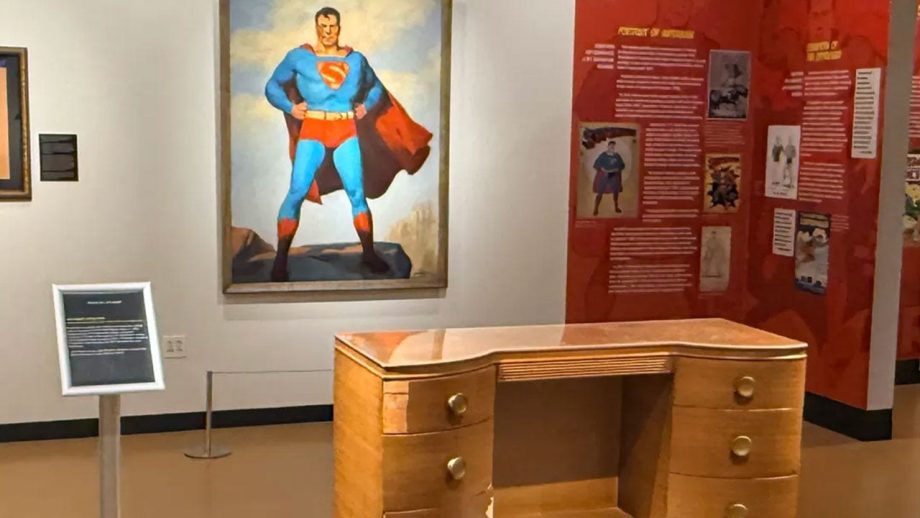
He became the first superhero to transition into other media with the immensely popular radio show, The Adventures of Superman. To promote it, DC’s co-owner, Harry Donenfeld, commissioned a life-size oil painting in 1940 to use in ads as well as display in his office. It hung there until 1957, when it mysteriously disappeared. Now one of the Maltz exhibit’s centerpieces, the portrait — originally painted by Hugh J. Ward with later reworking by Joseph Szokoli and possibly Stanley Kaye — became famous over the decades, gaining almost legendary status among fans and historians, having appeared in the background of several press articles but thought lost to history.
Read Full Article At Source