SINGAPORE – In 2013, a muster of six storks wowed a crowd of bird photographers in a flooded Seletar field. Unknown to many at the time, this was the first of many Asian openbills (Anastomus oscitans) to be recorded in Singapore.
Six years later, the storks began to descend on the city-state by the hundreds, becoming both a symptom and a driver of ecological changes here that scientists have yet to fully understand.
Flocks of the greyish-white waterbird were likely from Malaysia, where breeding colonies have established in Penang and Malacca.
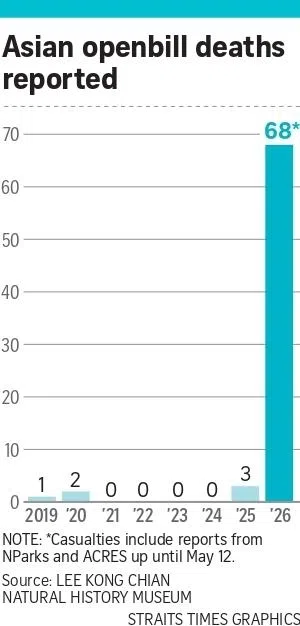
From Lim Chu Kang to Tampines, the Asian openbill is now a familiar sight in parks, in fields and – unfortunately – on the necropsy table, with their death toll rocketing to a record high in the first five months of 2026.
Bird scientists told The Straits Times that the species, named after the gap in its beak, is likely one of the fastest-spreading avian migrants in the region. They are thriving as they feed on snails that other birds shun, and are adaptable to freshwater habitats used by humans.
In Singapore, the volume of openbill carcasses in 2026 has overwhelmed the hotline run by the Republic’s only natural history museum, marking a spike from the single digits reported in previous years.
Since January, Dr Tan Yen Yi, who conducts post-mortem examinations of the birds for the NUS Lee Kong Chian Natural History Museum, has dealt with 68 dead Asian openbills from hotline reports and animal rescue groups.

Assistant senior curator of birds Tan Yen Yi holding an Asian openbill specimen collected during the past migratory bird season from 2025 and 2026.
ST PHOTO: AZMI ATHNI
The influx makes the stork the third most common carcass of an avian migrant species reported to the museum since 2020, after the blue-winged pitta and yellow-rumped flycatcher.
“It’s really quite scary to see,” said Dr Tan, the museum’s assistant senior curator of birds. “We are struggling to cope with the storage for these specimens, so I have to pick and choose to get a good representation of the birds coming through Singapore.”
Notably, all of the dead were juveniles. Dr Tan observed that the young are more likely to die, as they are less experienced with foraging for food.