In the quiet, focused month of May, the air in Singapore’s arts district carried a new, ancient resonance.
It was the martial intensity and sculptural fluidity of Odissi, an Indian classical dance form more than 2,000 years old, which found its dedicated sanctuary at the National Library Board Drama Centre Black Box on May 8.
The opening night served as a powerful testament to this vision, graced by President Tharman Shanmugaratnam as the Guest of Honor.
Bhaskar’s Arts Academy (BAA) orchestrated the country’s first-ever Odissi Festival, a multi-day spiritual and technical journey that sought to elevate a “lesser-known” tradition into a distinctive visual force within the local arts landscape.
The festival was led by Ms Indu Vijay, BAA’s resident Odissi dancer and choreographer.
Preparation for the event was rooted in the philosophy that learning must transcend the four walls of a studio.
The academy buzzed with a rhythmic confluence of activity, blending the segments of Odissi Mancha (performance) and Prashikshana (pedagogy).
Prashikshana served as a comprehensive learning platform where participants immersed themselves in the Odissi tradition through a series of intensive sessions.
Mr Rahul Acharya, a recipient of the Ustad Bismillah Khan Yuva Puraskar, led a workshop at the Nrityalaya Black Box focused on the Arabi Pallavi, which culminated in a performance by the students as the opening act on May 9.
During this period, he also presented a performance piece “Konark A Glimpse into Eternity”, while BAA hosted masterclasses where Guru Aruna Mohanty explored the lyricism of movement and the intricate art of Sanchari storytelling.
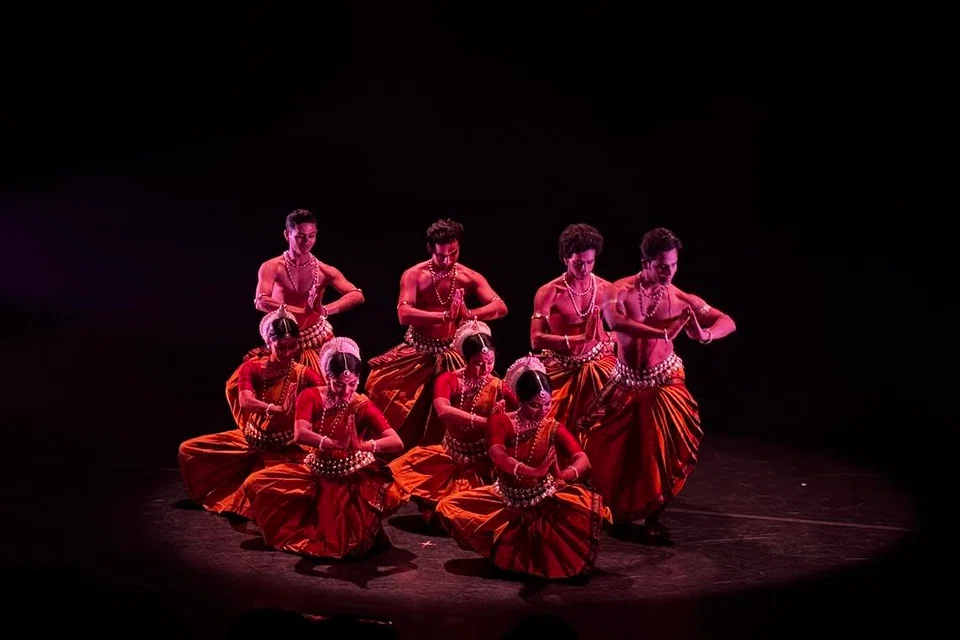
Dancers from Orissa Dance Academy.
Mr Rahul Acharya provided a guided academic study of the foundational texts that enrich the dance form.
Reflecting on the vision that drove the gruelling rehearsal schedule and the curation of international stalwarts, Ms Indu emphasised the unifying power of the craft.
“The underlying purpose, I strongly believe, of the arts is to create peace and harmony, to bind people together, to share, to spread messages of peace,” she noted, framing the festival as a bridge for a nascent community.
The spotlight fell upon 67-year-old Guru Aruna Mohanty and her troupe from the Orissa Dance Academy.
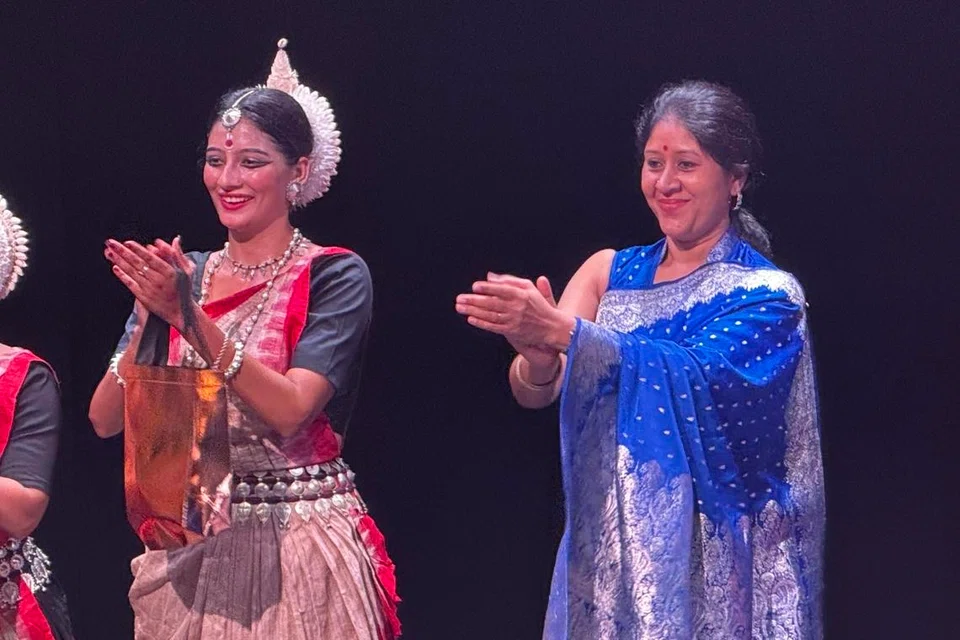
Ms Guru Aruna Mohanty (left) and Ms Indu Vijay (lady in blue saree).
Photo: Kaamini Hashwin
Their performance, Eka Prashna, was a masterclass in abhinaya (expression), where mythological themes were explored with a contemporary, “out-of-the-box” sensibility that challenged the boundaries of tradition while remaining firmly anchored in its roots.
Beyond the technical brilliance of the footwork and the silver filigree jewellery, the festival integrated a sensory showcase of Odia heritage.
In collaboration with the Odia Society Singapore, the venue was transformed into a cultural tapestry featuring Odia weaves, literature and a visual photo exhibition detailing the dance’s evolution from temple recluses to the global stage.
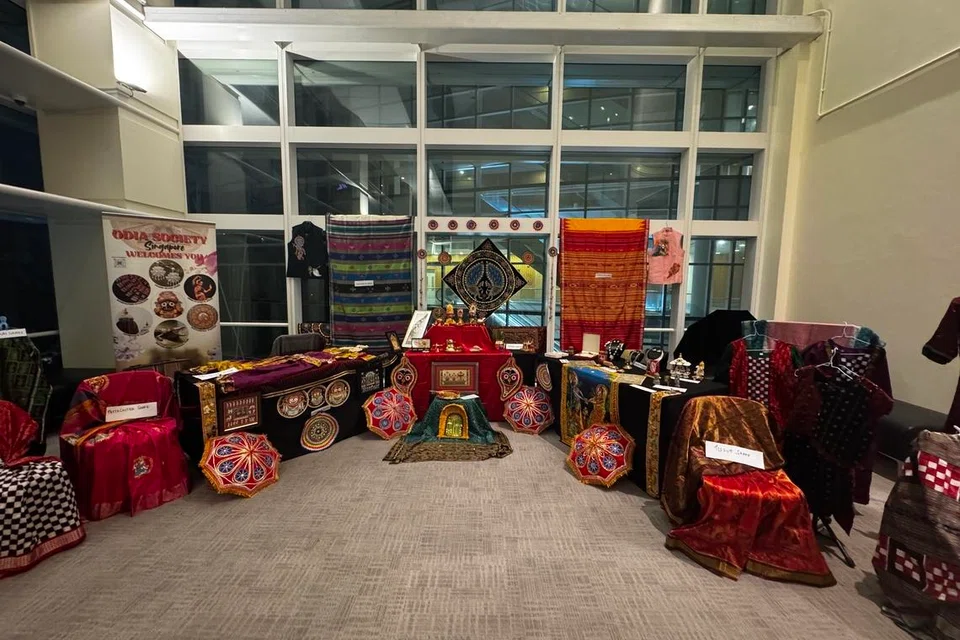
Odia weaves, literature, and a visual photo exhibition by the Odia Society Singapore.
Photo: Kaamini Hashwin
As the festival concluded, the impact was measured not just in applause, but in the positive energy brought from the soil of Odisha to Singapore.
For Guru Aruna, the journey was about more than just aesthetics; it was about the “soft power” of heritage in a fractured world.
“In this world there is so much of hatred, war, dividing people in the name of greed, let’s bring through the soft power, through the performing art, through the music, through the dance, bring peace and harmony to this world,” she said.
Audience-member Sarah Yashodha Balhetchet, 25, who is also learning Odissi, said: “It’s wonderful to see an event like this because Odissi isn’t a very common classical Indian dance style in Singapore. The dancers were incredible; their stamina and ability to perform for such a long duration was truly impressive.
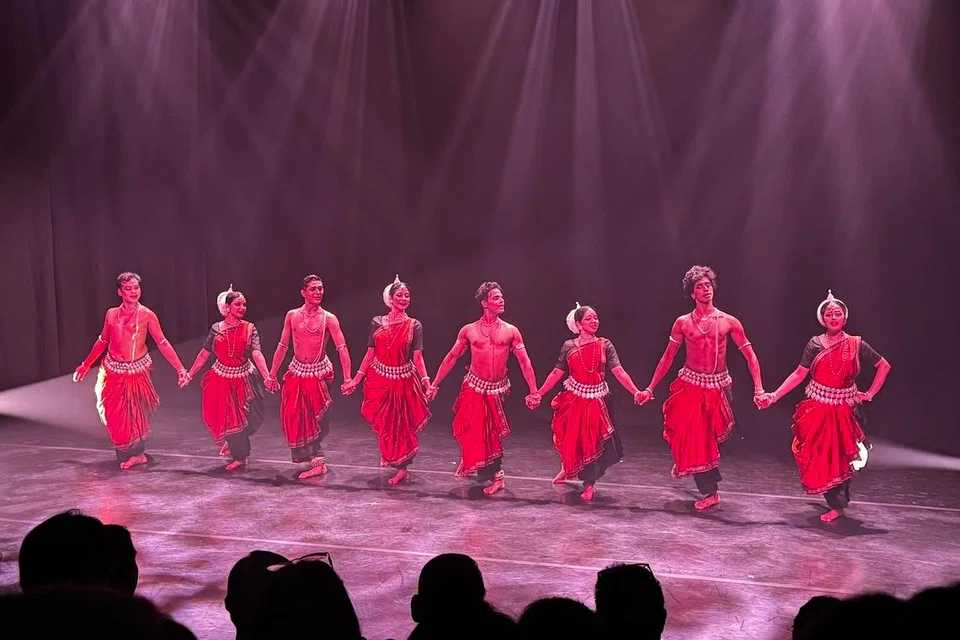
Dancers from Orissa Dance Academy.
Photo: Kaamini Hashwin
“As a dancer myself, witnessing this level of standard and quality gives me a clear goal to work towards. It’s deeply motivating and inspires me to strive for that same level of excellence in my own practice.”
The inaugural Odissi Festival did more than showcase a dance form; it established a new legacy in Singapore, proving that when artistes honour their roots, they offer the world a path towars collective tranquility.