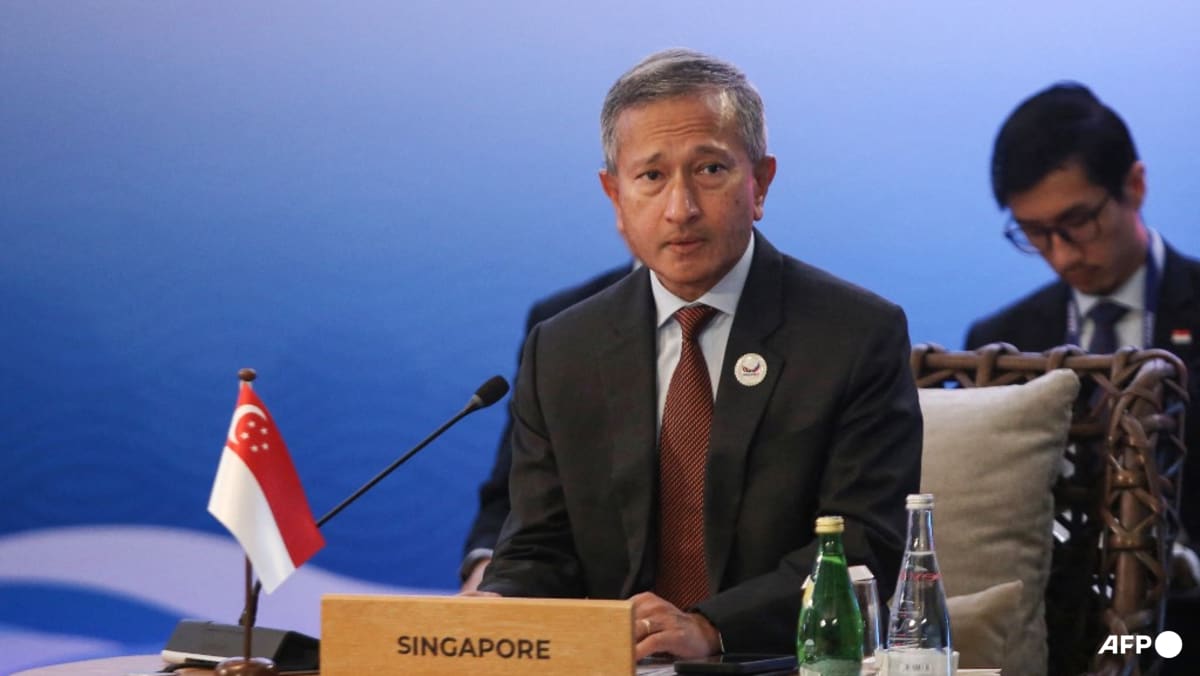
SINGAPORE: With globalisation coming under pressure and free trade links becoming dismantled, the Association of Southeast Asian Nations (ASEAN) and the European Union (EU) should be “doubling down” on their common approach to cooperation, Minister for Foreign Affairs Vivian Balakrishnan said on Wednesday (Apr 29).
“Why? Because we believe that EU, Southeast Asia, we are all still trade dependent. We all still believe in multilateralism. We still believe in the rule of law, and … that alignment creates quite (a) natural partnership,” said the minister at the European Chamber of Commerce Singapore’s annual general meeting at Amara Singapore.
“Because the rest of the world is being disrupted, globalisation is under pressure, free trade is being dismantled – it calls for even more, a doubling down of this common collective approach between the EU and Southeast Asia,” he said.
To this end, Dr Balakrishnan said Singapore recognises that Europe plays an important role in a multipolar world and advocates for greater engagement between the EU and Southeast Asia.
He noted that the EU already has a free trade agreement with Singapore and Vietnam, and has settled negotiations with Indonesia.
“Actually, what I would like, would be to accelerate an EU-ASEAN free trade agreement,” he said.
Earlier discussions of a regional pact between the two blocs initially failed to make inroads, but have since resumed with the EU striking bilateral deals with individual ASEAN members while negotiations continue.
Beyond a free trade pact with ASEAN, Dr Balakrishnan said Singapore would also like to push for a dialogue, partnership or “something even more ambitious” between the EU and the Comprehensive and Progressive Agreement for Trans-Pacific Partnership (CPTPP).
The CPTPP is a free trade agreement with 12 economies: Australia, Brunei, Canada, Chile, Japan, Malaysia, Mexico, New Zealand, Peru, Singapore, the United Kingdom and Vietnam.