ChatGPT Health: OpenAI’s AI health and wellness assistant

ChatGPT Health: OpenAI’s AI health and wellness assistant


  1. 1. How does ChatGPT Health work?
  2. 2. How was ChatGPT Health developed?
  3. 3. How do I get and use ChatGPT Health?

Did you know that 230 million people across the world ask health and wellness-related questions on ChatGPT per week? That’s a lot of tokens spent on asking if one can eat meat from a chicken while having a cough.

To create a better user experience, OpenAI has developed and released ChatGPT Health, which is your typical ChatGPT but only for health and wellness conversations.

How does ChatGPT Health work?

Naturally, matters of health and medicine are highly regulated across many territories, and an AI assistant like ChatGPT Health dispensing nuggets like these would come under intense scrutiny.
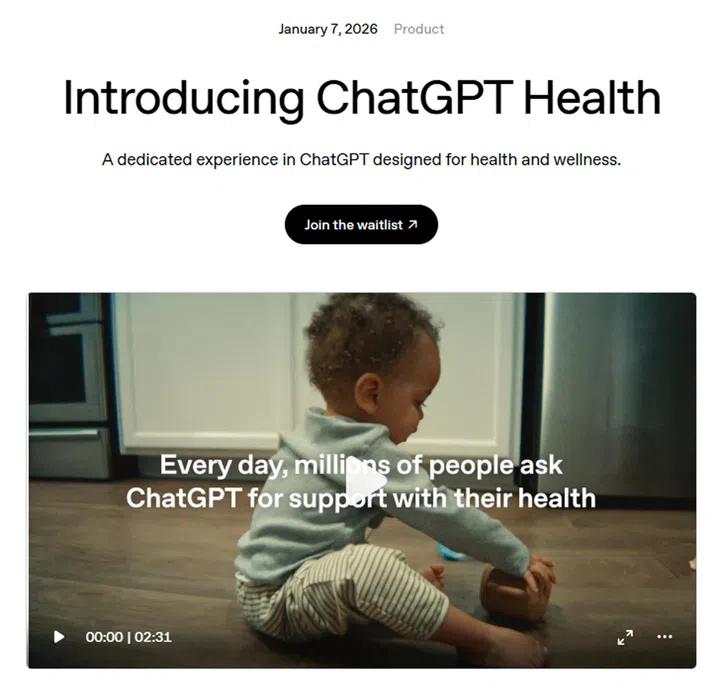
Launch of ChatGPT Health

ChatGPT Health sign-up page.

Screenshot: HWZ

According to OpenAI, ChatGPT Health’s responses do not replace professional medical care, diagnosis, or treatment; it’s designed to support health-related queries and provide further clarity. One example is it helps people ask the right questions when they get the chance to speak to an actual healthcare provider. Another example is to help you spot patterns in your health journey (and, if anything, that’s what the current state of AI does well, which is to recognise patterns more than badminton).

The AI’s responses are based on your existing private health data. OpenAI said that ChatGPT Health can be connected to health records and wellness apps, listing down examples like Apple Health, Function, MyFitnessPal, as well as medical records, files, reports, and even your insurance coverage to get a fuller picture on your preparedness and health posture. Explicit user permission is required for such connections. Also, app integration isn’t new to ChatGPT.

Also, ChatGPT Health is presented separately from the rest of your ChatGPT conversations. Medical records, connected health app data, and its resulting AI memories are separate from the rest of ChatGPT, while the generated information all stays within the Health sub-category. 

It is, however, capable of taking information from your non-Health ChatGPT conversations where relevant (OpenAI gave the example of moving to a new place or a shift in lifestyle). The crucial detail here is that other information can go in to ChatGPT Health, but not out of it to other parts of ChatGPT’s ecosystem.

There’s also the option to enable multi-factor authentication if you want to add extra layers of verification for access.

In the US, ChatGPT Health is partnered with b.well, a health data privacy provider. 

How was ChatGPT Health developed?

Launch of ChatGPT Health

ChatGPT Health isn’t a doctor, but it can help you ask smarter questions when you finally see one.

Stock Photo: Maxime on Unsplash

OpenAI claimed that it worked with 260 physicians in 60 countries to narrow the distinction between helpful and harmful health questions. 

These 260 individuals provided feedback on model outputs across 30 areas of focus, over 600,000 times.

The exact names and fields of expertise of these physicians are not publicly available.

How do I get and use ChatGPT Health?

At launch, OpenAI is providing it free to ChatGPT Free, Go, Plus, and Pro users outside of the European Economic Area, Switzerland, and the United Kingdom. 

However, there is a registration waitlist, which requires signing up before getting access to the service.

OpenAI plans to expand Health to all ChatGPT users, via web and via the iOS app, in “the coming weeks”.

Source: OpenAI


Read Full Article At Source