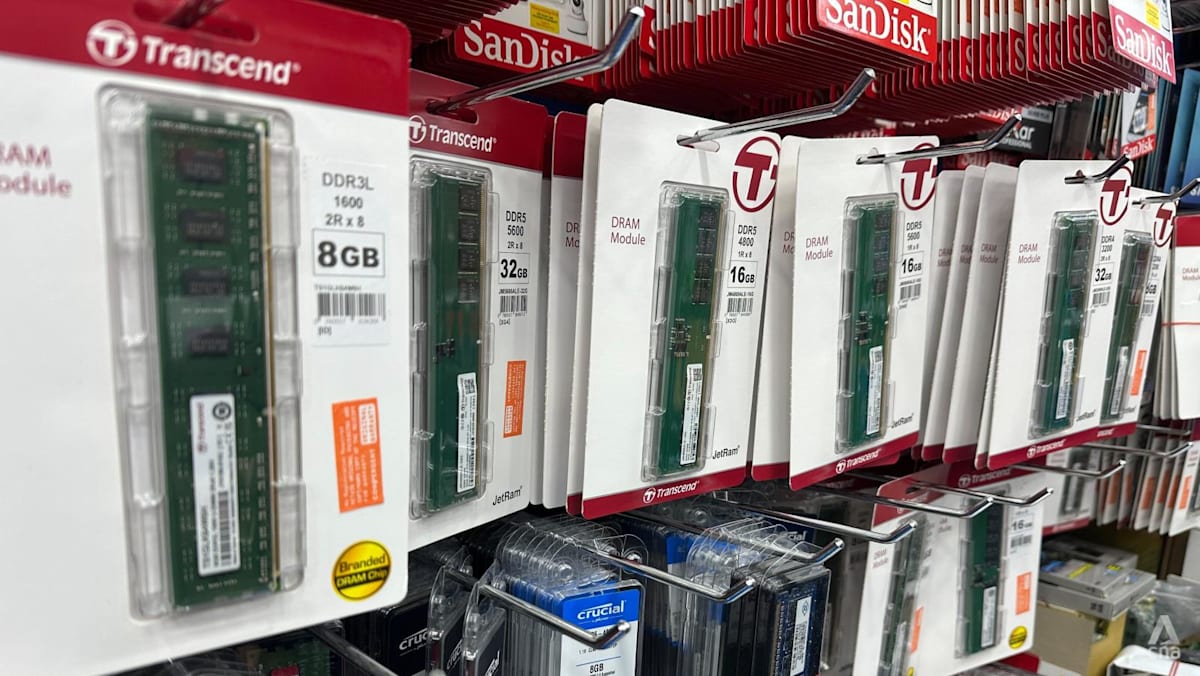
SINGAPORE: Behind a retail counter at Sim Lim Square, Mr Abdul Bari has been seeing memory chip prices being marked up in a way that he has never seen before.
As recently as a month ago, some brands of random access memory (RAM) chips – electronic components that are fundamental parts of modern computing – were upped by eye-watering amounts in a single price adjustment, said Mr Abdul, a store-in-charge who works for computer retailer Dynacore Technologies.
A 32GB RAM chip that would have cost less than S$200 just about a month and a half back, now costs between S$600 to S$700, which the store manager said is the highest it has ever been.
Because of this, customers are holding back on buying new computers or upgrading existing ones, with several Sim Lim Square retailers telling CNA that they are making significant losses.
Such a price spike has “never happened before”, said Mr Abdul, who has been in this line for over a decade.
Essentially, RAM is what computers use for short-term memory storage. It is necessary to run the device’s operating system and applications efficiently and has an impact on the computers’ processing speed.
The reason for unprecedented price increases in recent months is twofold. Artificial intelligence (AI) has fuelled a surge in demand for silicon of all varieties, and chip manufacturers have responded in kind by limiting consumer supply and redirecting production capacity to AI chips that have higher profit margins.
Amid the supply crunch, electronics makers are rushing to stockpile chips to meet their production needs, major outlets including Bloomberg and Nikkei Asia.
This, said those in the industry, is the other side of the AI boom that led to Singapore’s unexpected economic boost at the tail end of 2025.
In his New Year’s message, Prime Minister Lawrence Wong said Singapore benefited from the surge in demand for semiconductors and electronics driven by the AI boom.
As a result, the manufacturing sector expanded by 15 per cent in the fourth quarter of 2025 alone.
RECORD HIGHS
Retailers here told CNA that the prices of RAM units have surged to record highs, impacting their earnings and changing customers’ purchase habits.
Demand for higher capacity versions, like DDR5, have seen manufacturers Samsung, SK Hynix and Micron — who account for over 90 per cent of the RAM market — pivot towards that space, a move which is more profitable, but limits supply for regular computer users.
US memory giant Micron produces about 98 per cent of its top-end flash memory chips in Singapore.
At Computer Safari, chief executive Tanveer Ahmad said that prices have surged across all memory segments, regardless of the type of RAM. His shop sells the older DDR4 version.
Three weeks ago, a 32GB unit cost around S$65. It is now S$160, which is around a three times increase, noted Mr Ahmad.
While such price movements happen seasonally, this year’s spike is exceptionally high, he noted.
Agreeing with Mr Abdul from Dynacore, Mr Ahmad said this hike has been the worst in his experience as a computer retailer for two decades.
Likewise, a manager at Bizgram Asia told CNA that RAM prices have risen almost 400 per cent over the past month, with 32GB units now going for S$600, 64GB ones for S$1,399 and the massive 128GB units at S$2,699.