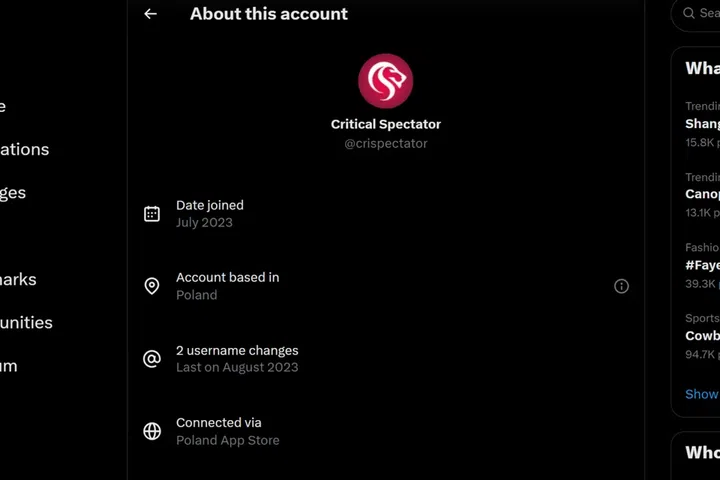
On Nov 23, social media platform X rolled out a new feature that makes the public aware where an account is based.
It sparked a firestorm in the US and around the world, with concerns raised about potential foreign interference.
Among other things, the new “About This Account” feature showed that many accounts which were supposedly American were operating from countries such as India or Nigeria
Some of these accounts have hundreds of thousands of followers, with many posting about domestic policies.
One of them, @TRUMP_ARMY_, with almost 600,000 followers, commented extensively on things like immigration, with one post in 2024 calling illegal immigration the greatest threat to the US.
After being revealed to be operating from India, the account quickly changed tack, positioning itself as “an Indian who loves America, President Trump, Musk!”.
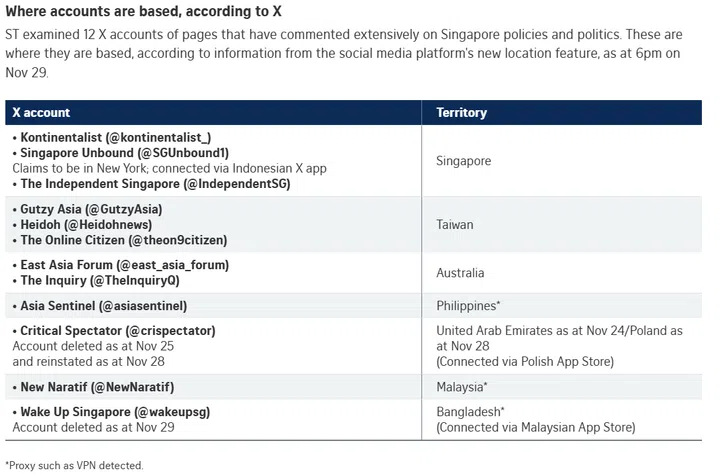
The Straits Times examined 12 X accounts of pages that have commented frequently on Singapore’s policies and politics, and found that most of them appeared to be based elsewhere.
One account, by the Critical Spectator, was found to be based in the United Arab Emirates and was deleted shortly after the release of the new feature.
The feature was first announced by X product head Nikita Bier on Oct 15.
He said it aims to reduce inauthentic engagement on the platform by exposing these details.
This allows users to make a more informed decision about whether they are interacting with a bad actor that may be trying to incite tensions or spread misinformation.
“This is an important first step to securing the integrity of the global town square,” he said.
“We plan to provide many more ways for users to verify the authenticity of the content they see on X.”
Accounts with grey check marks, indicating that they belong to a government organisation or official, or a multilateral organisation, are exempted from having their locations displayed, he added.
While Mr Bier described the accuracy as being “nearly 99.99 per cent”, X did not provide any information as to which data sources it pulls from to pinpoint a user’s location.
There have been some disparities between where users claim to be and the location data provided by X. This has led to accusations of deception, with some users being accused of being foreign agents.
Mr Oleg Ishanov, the director of threat research at cyber-security firm Acronis, said that although the platform can make an educated guess, the process is not completely foolproof.
He explained that tech platforms tap a number of data points, including a user’s IP address and which country’s app store an app was downloaded from, to derive the user’s location.
This is reasonably accurate, but not 100 per cent, he told ST.
Factors such as a user travelling outside the country or the use of a virtual private network (VPN) may affect the location shown.