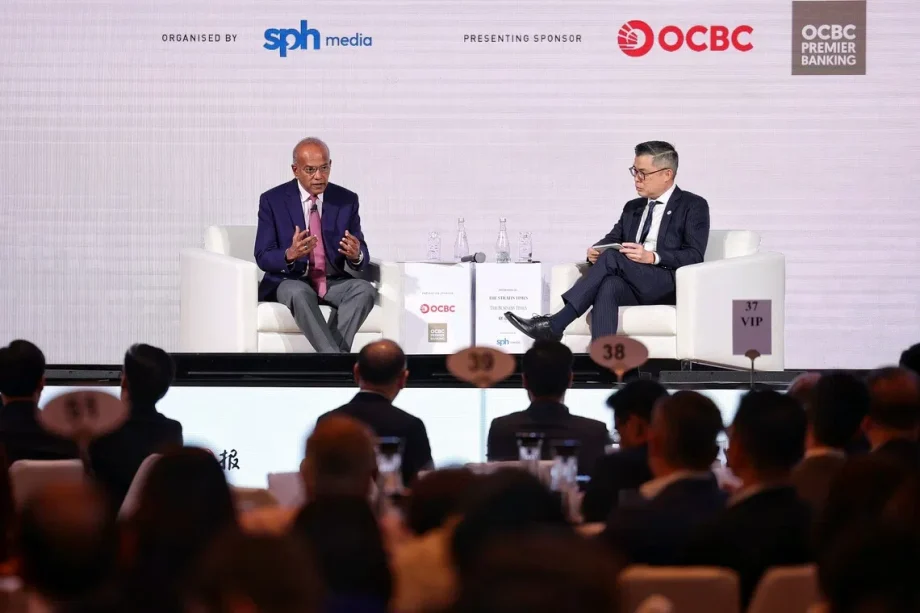
SINGAPORE – Wars abroad and foreign influence have always had an impact on domestic politics, but a more interconnected world means it has become ever harder to keep a society like Singapore cohesive, said Coordinating Minister for National Security K. Shanmugam.
While views may differ depending on one’s race or religion, today’s technology can give rise to a multiplicity of viewpoints catering to narrow segments, and a fair bit of misinformation on every conflict, he said.
Foreign governments who want to intervene in another country’s affairs can also target that country’s population and exploit existing fault lines more easily, he added.
the Asia Future Summit
on Oct 9, Mr Shanmugam raised the examples of how the Gaza conflict and the Russia-Ukraine war have been viewed differently by various communities here.
Surveys have shown that Muslims are more affected than other Singaporeans by the Gaza conflict, while a significant number of Chinese Singaporeans – especially those who are older – hold the view that Ukraine is at fault in the Russia-Ukraine war, he noted.
Having a highly literate and online population in Singapore means people here have access to both information and misinformation, and information wars that do not necessarily target Singapore could risk being played out in the city-state, he added at the dialogue, which was moderated by Straits Times editor Jaime Ho.
The Asia Future Summit was jointly presented by SPH Media flagship titles The Straits Times, Lianhe Zaobao and The Business Times, with OCBC Bank as the presenting sponsor.
While Singaporeans’ positions on these conflicts abroad are partly based on the information they consume from sources, racial and religious ties are also a factor, said Mr Shanmugam.
“These are deep-seated human emotions,” he said. “They are not going to be diluted significantly by 60 years of nation building.”
But there are “antidotes” to these threats, which include continuously building bonds between people; a credible government that delivers; and a trusted mainstream media, said Mr Shanmugam, who is also Minister for Home Affairs.
Cynicism and a willingness to believe in conspiracy theories are closely linked to a lack of trust in one’s government to deliver, he said.
He cited the example of Britain, where the murder of three young children in July 2024 led to widespread anti-immigrant protests owing to
misinformation on social media
that the attacker was a Muslim and an immigrant.
This occurred partly because Britain’s political system today faces challenges in dealing with basic issues like public safety, the housing shortage and healthcare needs.
It has also been taken over by an ideology that allows for hate speech under the guise of free speech, said Mr Shanmugam.
“You have that as a framework for your government… you get lawlessness, you get riots, you get racial attacks, religious attacks,” he said. “You get cynicism, loss of trust, and this is not just the UK – it’s across Europe and the US.”