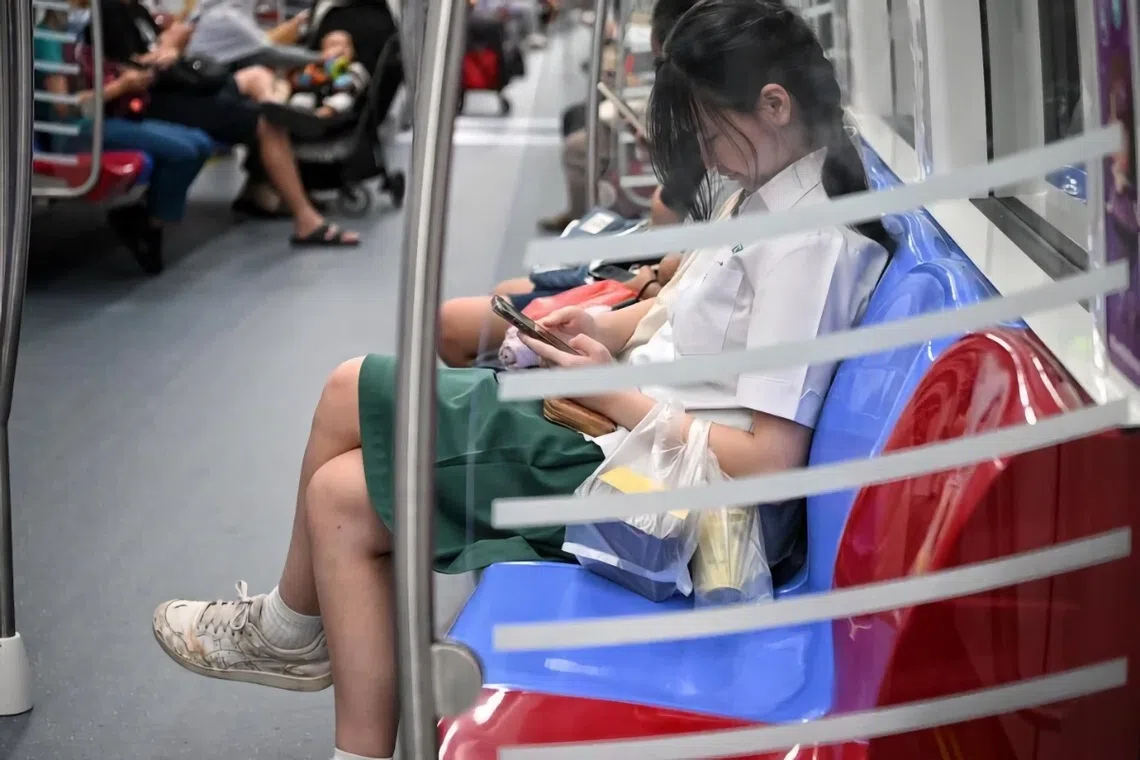
From January 2026, secondary school students will not be allowed to use smartphones and smartwatches outside of lesson time, such as during recess and co-curricular activities (CCAs), as part of tightened guidelines on screen use.
Currently, they are limited in their use of these devices only during regular lesson time.
The new tightened guidelines, which will also cover supplementary, enrichment and remedial lessons, align with the restrictions put in place for primary school pupils since January 2025.
The revised guidelines by the Ministry of Education (MOE) are part of a series of initiatives announced on Nov 30 to help children and their parents develop healthy digital habits.
MOE said in a statement that students’ devices will have to be kept in designated storage areas such as lockers or in their school bags during school hours.
Smartwatches fall under the guidelines as they enable communication through messaging and access to apps including social media, which can lead to distractions, passive screen use and reduced interaction with peers, it added.
“Where necessary, schools may allow students to use smartphones by exception,” the ministry said.
A ministry spokesman said some secondary schools had adopted these tighter guidelines after they were announced for primary schools, with positive outcomes. These included improved student well-being, enhanced focus, and more physical interaction during unstructured time such as breaks.
MOE said it also would bring forward the default time that personal learning devices are locked nightly to 10.30pm, from the current 11pm. This will kick in from January, meaning the devices will be on sleep mode nightly from 10.30pm to 6.30am.
“This can help students to manage device use before bedtime, and nudge them to sleep earlier,” it said.
Since 2021, secondary school students have had their own personal learning devices, which are school-sanctioned tablets or laptops – mostly iPads or Chromebooks.
Each personal learning device has a device management application installed on it, which allows schools to block access to undesirable internet content, such as pornography and gambling, and set screen time limits.
Outside of school hours, parents can opt for their child’s personal learning device to either keep to default management application settings, operate on modified settings, or disable the application entirely, which means the devices’ default screen time limits can be relaxed.