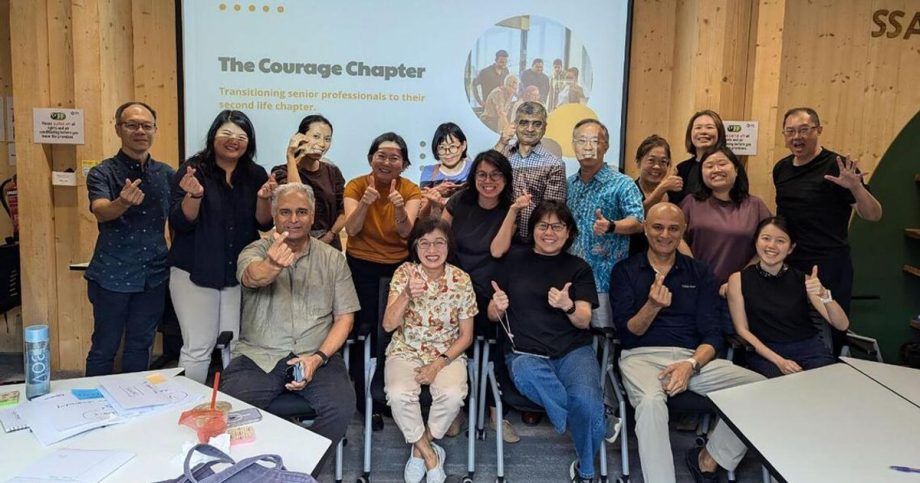
At 26, Lim Kai Ning was told by a senior colleague in South Korea that she was the best human resources business partner he had worked with.
Yet, he dismissed another colleague of her age as “too young”, unaware of Kai Ning’s age.
The contradiction showed her how easily assumptions could limit someone’s potential. Watching a Vietnamese colleague speak her mind in Seoul’s hierarchical workplace encouraged Kai Ning to do the same, revealing a more confident side of herself.
For Anni Cai, studying at Harvard and working at investment firms Blackstone and General Catalyst in the United States gave her exposure to different perspectives, global ambitions and a greater appetite for risk.
Lye Junxu absorbed Silicon Valley’s entrepreneurial energy, while Tor Cheng Yao spent years mastering traditional shoemaking in Japan.
Their experience abroad broadened their sense of what was possible but they opted to return – encouraged by the chance to be near their family, Singapore’s work culture, and opportunities, as well as the certainty here, compared with relatively more fluid situations elsewhere.
Anni and Cheng Yao wanted to be near family; Kai Ning had always viewed her Korean posting as temporary; Junxu wanted to raise his children here.
Coming home involved trade-offs but confidence and hope in the opportunities here, and faith in being able to work with people and professionals as well as policies and systems in place, made them optimistic.
Junxu acknowledges that Silicon Valley offers richer opportunities, particularly in artificial intelligence (AI), while Cheng Yao found few suppliers or trained workers to support his craft in Singapore.
Yet, like the other two, they found the chance to start something of their own, let their passions flourish to improve people’s lives and contribute, in their own way, to changing times in the Republic’s evolving horizons – not an easy task, given the country’s exposure to technological and geopolitical upheaval.
The country’s safety, efficient institutions, reliable infrastructure and personal networks can provide the foundation to take chances, the four agree.
Making experience count
Seoul changed Kai Ning’s thinking about money and success, but also about the assumptions people make about age and ability.
Having found the confidence to speak up and challenge her own limitations, she returned to Singapore wanting to help mid-career professionals struggling to find their next chapter.
She believes growing older should not mean fewer opportunities to contribute.
In 2023, she co-founded The Courage Chapter in Singapore.
Today, its community has about 1,500 professionals, and it has placed more than 100 PMETs aged 40 and above in jobs and projects.
Initially, Kai Ning thought convincing employers to hire experienced workers would be enough, but she soon realised that job seekers also needed to demonstrate their capabilities, while companies had to look beyond conventional job descriptions.
The Courage Chapter works on both fronts, helping employers create flexible, skills-based roles rather than judging candidates by age or conventional career paths.
Through Prudential’s PRUPrime initiative, professionals are recruited for their skills rather than a specific position, receiving a retainer between deployments while the insurer draws on their expertise as needed.
More than 20 members had secured retainer projects by May 2026.
Another approach involves three-month trial assignments in social services.
Corporate professionals can apply existing skills, such as business development or finance, to charities, while employers assess their suitability before considering permanent positions.
Tan Mei Yee, in her 40s, joined the PRUPrime pilot initiative more than a year after leaving the pharmaceutical industry.
She says her experience taught her that a career break and ageism do not erase her capability and experience.
“I didn’t doubt my ability to contribute. What I needed was an opportunity to prove it. The programme gave me that, including in an industry and function different from my past experience. It showed that transferable skills and experience still carry real value,” Tan says.


Read Full Article At Source