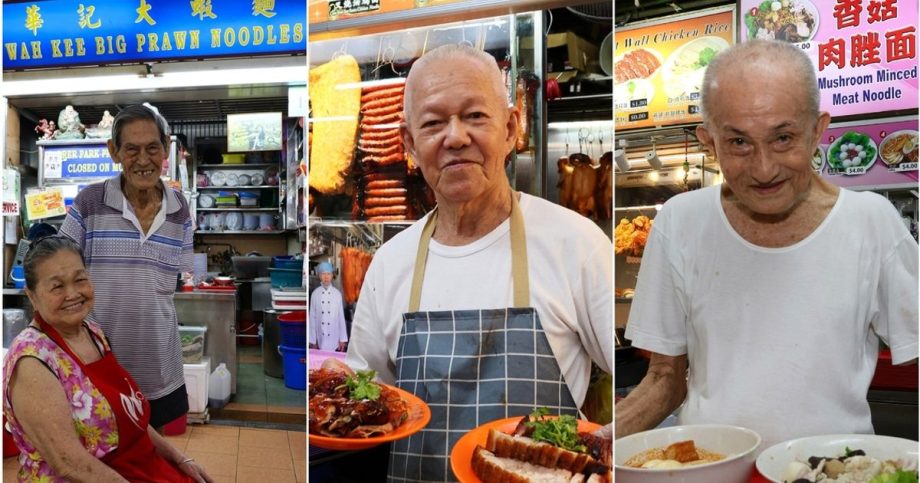
Working in their 80s: Singapore hawkers refuse to retire

Working in their 80s: Singapore hawkers refuse to retire


SINGAPORE – They are well past 80, but have no plans to call it a day.

At Pek Kio Market & Food Centre, veteran hawker Lau Fook Wah, 84, and his wife, Tham Lay Mon, 81, begin work at 5am, five days a week. The couple prepare the signature prawn broth at their stall, Wah Kee Big Prawn Noodles, and finish work about 12 hours later.

At Toa Payoh Central, 88-year-old Lee Siong Kun is more sprightly than his frail figure suggests. He moves briskly around his stall, Mushroom Minced Meat Noodle, slicing fishcake and hauling bags of ingredients from a freezer at the front of his stall to the preparation area inside his stall.

Cho Siew Wan, 86, takes a 45-minute bus ride almost daily from his home in Ang Mo Kio to People’s Park Food Centre, where he works as head roast master at 116 Shao La. His sole day off is Monday once a month as the stall is short-handed.

Well past retirement age, these hawkers continue to put in long hours at physically demanding jobs that easily exhaust those half their age.

It is not for want of money, they say. So what makes them toil behind hot stoves instead of spending their golden years taking it easy?

The Straits Times speaks to four octogenarian hawkers about why they find it so hard to walk away. 

Not ready to give up: 88-year-old Lee Siong Kun

Lee Siong Kun, 88, pivoted to selling mushroom minced meat noodles when selling prawn noodle resulted in losses.

Lee Siong Kun, 88, pivoted to selling mushroom minced meat noodles when selling prawn noodle resulted in losses.

ST PHOTO: HEDY KHOO

Mushroom Minced Meat Noodle
Where: 01-316, 183 Food Court, 183 Toa Payoh Central
Open: 10am to 3pm, 5pm to 7pm daily (no fixed day off)

Despite losing a few thousand dollars and not being able to pay himself a salary for three months after setting up a prawn noodle stall at 183 Food Court in Toa Payoh Central in June, 88-year-old Lee Siong Kun is not throwing in the towel.

On Oct 1, he overhauled his menu and signboard, pivoting to selling mushroom minced meat noodles and fishball noodles. The only item he kept from his original menu was laksa.

Lee prepares his laksa using premium rempah.

Lee prepares his laksa using premium rempah.

ST PHOTO: HEDY KHOO

With monthly operating costs of about $4,500, including $3,800 in rent, Lee could no longer afford to continue selling pork rib prawn noodles and bak kut teh due to the higher cost of ingredients. 

Prawns cost $16 a kg and pork ribs $8 a kg. By switching to dishes which cost less to prepare, he was able to pay himself $1,000 at the end of October. 

The widower, who lives alone in a flat in Toa Payoh Lorong 8, is realistic about how much he can make running a noodle stall. 

Minced Meat Mushroom Fishball Noodle.

Minced Meat Mushroom Fishball Noodle.

ST PHOTO: HEDY KHOO

But between earning a meagre wage and staying home with nothing much to do, he prefers to work daily.

“Staying at home is torture. It’s harder than working,” says Lee in Mandarin. His wife died years ago. His two daughters, who have their own families, visit occasionally. He has three grandchildren.

Most of his friends have died, as have his two younger sisters and younger brother.

Before starting his current stall, he spent much of his time watching television. He has little interest in mobile phone games or social media.

He would rather work than go window-shopping or sit around at coffee shops. “At home, I feel very bored. I want to work. Time passes faster,” he says.

His daughters are supportive and chipped in about $20,000 to help him set up the stall and arranged for the change of signboards when he decided to change his concept. 

Better than staying home

Every morning, he takes a 20-minute bus ride to work, arriving at 8am, two hours before opening.

He marinates pork, boils stock, prepares minced meat and braises mushrooms.

As he works alone, he keeps his menu to four manageable items: Mushroom Minced Meat Fishball Noodle ($5), Fishball Noodle Soup or Dry ($4), Fishball Soup ($4) and Laksa ($4).

Fishball Soup.

Fishball Soup.

ST PHOTO: HEDY KHOO

During the break between lunch and dinner, he slices fishcake, packs ingredients and washes dishes.

He cannot afford an assistant, which would cost $80 to $100 a day. But he insists he does not find the work tiring.

“I want freedom. I can do as I please,” he says. He operates his stall daily, taking a day off only when he feels tired.

Lee prepares all the ingredients on his own.

Lee prepares all the ingredients on his own.

ST PHOTO: HEDY KHOO

Seven decades in the trade

Lee has been working since he was 17, after his mother died. His late father was a gardener and he had to help support three younger siblings.

He started as an economy rice stall assistant, earning just $30 a month, and later learnt to prepare bak chor mee, braised duck rice and other dishes.

Over the decades, he has operated stalls in Whampoa, ITE College Central in Ang Mo Kio and Old Airport Road Food Centre.

He closed his Old Airport Road stall in April 2025 because of poor business and decided to retire at age 87. But he felt restless at home.

He acknowledges he had not expected running the stall himself to be so tough. “When I was a hawker before, business was easier. The competition was not so keen. Now, the market is saturated and diners have no lack of options.”

Though not a chatty person, he enjoys the interactions he has with customers and fellow tenants at the coffee shop. He says he has no plans to retire, although he will close the stall if it becomes financially unsustainable.

“I don’t feel lonely when I am at work,” he says. “Just be happy and content. In life, it is important to be happy.”

‘What retirement?’: Lau Fook Wah, 84, and Tham Lay Mon, 81

Lau Fook Wah (right) and his wife Tham Lay Mon, run Wah Kee Big Prawn Noodles at Pek Kio Market & Food Centre.

Lau Fook Wah (right) and his wife Tham Lay Mon, run Wah Kee Big Prawn Noodles at Pek Kio Market & Food Centre.

ST PHOTO: HEDY KHOO

Wah Kee Big Prawn Noodles
Where: 01-15 Pek Kio Market & Food Centre, 41A Cambridge Road
Open: 9am to 2pm, Wednesdays to Fridays; 9am to noon, Saturdays and Sundays. Closed on Mondays and Tuesdays
Tel: 9688-3633 

“We don’t look after grandchildren,” expels Lau Fook Wah, 84, unprompted at the start of the interview.

He and his wife, Tham Lay Mon, 81, would rather run Wah Kee Big Prawn Noodles at Pek Kio Market & Food Centre than mind their grandchildren.

Five days a week, they are on their feet for about 12 hours. They start at 5am, preparing the prawn broth and other ingredients before opening at 9am. After the lunch rush, there are dishes to wash, and shallots and pork lard to fry.

“Retirement is not on my mind,” declares Lau. “What retirement?”

The couple have three sons, who give them monthly allowances. But they prefer earning their own keep. As for how many grandchildren they have, Tham says: “Four to five, we don’t count.”

Lau says staying busy keeps them mobile. “Now that we are elderly, we need to keep active or we will lose our mobility. As hawkers, we are used to keeping active with physical labour.”

When Wah Kee stayed shut for five months earlier in 2026, customers got worried something had happened or they had retired.

Regulars often call ahead to place advanced orders for the stall’s famed big prawn noodles.

Regulars often call ahead to place advanced orders for the stall’s famed big prawn noodles.

ST PHOTO: HEDY KHOO

The stall usually closes for about four weeks around Chinese New Year because prawn prices rocket then and the couple refuse to raise their prices. In 2026, however, Tham needed cataract surgery, so the break stretched from February to June.

At the stall, the couple work in sync. Lau cooks the prawn stock and handles the seafood. Tham takes orders, cooks noodles and dresses them with lashings of fried shallots, pork lard and shallot oil.

Lau and Tham work in sync.

Lau and Tham work in sync.

ST PHOTO: HEDY KHOO

Heritage hawker

They have done it this way for decades. The business began in 1951, when Lau’s father peddled prawn noodles from a pushcart along Rangoon Road. Lau helped as a schoolboy and took over in 1971. The couple began working together at Farrer Park food centre in 1980 and moved to Pek Kio in 1997.

It was in 1980 that Lau overhauled his father’s recipes, omitting pork in the stock in favour of seafood and introducing large wild-caught prawns.

Tham may be brusque at times, but she has a caring side and a soft spot for elderly customers.

Tham may be brusque at times, but she has a caring side and a soft spot for elderly customers.

ST PHOTO: HEDY KHOO

But Wah Kee’s longstanding reputation is not without controversy. Its Google rating is a dismal 2.9 stars, with multiple complaints about high prices and Tham’s brusque manner.

She often tells customers to move away from the wet floor in front of the stall. What some take for rudeness is her worry that someone, particularly a pregnant woman, may slip or get splashed with hot soup.

Tham takes care to serve elderly customers at their table.

Tham takes care to serve elderly customers at their table.

ST PHOTO: HEDY KHOO

Prices on the menu range from $5 to $25, but regulars order off-menu bowls costing $30 or more for larger, wild-caught prawns. The biggest can cost $50 a serving.

Lau says the $5 bowls, sometimes reported as unavailable, are reserved in limited quantities for elderly residents unable to afford pricier meals. They need only nod at the couple to have their orders prepared.

A $25 bowl of prawn noodles dry at Wah Kee Big Prawn Noodles at Pek Kio Market & Food Centre.

A $25 bowl of prawn noodles dry at Wah Kee Big Prawn Noodles at Pek Kio Market & Food Centre.

ST PHOTO: HEDY KHOO

Tham insists those with mobility problems sit down, while she serves them. Sometimes, the couple treat residents who live nearby and who cannot pay.

“Not everything is about money,” says Lau.

Lau prepares the prawns to order.

Lau prepares the prawns to order.

ST PHOTO: HEDY KHOO

His face softens when he speaks of Tham. People do not realise she has a kind heart, he says. Every Chinese New Year, she gives generously to charities, including orphanages and homes for the elderly.

His seafood-based broth contains no pork, but he will not disclose the ingredients. Even the pork lard is fried fresh in small batches. On Tuesdays, his day off, he returns to the stall to prepare it.

The broth is made from prawn heads and seafood.

The broth is made from prawn heads and seafood.

ST PHOTO: HEDY KHOO

‘We are not tycoons’

Despite the high prices, the couple maintain they are not rich as ingredient costs are high. They still live in the four-room HDB flat they moved into in 1997 near the market. Asked if he owns other properties, Lau laughs and shakes his head.

Despite undergoing surgery for a blocked carotid artery about a decade ago, Lau still relishes working. Tham, too, carried on after a fall some years back.

They enjoy recognising regulars and know their orders by heart – the type of noodle they want, more chilli or no chilli.

Some first visited as children and now bring their own, says Lau with pride in his voice. 

But he no longer sees any need to rush. “Even if I sell one more bowl, I can’t get rich,” he says.

He adds that both him and his wife are happiest when they can work at their own pace, without worrying about having nothing to do.

“If we retire, it is just TV or sleep,” he says. “Working means the days pass quickly.”

‘If I don’t work, life has no meaning’: Cho Siew Wan, 86

Roast master Cho Siew Wan is 86 years old and has no intention to retire.

Roast master Cho Siew Wan is 86 years old and has no intention to retire.

ST PHOTO: HEDY KHOO

116 Shao La
Where: 01-1092 People’s Park Food Centre, 32 New Market Road
Open: 7am to 9pm daily

Roast master Cho Siew Wan keeps a hawkish watch over the fire when roasting pork belly. Too much heat and the meat can burn, ruining the much-prized crackling and resulting in meat with a tough texture.

The 86-year-old learnt this as a teenager, after he spent two years mastering the art of roasting under his father, a Cantonese roast meat hawker who came to Singapore from Hong Kong. 

Seven decades later, Cho still follows his father’s recipes at 116 Shao La in People’s Park Food Centre, where he has been head roast master since July 2024.

“All my recipes are in my head. And fingertips,” he says, switching between Mandarin and Cantonese effortlessly.

His day begins at 4am in his rental flat in Ang Mo Kio. He makes coffee, eats bread, prays to Guan Yin and does laundry before catching a bus to Chinatown.

By 6.30am, he is at work. Each day, he prepares and roasts about 80kg of pork for char siew, roast pork belly and barbecue spare ribs, as well as 15 chickens and 18 to 20 ducks.

He cuts and marinates the meats himself, keeping a close watch over the fire.

Cho works his way through preparing some 80kg of meat daily.

Cho works his way through preparing some 80kg of meat daily.

ST PHOTO: HEDY KHOO

Hectic schedule

He finishes roasting around noon, but there is no time to put his feet up. He takes a quick midday meal of economy beehoon with cabbage, then spends the afternoon preparing the next day’s ingredients, slicing pork belly and pork collar, and cleaning chickens and ducks before preparing the various marinades. 

He eats an early dinner of roast meat and rice before leaving around 4pm. He is home by 5pm or 6pm, winds down over his second cup of coffee for the day and is in bed by 8.30pm.

“Rest is the most important,” says the widower. “If I don’t work, life has no meaning.”

Cho started helping his parents at 15, after leaving school in Primary 2 because life was hard at home. His father initially sold roast duck from a roadside stall along Upper Thomson Road before opening a coffee shop in 1971.

As the eldest of nine children, Cho helped pluck duck feathers, clean innards and skewer duck intestines. He learnt to roast duck, chicken, char siew and pork belly by watching his father.

Roast pork belly was the hardest to master. He burnt so many pieces that he had to scrape off the charred portions. His father never once raised his voice at him.

“My father was a very patient man. He had a hard life,” says Cho, who remembers his father’s insistence on watching the fire and making food look presentable.

He still sticks closely to those recipes that have been passed down. His char siew gets its sweetness from maltose, honey and a little white sugar.

Cho has two younger brothers – both retired zi char chefs – and six younger sisters. One sister has died, while the remaining five often visit him at work and tell him his roast meats taste like their father’s.

“I feel happy when they give me such compliments as it means I have managed to replicate the taste of his roast meats,” he says, beaming.

No interest in being boss

Before he turned 60, Cho once ran a large eatery in Raffles Place with more than 10 employees and stalls selling roast meat, fish soup and other food. But when the monthly rent was raised from $13,000 to $28,000, he gave it up.

For six months, he rested, met friends for tea, exercised and took trips to Malaysia. But retirement quickly lost its shine for the man used to hard work.

“Apart from going to the coffee shop, there is nothing much to do. I don’t like sitting around,” he says.

He returned to the trade, working at various establishments, including popular Chinese restaurant chain Peach Garden, before joining 116 Shao La.

Its owner, Liu Li, 49, knew Cho from his days working at another stall in Chinatown Complex years ago. He had generously offered advice on improving her roast meats despite her being a competitor.

Cho (right) and stall owner Liu Li.

Cho (right) and stall owner Liu Li.

ST PHOTO: HEDY KHOO

When her head chef left, she thought of Cho. “He is very healthy and very strong. He is so skilled and experienced,” she says in Mandarin. “His knife work is excellent.”

She lets him use his own recipes and entrusts him with planning the roasting and preparation. He has also taught her his techniques.

Not only can Cho roast meats well, but he also has excellent knife skills.

Not only can Cho roast meats well, but he also has excellent knife skills.

ST PHOTO: HEDY KHOO

Several younger cooks he trained over the years have opened their own businesses, including one who started a factory and another who opened a coffee shop chain in Batam.

Many customers are surprised to learn he is 86, assuming he is in his 70s.

Cho lives alone. His wife died of illness when he was in his 50s. Their daughter, now in her 50s, has four daughters of her own.

He says he does not need to work for money as his daughter gives him a monthly allowance, but he prefers being financially independent. He also uses part of his salary to help his relatives, adhering to his father’s wish that the siblings remain close.

A monthly check-up keeps tabs on his high blood pressure, which is slightly elevated. Otherwise, he says he feels fit, crediting the physical work that keeps him perspiring.

Secret to strength

He also has his own theory about staying strong, which is eating lots of meat.

His favourite is roast pork belly, which he eats about four times a week. He says meat makes him feel strong, unlike vegetables, which he eats little of. Eating the different meats he roasts also allows him to check on quality and taste. 

His roast pork belly, char siew, lap cheong (Chinese sausage) and barbecued ribs cost $5 for 100g. Roast duck is priced at $23 for half and $46 for a whole bird.

Roasted pork and char siew prepared by 86-year-old roast master Cho Siew Wan.

Roasted pork and char siew prepared by 86-year-old roast master Cho Siew Wan.

ST PHOTO: HEDY KHOO

Asked if his younger siblings are as strong and as mobile as he is, he grins and says they do not eat enough meat.

For Cho, working keeps his memory in tip-top condition. He says he needs to concentrate when roasting meat, keeping track of the fire and preparation steps for the marinades without referring to written recipes. 

“Work is meaningful,” he says. “It keeps my brain and body active.”


Read Full Article At Source

Share. Save. Don't Miss The Buzz: FacebookRedditTelegramWhatsApp

Leave a Reply

Your email address will not be published. Required fields are marked *