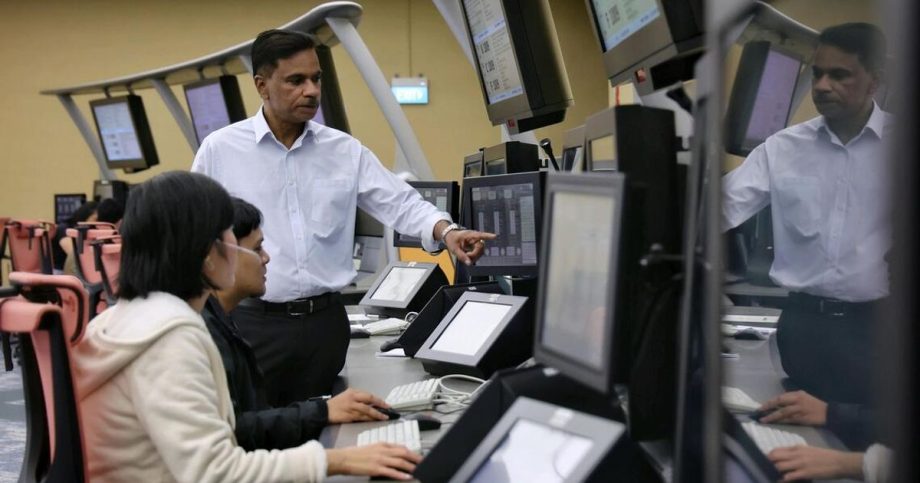
SINGAPORE – From lining up incoming aircraft before touchdown to guiding departing flights to their cruising altitude, Singapore’s air traffic controllers keep traffic moving through the skies round the clock.
Even as today’s tools can anticipate complex traffic patterns and potential disruptions long before they happen, air traffic control is fundamentally still a people-driven operation.
Having witnessed the evolution of technology across his more than 35-year career as a controller, Kathirvelu Krishnan, 58, can attest to the importance of the person behind the screen, plugged into a headset.
“New systems and greater automation can help us process information, anticipate situations and manage increasingly complex air traffic. But these technologies are ultimately there to support the air traffic control officer,” he told The Straits Times.
“No matter how sophisticated the tools become, we still need a well-trained officer who can understand the situation, exercise sound judgment and make the necessary decisions.”
Developing a pipeline of air traffic controllers takes time and rigour, said Kathirvelu, who is also senior chief for air traffic control training at the Civil Aviation Authority of Singapore (CAAS).
After an introductory four-month course on subjects such as meteorology and aviation law, trainees are assigned to one of three specialisations – aerodrome, area or approach.
Aerodrome controllers work at the Changi or Seletar control towers, overseeing air traffic at the respective airports and managing take-offs, landings and ground movements.
Area controllers, like Kathirvelu, handle aircraft during the en-route phase of their journeys, or when aircraft are flying at cruising altitudes.
The area controllers are based at the Singapore Air Traffic Control Centre near Changi Village, alongside approach controllers, who guide arriving flights through their descents, including lining up aircraft before they land.
Approach controller Farwizah Batrisyia Aziz, 27, concluded her training about seven months ago. She said she was initially apprehensive about the intensity of the programme, having heard stories from three of her university friends.
She eventually decided to pursue the vocation after speaking to other air traffic controllers at networking events.


Read Full Article At Source