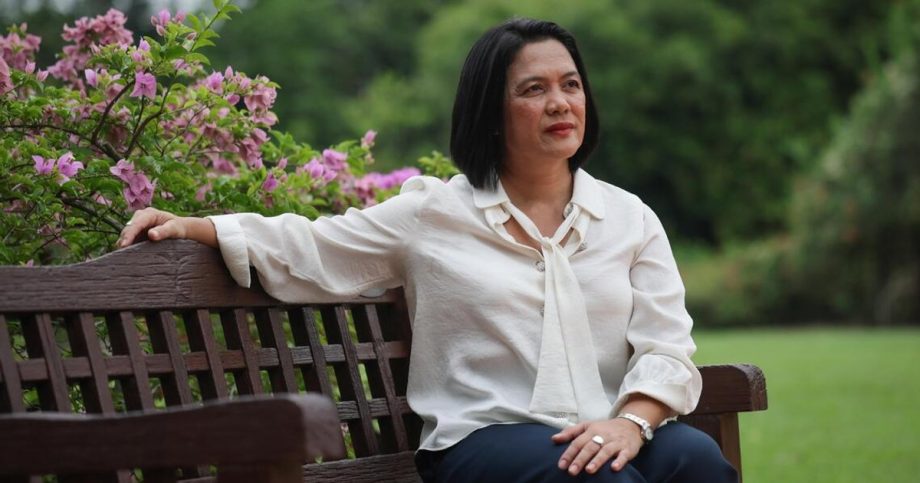
SINGAPORE – Leizle Menez woke up one morning in 2008 to discover that Lee Lai Ho, the 83-year-old woman she had cared for over the past three years, had died in her sleep.
Towards the end of the elderly woman’s life, the Filipino domestic worker had shared a bedroom with her. When Menez found her that morning, her body was still warm to the touch.
Her employers asked her to wash the body, dress the deceased in funeral robes and apply her make-up so that they could take a final photograph before the funeral home workers came to collect the body and seal the coffin.
“I put some lipstick and make-up on her, and I thought: ‘Can I really do this?’” She did it, crying. “It’s not like they were forcing me to do it, but I didn’t have a choice.”
The family did not realise how distressed she was until they heard her crying. They then comforted her.
Now 47, Menez has spent 24 years – more than half of her life – working as a domestic worker in Singapore. She still vividly recalls that morning nearly 20 years ago. For her, it shows how Singapore families sometimes overlook a domestic worker’s feelings, even when she has cared for a loved one in their final days.
She is one of five domestic workers interviewed by The Straits Times who were hired by Singapore families to care for elderly relatives who could no longer live independently because of dementia, cancer, stroke or other debilitating conditions.
Yet when these elderly charges die, the workers are often left to process their mourning in silence. The term “disenfranchised grief” is used by counsellors to refer to loss that goes unacknowledged because the person grieving is not considered family.
As Menez puts it: “(The children) are not sleeping with their mothers; domestic workers do that. They don’t shower their mothers; domestic workers do that.
“When that person passes away, it’s hard for us, the caregivers, even though they’re not our family.”
“Grandma” and “Grandpa”, as Menez calls them, were in their 80s when she started working for the family.
Grandma had dementia, diabetes and a hip problem that left her in a wheelchair and needing help with daily tasks. After her death, Grandpa’s health took a turn for the worse, eventually requiring Menez to change his urinary catheter every six hours.
Menez had no healthcare experience and learnt on the job, often from physiotherapists and nurses.
She learnt to manage the mood swings and confusion of dementia, transfer and exercise someone in a wheelchair, dress wounds and change catheters.
Like other domestic workers who spoke to ST, Menez found that the elders preferred her to bathe and tend to them, even in hospital with nurses available. She believes they wanted to hold on to what independence they could and avoid troubling others.
The relationship was contractual, which set her apart from the family. Yet it was also deeply familial. She picked up some Cantonese and learnt to cook dishes the couple loved. She also learnt to play mahjong, which they played almost every day, even on family holidays to China.

Leizle Menez (left) with Lee Lai Ho, whom she looked after for three years.
PHOTO: LEIZLE MENEZ
“It just made me feel that this was my father and this was my mother,” she says, tearing up as she recounts their time together. “I loved my job, even though there were challenges and stress.”
After the couple died, Menez worked for another family but stayed in touch with her former employers. They still meet occasionally for meals and to pay their respects to the late elderly couple. The family agreed to let ST use Grandma’s photograph for this story.
As Singapore relies more on domestic workers to care for its elderly, an uncomfortable reality is emerging. They provide care that many families cannot give, while leaving behind their own loved ones who may need the same.
“After Grandma passed away, I realised that I didn’t get to do for my own father what I did for her,” she says. “I bathed her, I put on her make-up, I was very involved during her funeral and everything, but I never did that for my father.”
Her father fell ill in the same year, 2008. She was given time off to return to the Philippines. But she arrived too late to be with him in his final moments.
A job deeply human
Jasmine Wong, 46, the late couple’s granddaughter, says Menez’s contributions “went far beyond the practical care she provided”. She became someone her grandparents trusted and felt safe with, particularly towards the end of their lives.
“Even after my grandparents passed away, the relationship we had built continued,” adds the social worker. Menez’s care, she adds, was more than just a transactional job. “It was deeply human,” she says.
Menez’s experience is increasingly common. In September 2026, Singapore officially became a super-aged society when more than one-fifth of its citizen population crossed the age of 65. The role of domestic workers in Singapore has shifted with it.
The decades since the 1970s have seen a drastic evolution in the role of foreign domestic workers in Singapore’s social fabric.
The foreign domestic servant scheme was introduced in 1978 to help more Singapore women join the workforce. In 1970, only one in seven married women was economically active.
As the Ministry of Labour wrote at the time: “There is a good number of women in Singapore with special skills or training but who are not in gainful employment as they are being burdened with household duties.”
The work was long associated with child-rearing. Today, helpers are increasingly hired for the oldest member of the family rather than the youngest.
Dr Chong Poh Heng, medical director at HCA Hospice, attributes this to the “sandwiched generation”: middle-aged adults stretched between ageing parents and children, often in dual-income households. It is now almost customary for families to hire a domestic worker after an elderly family member loses independence.
With foreign domestic labour not cost-prohibitive, “it is not uncommon for me to see average households with two helpers during my rounds in the community”, Dr Chong says.
The data bears this out. A 2011 survey for the Ministry of Community Development, Youth, and Sports – the last major one on informal caregiving – covered more than 1,000 primary caregivers of adults aged 75 or above. Two-thirds of these caregivers had secondary caregivers, 71% of whom were domestic workers.


Read Full Article At Source