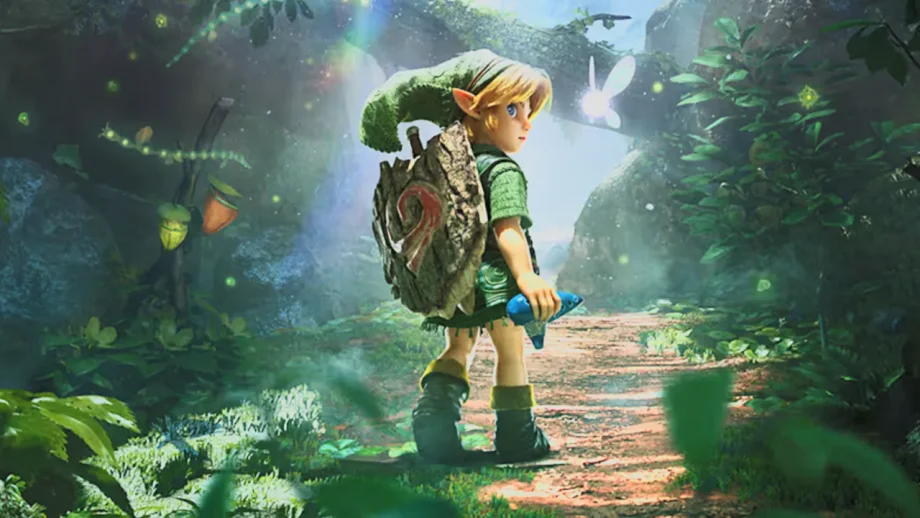
The Legend of Zelda: Ocarina of Time remake is framed as a legend retold. It opens on a tapestry depicting Hyrule’s people and places, as a narrator reflects on Link’s journey like it’s a valuable story worth passing down. For Zelda producers Eiji Aonuma and Hidemaro Fujibayashi, a desire to pass the original game down to a younger group of Zelda developers is one of the main reasons this remake exists:
“There are much younger developers who are working on this game, and I do think this is a really valuable experience for them to familiarize themselves first with the original Ocarina of Time and then have their own reinterpretation of it,” Aonuma said. “And to have those conversations throughout the course of development that may aid them in future projects as well.”
This is just one way the pair is reflecting on this franchise they’ve spent decades working on. I spoke to Aonuma and Fujibayashi for nearly an hour ahead of the release of Ocarina of Time, and we discussed the elements that make a Zelda game, how real-world inspirations and expertise play into game development at Nintendo, and their strongest memories and reflections as the Zelda franchise celebrates its 40th anniversary. Read on for my full conversation, including one of Aonuma’s key memories with Zelda creator Shigeru Miyamoto: “Hey, Mr. Aonuma, you know you can’t really cut a wooden crate with a sword, right?”
IGN: It is great to meet you both. I’d like to start by congratulating you on tonight’s launch of the Legend of Zelda: Ocarina of Time, as well as the 40th anniversary of The Legend of Zelda.
Both: Thank you.
IGN: The opening cutscene of Ocarina of Time’s remake and its tapestry present this remake as a legend being passed down. I can’t help but think of the parallels with its development. Mr. Aonuma, you said that you wanted your team to understand the significance of Ocarina of Time. In a way, you’re passing down a legend of your own, and I’m wondering if this connection was on your mind throughout development.
Eiji Aonuma: So the specific cutscene with the tapestry was not necessarily something that I had created with that in mind in terms of handing down a legacy, as you say. That was something that developers who were working more directly on the game contributed to. But for me, certainly as you mentioned, there are much younger developers who are working on this game, and I do think this is a really valuable experience for them to familiarize themselves first with the original Ocarina of Time and then have their own reinterpretation of it. And to have those conversations throughout the course of development that may aid them in future projects as well.

IGN: I’d like to ask about that more because one of my takeaways from this game is how much value I find in the traditional 3D Zelda formula, and you’ve said newer developers understanding the structure is one of the purposes of this remake. But it’s also caused you both to revisit this traditional Zelda formula after several years away. Revisiting it with fresh eyes, what positive aspects of this more linear type of 3D Zelda have stuck out the most?
Hidemaro Fujibayashi: As you mentioned, Ocarina of Time perhaps could be described as simpler. And going back to Zelda as a whole, regardless of whether it’s an old Zelda game like the initial original Zelda or newer ones, I think the core of what makes a Zelda game, from my experience and thinking, is that it’s the combination of exploration and discovery. And that’s something that has been with the Zelda series, starting from the very first Zelda game all the way to recent games like Tears of the Kingdom. And I think that’s a common through line. And even as we’ve gotten into newer games that have the open-air gameplay style, it becomes a little bit more complex. But as we return to a more focused 3D Zelda experience, as you mentioned, it’s kind of given us an opportunity to bring the comforts and the play styles of the modern games.
For example, having a second control analog stick so that you can control the camera. That really eases the experience of gameplay so that coming back to a more straightforward, focused experience really allows the player to focus on the core aspect of Zelda, which, again, is exploration and discovery. And so there’s almost this multiplicative gameplay that allows you to dive even deeper into the idea of exploration, discovery. And that’s something that I really felt like I kind of reconfirmed within myself that that is really what makes a Zelda game a Zelda game.
IGN: I’d love to know when this project started development. Mr. Aonuma, you’ve mentioned that this was a great way to celebrate Zelda’s 40th anniversary. I’m wondering when the idea came up and if it was before or after Tears of the Kingdom was released.
Aonuma: It’s hard to say exactly when the decision came about to remake Ocarina of Time in this way. I do believe it was after the Tears of Kingdom development had ended, we started to see staff being released to other projects that we were talking about the 40th anniversary timing coming up, and what would be best to celebrate an anniversary like this. So as we were discussing it and looking back over the Zelda franchise through the years, we talked about Ocarina of Time being a really good starting point for a lot of people who have played the franchise, and my professional starting point with the series as well. And I was really curious to see how the younger generation of developers at Nintendo would interpret a game like this for a new generation, for new players. So it’s a little hard to nail down the exact timing because there were so many steps along the way, but I do believe it was after the development of Tears of the Kingdom had finished.
IGN: Mr. Fujibayashi, I noticed this was your first time serving as producer on a Zelda game after directing the last few. What was that transition like for you? Was it difficult to take a step back in any specific situations?
Fujibayashi: Even though my role on this title has been producer, I feel like my producer role has been relatively close to the front lines of development. But in terms of maybe a challenge that I faced was, because we now have a younger staff that’s working with us, when I’m discussing things like what makes a Zelda or when I’m trying to provide advice or guidance, we have such a vast range of ages in our team. And some of the language we use or some of the way we communicate is a little bit different. So I found myself needing to adjust and recognize if this person has been involved with the series for a long time or if this person is new to the series. And adjusting the way I provide advice or, say, be involved with ideations with those people, I really felt like I had to kind of pull out my wisdom to make sure that the communication works for the person that I’m speaking to.
IGN: I’ve finished Ocarina of Time on Switch 2, and I really loved it. What struck me was the intertwining of these two eras that you’ve mentioned of modern presentation and controls through an old-school Zelda world. And I found this overlapping muscle memory of, originally I would expect Link to auto jump and he didn’t and I fell. Or, I thought I could climb a rock and I couldn’t. My brain was pulling from Breath of the Wild and pulling from the original Ocarina of Time. What’s something that sticks out to you about blending these two eras of Zelda together that makes this remake special?
Aonuma: There were certainly a lot of moments in development where our younger developers on the staff were considering how to familiarize and reinterpret the original Ocarina of Time. And we didn’t tell them what to do in terms of “change this or don’t change that,” but rather they would come to the experience and try to feel a natural need for something. And I think two examples are both shifting to a manual camera control, and an auto jump system, where they decided that it was justified to make a change. Now, of course, in some cases, this might mean that you’re adding additional review that’s necessary because you have to control player access if they can jump absolutely anywhere. But I do believe that it adds a greater feeling of freedom compared to the original jump system in the game. And I hope that that is something players find to be a really good fit. I know that if they are more recent Zelda players who have a lot of experience with Tears of the Kingdom and Breath of the Wild, that’s perhaps going to feel like a more natural choice for them.

Read Full Article At Source