This follows a ‘broad but uneven’ market correction; institutional flows diverge across sectors: SGX
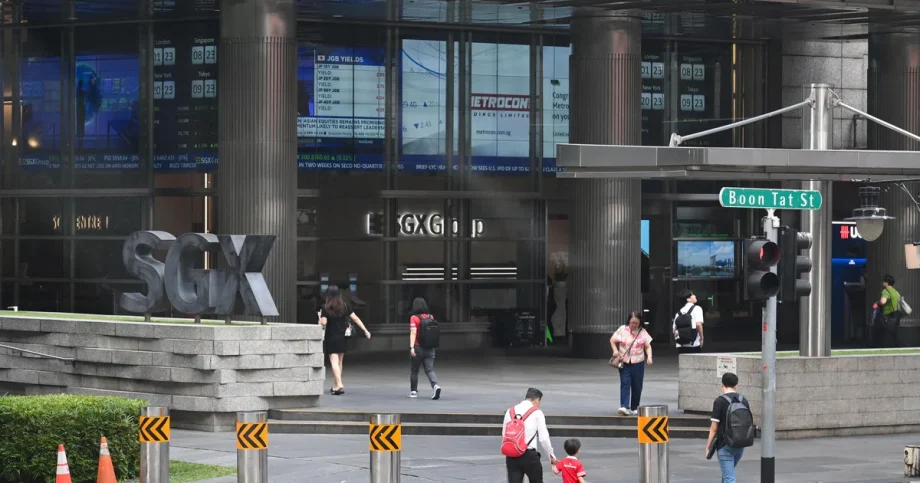
[SINGAPORE] After recording gains through much of 2026, Singapore equities underwent a “broad but uneven” market correction in October, the Singapore Exchange (SGX) said on Monday (Nov 2).
The Straits Times Index (STI) recorded a 5.2 per cent decline in total returns, trading mostly between 5,370 and 5,450 over the final 16 trading sessions of the month.
The iEdge Singapore Next 50 Index fell 6.8 per cent.
Institutional flows “diverged across sectors” during the month, while Singapore’s underlying economic activity continued to expand, SGX noted.
Technology stocks bore the brunt of October’s sell-off, with the FTSE ST All-Share Technology Index plunging 17.3 per cent.
Real estate investment trusts (Reits) proved comparatively more resilient; the iEdge S-Reit Index declined 1.4 per cent. SGX noted that telecommunications stocks also “generally recorded smaller declines than many technology counters”.

The correction came despite continued expansion in Singapore’s economy.
Advance estimates showed that gross domestic product grew 5.4 per cent year on year in the third quarter of 2026, following growth of 6.2 per cent in Q2.
However, the correction was not confined to Singapore, SGX noted, as major Asian equity markets, including South Korea, China and Japan, also recorded declines during the month.
SEE ALSO

Tech returns uneven
October’s decline in tech stocks followed substantial gains earlier in the year, leaving “a wide spread” in year-to-date returns among individual counters.
AEM , UMS Integration and Frencken fell between 23 and 26 per cent in October. However, they retained total returns of 335 per cent, 80 per cent and 47 per cent, respectively, over the first 10 months of 2026.
All three recorded institutional net outflows in October, although they remained net inflow recipients over the January-to-October period.
The declines tracked a slide on Wall Street. Shares of Alphabet, which owns Google, recorded their biggest single-day loss since the company’s listing on Oct 29, closing 12.6 per cent lower at US$283.82.
But not all technology counters moved in tandem. AvePoint gained 26 per cent in October, bringing its return for the first 10 months of the year to 22 per cent.
On Oct 20, the International Monetary Fund said that investment in artificial intelligence infrastructure continues to support Asian semiconductor demand and exports. However, it also identified a reassessment of AI profitability and productivity as a downside risk.
Reits prove resilient
Singapore-listed Reits were relatively more defensive in October.
CapitaLand Integrated Commercial Trust ( CICT ) recorded the largest institutional net inflow among Singapore-listed stocks, at S$79.2 million, SGX noted, adding that the trust delivered a positive total return of 2 per cent for the month.
CapitaLand Ascendas Reit , meanwhile, recorded its second-highest monthly traded value on record.
The three best-performing S-Reits in October were Acrophyte Hospitality Trust , Frasers Centrepoint Trust and Suntec Reit , SGX said.
“Operating updates prior to the Oct 30 close showed positive rental reversions but mixed distribution outcomes,” the bourse operator added.
Institutional participation was also uneven, it noted. CICT attracted net inflows, while CapitaLand Ascendas Reit, Keppel DC Reit and Frasers Centrepoint Trust recorded net outflows of S$51.3 million, S$28.7 million and S$25.7 million, respectively.
S-Reit’s “more defensive performance coincided with lower long-term government bond yields towards the end of October”, SGX pointed out.
The US 10-year Treasury yield ended the month at 4.9 per cent, down from a high of around 5.36 per cent on Oct 7, and 35.6 basis points lower over the month.
Read Full Article At Source