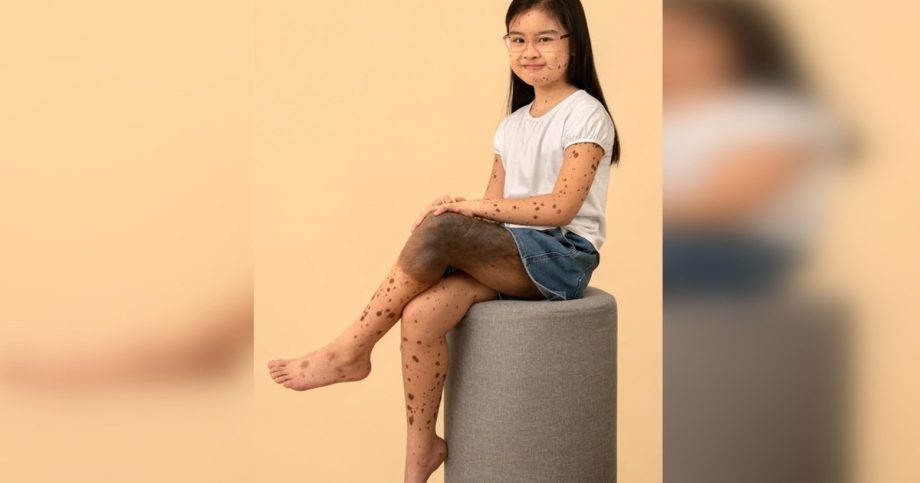
SINGAPORE – “They are my birthmarks.”
That was what 12-year-old Charlotte Lim told everyone and anyone who bothered to ask her about the spots on her skin, especially the large one that covered much of her body and extended down her legs.
Charlotte was born with an enlarged birthmark that now covers about 30% of her body.
“It extended from her diaphragm to her legs, and she has smaller spots on her body and face that have grown progressively larger,” her mother Esther Zheng, 43, told The Straits Times.
Zheng, a civil servant, said she was shocked when she first saw her daughter’s extensive dark markings. “She also has over 100 smaller moles on her stomach, scalp, face, arms and legs.”
What Charlotte has is a rare, non-cancerous pigmented birthmark called a giant congenital melanocytic nevus (GCMN), which can enlarge as a child grows.
The condition affects about one in 100,000 newborns, said Mark Koh, who heads the department of dermatology at KK Women’s and Children’s Hospital (KKH).
“A congenital nevus (is a pigmented mole or birthmark) that occurs due to a mutation in the genes affecting pigment cells. It occurs while the embryo or foetus is growing in the mother’s womb,” he added.
“The size of the congenital nevus depends on how early the mutation occurs during the pregnancy, with earlier mutations causing larger lesions. The size and location of the lesion also vary.”
He said that while GCMN is a genetic condition, it is not passed down from parent to child.
Koh said some patients with GCMN may have moles in the brain and spine called neuro-melanosis, which can lead to neurological problems such as weakness or seizures.

Read Full Article At Source