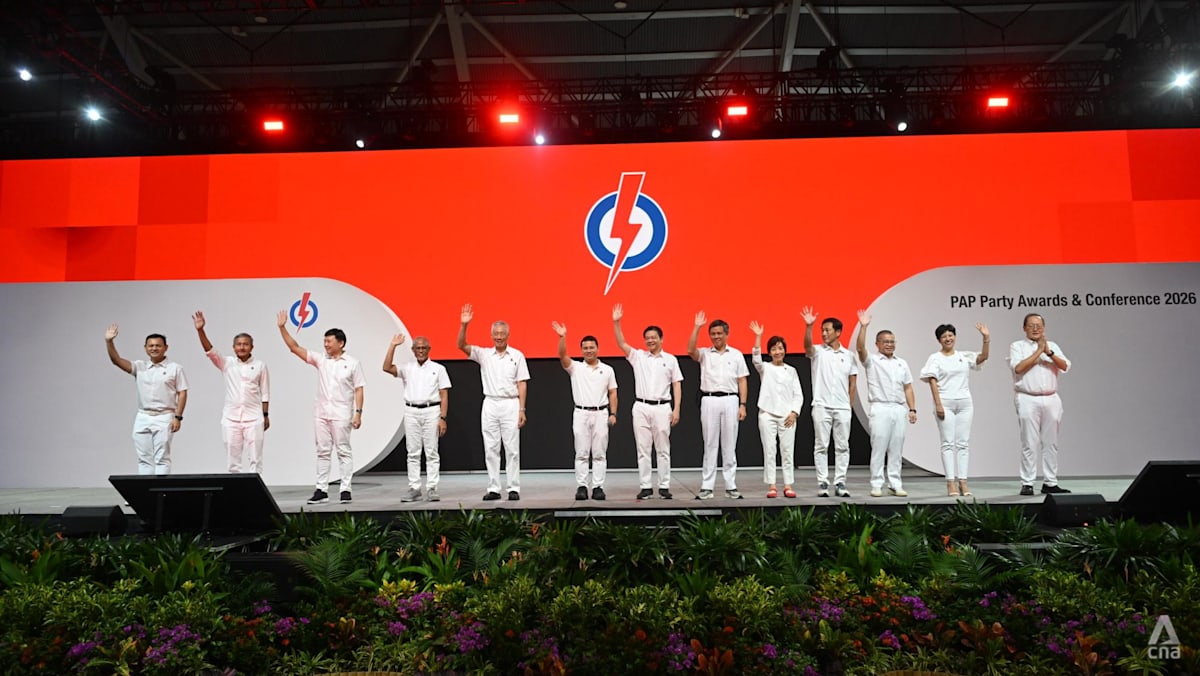
SINGAPORE: The outcome of the People’s Action Party (PAP) central executive committee election on Sunday (Oct 25) showed that the cadres drew a distinction between government leadership and party leadership, and that Prime Minister Lawrence Wong might have faced some challenges in renewal, although that remains high on the party’s agenda.
Analysts pointed to how some first-term MPs have taken on Cabinet positions but didn’t make it into the PAP leadership this time, reflecting how the cadres view the government separately from the party and assess them differently based on other considerations.
Sunday’s ballot saw an unchanged slate in the party’s top decision-making body, with the 12 elected and two co-opted all returning faces. Older members such as senior ministers Lee Hsien Loong and K Shanmugam, and Foreign Affairs Minister Vivian Balakrishnan remained.
Former Deputy Prime Minister Heng Swee Keat, who was elected to the CEC in 2024, stepped down following his retirement from politics in 2025. His place was subsequently filled by ex-MP Faishal Ibrahim, who was in turn replaced by Mr Zaqy Mohamad. The acting minister-in-charge of Muslim affairs was part of Sunday’s slate of 14.
While Transport Minister Jeffrey Siow and Acting Manpower Minister Jasmin Lau were nominated but ultimately not voted in, they could still be co-opted into the committee as part of the party’s longer-term renewal, added the observers.
Both first-term Members of Parliament were part of the initial shortlist of 19 nominees, which did not include fellow first-term minister David Neo, who is in charge of the Ministry of Culture, Community and Youth.
“Just because one is in Lawrence Wong’s core team does not automatically mean that this person is also core in the eyes of party cadres,” political observer Mustafa Izzuddin, a social and international affairs consultant, told CNA.
Observers also noted that Sunday’s outcome is a signal from the party faithful that the preference is for continuity over change, with experienced leaders at the helm as Singapore rides global and regional turbulence.
“With the multi-faceted challenges facing the country ranging from AI to geopolitics, the party cadres — as the barometer — are indicating that the imperative for change must be balanced against the need for the party to demonstrate stability, strength, and experience which the older leaders possess,” said Singapore Management University associate law professor Eugene Tan.
Dr Tan Ern Ser, an adjunct principal research fellow at the Institute of Policy Studies (IPS), said the election result suggests that cadres want the first-termers to prove themselves further.
“I reckon it suggests that party cadres still strongly support those who have a longer track record, while they probably believe that the new ministers need more time to gain their trust and support,” he said.
MORE TIME TO GAIN TRUST
Mr Siow and Ms Lau did not get voted into the CEC as they are still new and have not earned the full support of the party’s cadres, said political observers.
“They are still very new to the party as they joined the party just before the May 2025 GE, so no surprises that they are still not as popular as their more established colleagues,” said Assoc Prof Tan.
Independent political observer Felix Tan called it an indication that cadre members would prefer to see them “tested for a little longer”.
“They are still relatively new faces, and there may be a preference to allow them more time to build their political experience, establish a stronger track record and demonstrate themselves in their current roles before taking on more senior responsibilities within the party,” he said.
Read Full Article At Source


