It was National Day evening. Retired kindergarten operator Mary (not her real name) and her husband were watching the parade on TV when her phone started ringing incessantly.
She ignored the first few calls from the unfamiliar Malaysian number, but they kept coming. Assuming it was urgent, she finally answered.
The woman on the line recited Mary’s full name and identity card number and claimed to represent a moneylending company. She demanded payment for an outstanding debt.
“I didn’t owe anyone any money at all, so I just hung up,” Mary recalls. Immediately, calls from other numbers came in rapid succession. As soon as she declined one, another rang. Then came the WhatsApp messages.
One message from a Philippine number read: “Your helper say she clear today her loan. Now your helper still no reply lei… I ****ing ask my people go up ar your house.”
Mary’s domestic worker Lucy (not her real name), had flown back to the Philippines to visit her sick father. She had worked for Mary’s family for four years. Mary had always thought of Lucy, 51, as a competent worker and great cook.
Mary had dropped her off at the airport just days before, and was not expecting Lucy back for another two weeks.
The loan sharks claimed over the messages that Lucy had borrowed $180, and, along with interest, the debt had ballooned to $1,040.
They sent over images of Lucy’s work permit that also included Mary’s full name, IC number and her home address.
“The scary part is they knew there was porpor (an elderly woman) living in the house,” she says, referring to her 90-year-old mother.
Mary called Lucy to confront her about the debt. The helper denied taking any money, claiming she had only inquired about a loan.
“Then how did the loan shark get a picture of your work permit?” Mary pressed.
Shortly after, Lucy stopped replying and blocked her number. Meanwhile, the loan shark’s threats escalated, all the way into the early morning.
“I woke up at 3am, literally crying, afraid that I’d find paint splashed on my gate the next morning,” Mary recalls.
For foreign domestic workers (FDWs) who need cash urgently, borrowing can take several forms: a purchase on instalment that can be pawned for money, an informal loan, or a loan from an unlicensed lender. The costs can mount quickly. Employers may discover the problem only when creditors contact or threaten them, as Mary did.
How many FDWs face such debts is unknown. Singapore had 323,800 migrant domestic workers by June 2026, according to the Ministry of Manpower (MOM), but no public agency publishes a count of those in debt.
The last worker-specific figures show about 460 reports involving unlicensed moneylending from 2013 to September 2018. The 3,172 cases of unlicensed moneylending harassment recorded nationwide in 2025 cover all victims, not just domestic workers.
A route to ready cash
Many workers support relatives back home on modest wages. Starting base salaries here typically range from $550 to $650 a month, according to FDW matching portal HelperChoice.
“A lot of them experience intense guilt because they are away from their families,” says Billy Lee, a pastor and executive director of Blessed Grace Social Services (BGSS), an agency assisting indebted foreign workers. “They find it hard to say no to any financial request from home.”

Pastor Billy Lee assists foreign domestic workers in negotiating with creditors.
ST PHOTO: GAVIN FOO
In July 2019, Singapore tightened loan regulations for foreign workers earning less than $10,000 a year, cutting the total amount they could borrow from licensed moneylenders from $1,500 to $500. The Law Ministry said the move was to “address social issues arising from these moneylending activities”.
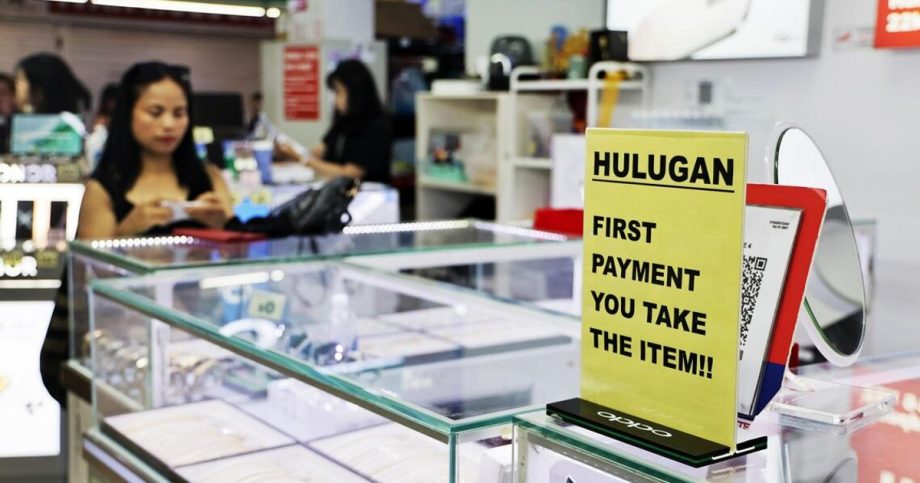
Lee says workers in need of larger sums have also turned to shops offering goods on instalment. A worker can buy jewellery or a mobile phone with little to no cash upfront, pawn or sell it, then send the proceeds home. The debt to the shop, with its interest rates, remains.
At Lucky Plaza, a popular gathering place for Filipino domestic workers on their days off, The Straits Times counted six licensed moneylenders, five pawnshops, seven remittance centres, and more than 20 jewellery and mobile phone shops advertising hulugan, the Tagalog term for instalment plans.
The density of services under one roof means a worker can buy an item on credit with no cash upfront, pawn it for cash and remit the money home in a single visit.
“The retail shops have taken the place of the licensed moneylenders,” says Lee.

At Lucky Plaza, there are many shops advertising hulugan, the Tagalog term for instalment plans.
ST PHOTO: KELVIN CHNG
The shift began in 2019 after the licensed lending cap took effect. Immediately after the restrictions kicked in, BGSS saw an influx of 200 to 300 workers seeking urgent help. The caseload kept rising, with roughly 100 new individuals seeking help each week.


Read Full Article At Source