Let’s play Family Feud.
Poll 100 people on the scariest game they’ve ever played. What’s on the board? Surely a Silent Hill, and a Resident Evil, too. Alien Isolation seems likely. One of the Fatal Frames has a good shot. Those who know ball may call out a deeper cut like Siren, Sylvio, or Visage. One name I’m certain makes it on the board–to the tune of my family cheering me on with “Good answer! Good answer!”–is Outlast.
The horror game from Montreal-based indie studio Red Barrels was released in 2013 as the debut effort from what was then a 10-person team. The studio was founded by developers with an origin story we hear about a lot in the games industry: They left roles at big-budget studios like Electronic Arts, Ubisoft, and Naughty Dog to pursue something they could call their own.
On an hour-long call with Red Barrels’ Phillipe Morin, he told me how he and his co-founders, David Chateauneuf and Hugo Dallaire, established Red Barrels as a fully independent game studio and built what has become a tentpole horror series.
Content warning: This article contains descriptions of extreme violence.
“After our project got canceled at EA, we were having a hard time picking up on where we would want to go, what we would want to do,” Morin said. “And so I think that’s when we realized that we were pretty much all at the same place career-wise [and felt] it was time we try to make a project of our own.”
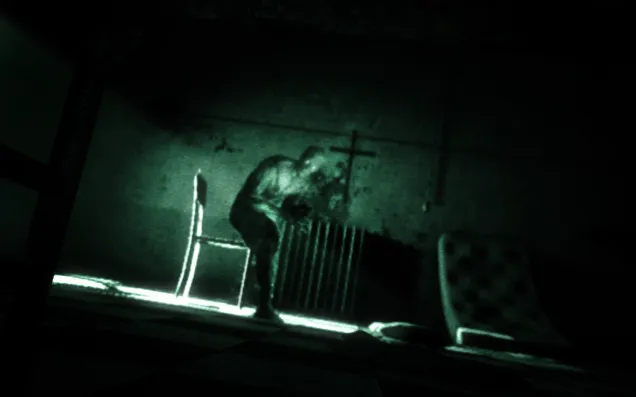
Morin said the burgeoning team didn’t know what its first game would be, but they landed on a horror game because that’s what they were passionate about, with a distinct style to stand out: first-person, defenseless in nature–players could only run and hide from enemies, not fight back–with what would become the game’s signature night-vision lens coloring the terror lurking around every corner.
“David was a huge horror fan, and I knew I would have a good time working on such a game. And Hugo came up with the idea behind the night vision and the visual style, mostly after watching the Rubber Johnny video.”

He explained that he and Chateauneuf tried to convince Ubisoft to let them make a horror game back in 2008 while they were still working there, but the developer-publisher wasn’t interested, which Morin cited as “mostly a financial thing.”
You might not remember, especially in today’s much more horror-obsessed climate, but during that period–call it 2006 to 2012 or so–horror games had mostly gone dormant. There were a few exceptions, but most of them were moving the genre in an action direction, like Dead Space and Resident Evil 5, unless you were playing under-the-radar PC gems like Amnesia: The Dark Descent and Penumbra: Overture. Horror games weren’t in, or so publishers that primarily dealt with AAA games believed, so they weren’t looking to invest in them.
The co-founders figured Frictional Games’ success with Amnesia proved there actually was a viable market for horror games, and they were grateful that the genre didn’t become oversaturated in the first few years after Amnesia, leaving an opening for them. Morin recalled how quickly their expectations unraveled.
“We thought at first that we’d come up with the pitch within three or four months and shop it around to a few publishers, and we’d find out pretty quickly if it works or not,” he said.
Instead, it took 18 months of meetings.
Partners were hard to come by; publishers were still obsessed with mobile games, a refrain I’ve heard often from developers who worked in that era. Morin remembered potential partners telling him that they’d “rather invest $50,000 in 10 mobile games than $500,000 in [Outlast].” Ultimately, the Canada Media Fund (CMF), a publicly funded investment program meant to support homegrown media projects across Canada, helped bring Outlast to fruition. But a million dollars from the CMF wouldn’t be enough.
Morin told me the group put forward an additional $360,000 from their own savings accounts and credit cards, and leveraged their home mortgages to see the project through to the end.
“Everything was pretty much on the line,” he reminisced. “Of course, it meant working very long, long hours. We were in a sprint to release the game before running out of money.”
Morin remembered potential partners telling him that they’d “rather invest $50,000 in 10 mobile games than $500,000 in [Outlast].”
No publisher materialized, but the work continued, and eventually the team felt it could get the game to the finish line without an outside publisher, so Red Barrels did exactly that, though Morin admitted the team had no experience with that side of making video games.
“We were experienced game developers,” Morin explained, “but we didn’t know much about that side–publishing and marketing and sales and all that. So we had to learn on the fly.”
A familiar name would come to Red Barrels’ aid: Amnesia. Some folks at Red Barrels sat in on a conference talk by Frictional Games co-founder Thomas Grip, who said Frictional sold 400,000 copies of Amnesia: The Dark Descent in its first year on Steam. Red Barrels adopted that same total as its goal for Outlast, but after a promising launch window in early September 2013, sales slowed, suggesting they weren’t on pace to hit it.
Morin reached out to Grip, who generously walked him through the ebb and flow of Steam sales.
“He explained to us the dynamic of Steam, and when you do promotion, it spikes back up, [then] goes back down, and basically your sales curve becomes like a roller coaster.”


.jpg?w=636)


