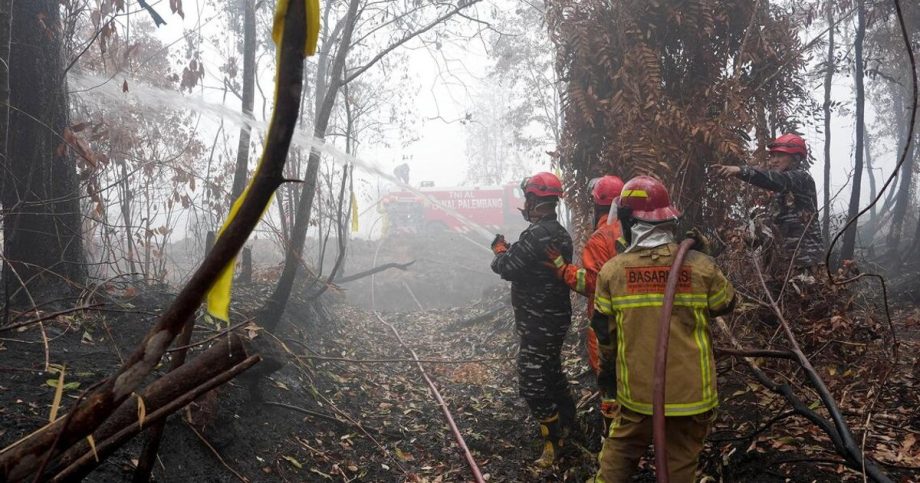
PALEMBANG – For months, firefighters in South Sumatra have battled peatland fires that refuse to die. They pump water into the smouldering ground and beat back the flames with basic tools, only to watch the fires flare up again.
The acrid smell of smoke greets you the moment you step off the plane at Sultan Mahmud Badaruddin II International Airport in Palembang, the provincial capital. The thick haze that has blanketed the city for weeks belies the firefighters’ painstaking efforts.
Now, an unlikely weapon has arrived from the other side of the world: a powder called Realiza Antichamas (Portuguese for “fire-retardant solution”) which forms a fire-suppressing gel when mixed with water.
Its maker, Brazilian firm Grupo Realiza, claims the product makes water up to 10 times more effective at fighting fires. Firefighting crews in Sumatra and Kalimantan have been testing it since early October.
With conventional firefighting efforts struggling to contain Indonesia’s stubborn peat fires, the authorities are turning to alternative measures.
But whether the gel can tackle the fires that matter most remains an open question: Peat fires can smoulder metres underground, beyond the reach of water sprayed from above, and it is not yet clear how deeply the mixture can penetrate. The trials come as a severe fire season sends choking haze across the region.
Palembang-based firefighter Sulaiman noticed the difference the first time he used it. “It hardens the soil and helps stop the fire from reigniting,” he told The Straits Times on Oct 14.
A severe fire season
The gel trials are among several alternative measures being tested as Indonesia endures an unusually severe fire season, exacerbated by a very strong El Nino.
Fires burned 202,004ha nationwide from January to July, up 69% from a year earlier, according to the Forestry Ministry’s SiPongi monitoring system. Forest fires have affected several of the country’s major islands, with Sumatra and Kalimantan among the hardest-hit areas.
The fires are difficult to extinguish because many burn in dry peat – thick layers of partly decayed vegetation that can smoulder for weeks below the surface, beyond the reach of water sprayed from above.
The resulting smoke also reduces visibility, hampering water-bombing operations by helicopter.
Efforts to contain the fires have intensified in recent weeks, even as smoke has spread to Singapore, Malaysia, the Philippines and Timor-Leste.
In Palembang, PM2.5 concentrations reached 816 micrograms per cubic metre at 5am on Oct 15, according to air-quality platform IQAir, nearly three times the 300-microgram threshold it classifies as “hazardous”.
The haze has fuelled respiratory problems, forced school closures and disrupted flights in Indonesia and neighbouring countries, increasing pressure on Jakarta to contain the fires.
High hopes, measured claims

The fires are difficult to extinguish because many burn in dry peat – thick layers of partly decayed vegetation that can smoulder for weeks below the surface, beyond the reach of water sprayed from above.
ST PHOTO: DIMAS ARDIAN

Read Full Article At Source