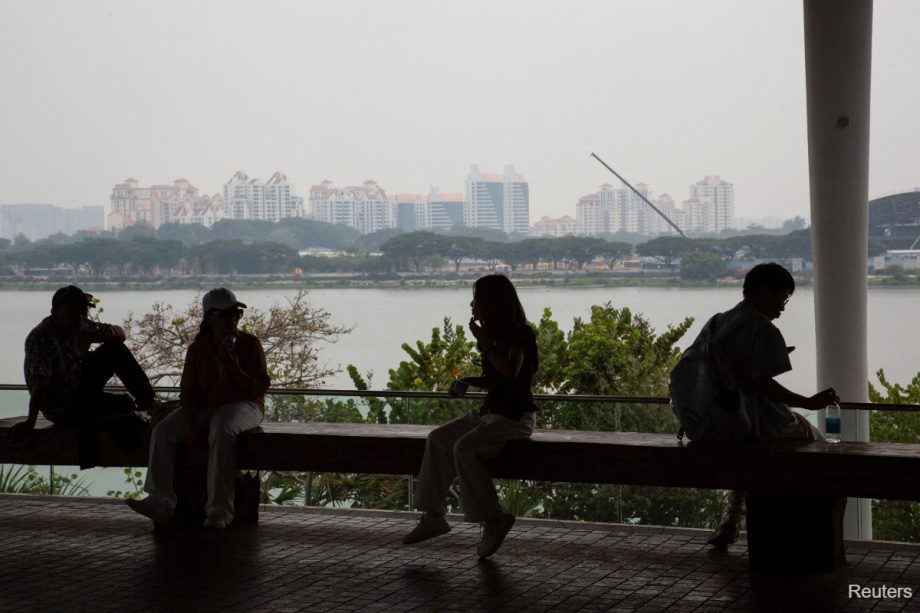
A cloud of haze has descended across Southeast Asia over the past few months as a brutal El Niño helps incinerate forest and scrub in Indonesia. Obscuring responsibility for the fires stems from a much deeper and more impenetrable legal pall.
The smoke has spread across the region, forcing schools to close in Malaysia, diverting flights, and giving tiny Singapore — which has no dry lands of its own aflame — the worst air pollution in the world. If current trends persist, this episode may turn into the worst in Southeast Asia since devastating wildfires in 2015.
To hear the way this is talked about in Singapore, the region’s wealthiest country, the whole situation is an act of God: Fires just happen, and no one can be sure exactly who is responsible. A more sophisticated diagnosis blames intransigence in the region’s largest country. When Singapore passed a law in 2014 threatening millions of dollars in fines for companies causing haze, Indonesia’s refusal to cooperate made it impossible to implement. For the city-state, discretion toward its giant neighbor has become the better part of diplomacy.
It’s certainly hard to discern precisely who is responsible for lighting Southeast Asia’s forest fires, but that’s because laws across the region are riddled with huge and obvious loopholes. With officialdom in Indonesia and Singapore blaming each other for the grim state of affairs, smallholders and businesses can get on with despoiling the landscape without anyone making a serious claim to accountability.
The central problem lies in the fragmented nature of Indonesia’s oil palm, timber and paper industries. In each case, large companies control key supply nodes, such as palm oil mills and pulp factories, as well as significant plantation estates. While Malaysia’s plantation companies such as SD Guthrie Bhd (KL:SDG) are mostly headquartered in Kuala Lumpur, many of Indonesia’s largest businesses are listed or headquartered instead in Singapore, the leading capital market and private wealth hub in the region.
Beneath these giants is a complicated network of suppliers. In palm oil, that includes millions of smallholders — often poor rural farmers managing just a few hectares, sometimes with uncertain rights to their land and under far less scrutiny from government forestry officials. Their crops frequently pass through intermediaries before reaching the mills. Pulpwood, by contrast, comes predominantly from large forestry concessions, whose ownership and relations with the major producers aren’t always transparent. Agribusiness companies source materials both from their own, more closely monitored plantations, and from outside suppliers whose environmental practices can be much harder to establish.
The result is a chronic governance gap. Singapore attempted to bring legal action against six companies over the 2015 fires, which cost the economy US$1.4 billion (RM5.7 billion) and led to 100,000 deaths across the region. But two of the cases were dropped, and in the other four, Jakarta refused to cooperate with Singaporean authorities’ requests to question a director. It’s similarly argued that maps that would be needed to establish concession boundaries, and thus link liability with the clear evidence of fire hotspots provided by satellite imagery, cannot be handed over because of Indonesia’s freedom of information laws. Faced with this pushback, Singapore allowed the cases to disappear into limbo.
That’s an unacceptably passive approach. The four unresolved cases didn’t involve obscure and remote companies, but major suppliers to Asia Pulp & Paper, part of the Sinar Mas business empire controlled by Indonesia’s Widjaja family. Another business associated with the family, Golden Agri-Resources Ltd, has long been embedded in Singapore’s corporate establishment.
If Singapore were serious about tackling this problem, it would leverage Indonesia’s reliance on its financial sector. Plantation companies seeking listings, loans or capital there should be required to provide up-to-date maps of their concessions and suppliers. Singapore could impose the same basic principle that the European Union is now applying to palm oil: Produce must be traceable to the plots where it was grown, rather than disappearing into a mill where fruit farmed responsibly can be mixed with supplies of murkier provenance.
Turning it into a bilateral fight is a convenient excuse precisely because it allows both countries to point fingers across the Strait. The truth, though, is that groups in each of them do well off the broken status quo, to the detriment of the vast majority who must live with the choking, eye-watering consequences — not to mention the rainforest itself, which is more shrunken and degraded with each passing year.
The aftermath of Singapore’s 2014 law proved that responsibility for haze can drift and disperse over international borders quite as effectively as the smog itself. If anything good can come out of the pollution disaster of 2026, let’s hope it’s rules that can finally deliver accountability to those who profit from the burning of the rainforest.
Uploaded by Magessan Varatharaja
Read Full Article At Source